Sign in to save

Bookmark this page so you can find it later.

Sign in to save

Bookmark this page so you can find it later.

Astronomy middle-school May 24, 2026

How Big Is the Universe?

The scale of space we can observe
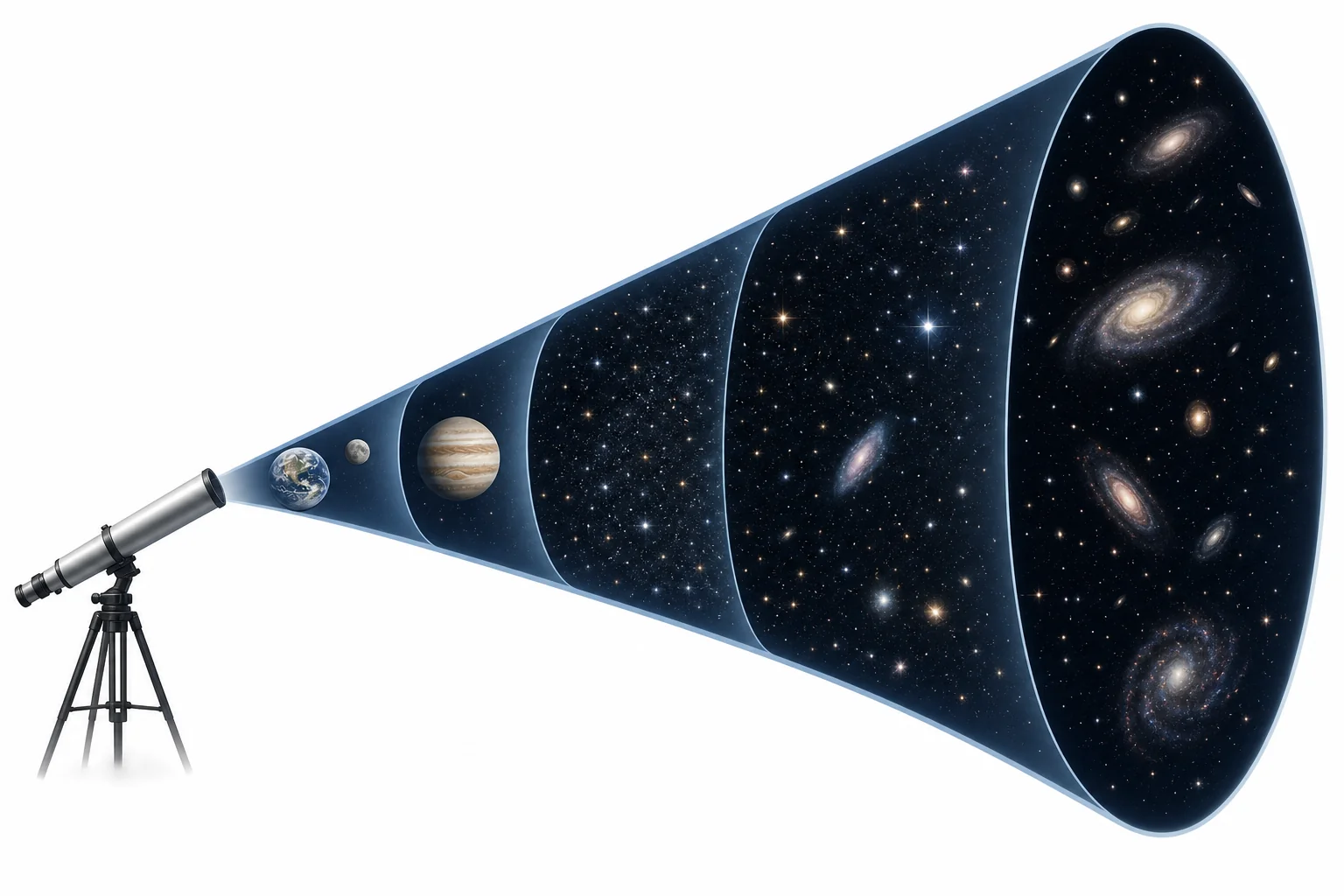
A scale illustration showing Earth, the solar system, the Milky Way, galaxy clusters, and the edge of the observable universe.

The observable universe is about 93 billion light-years across. That does not mean the universe is 93 billion years old, because space has been expanding while light travels. The whole universe may be much larger, and we may never be able to see all of it.

Big Idea. NGSS MS-ESS1-3 connects models and data to the scale of objects and distances in space.

The universe is bigger than any ruler, map, or classroom model can show at full scale. Astronomers do not measure it by sending a spacecraft to the edge. They use light. Light travels fast, but space is so large that light from distant galaxies takes billions of years to reach Earth. When we look far away, we also look far back in time. The farthest region we can study is called the observable universe. It is about 93 billion light-years across. That number can feel strange, because the universe is about 13.8 billion years old. The key idea is that space itself has stretched while the light was traveling. This article builds a scale ladder from Earth to galaxy clusters, then to the edge of what we can observe. It also explains why the whole universe may extend beyond anything light can ever show us.

Start with Earth
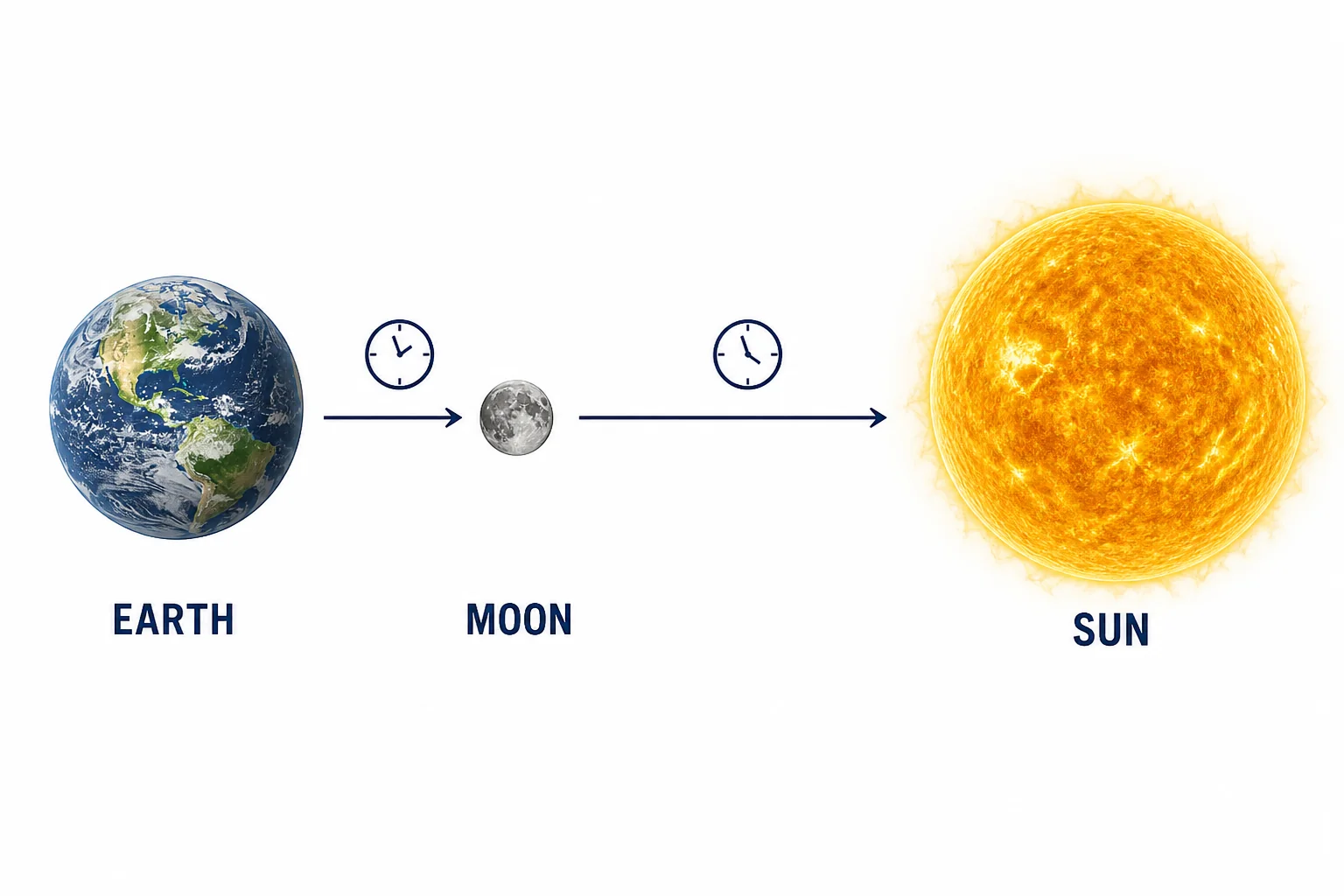
A scale ladder from Earth to the Moon to the Sun, with light travel times shown for each step.
Nearby space already needs a scale model.
A good scale ladder starts with something familiar. Earth is about 12,742 kilometers wide. The Moon is about 384,400 kilometers away. That distance is already hard to picture, but it fits inside our neighborhood. Light from the Moon reaches Earth in about 1.3 seconds. Light from the Sun takes about 8 minutes and 20 seconds. These times show why astronomers often talk about distance using light. A light-second is the distance light travels in one second. A light-minute is the distance light travels in one minute. These units are not magic. They are just distance units, like meters or miles, matched to the huge scale of space. The first step is simple. Even the solar system is too large for normal maps, so astronomers use models that shrink size and distance by the same ratio.

Light travel time turns huge distances into time you can compare.

Then the solar system
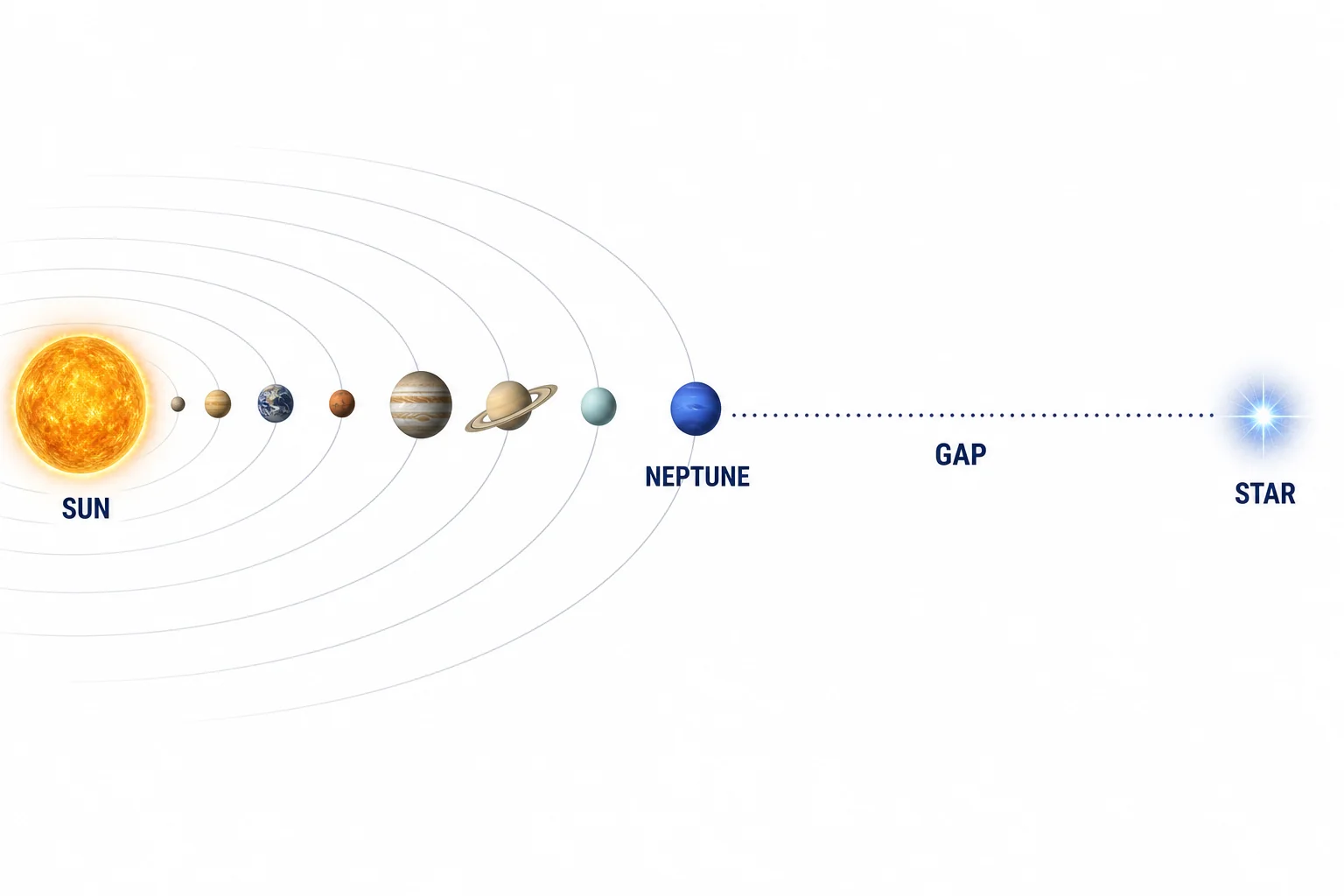
A compressed scale diagram showing the Sun, planetary orbits, Neptune, and a large gap to the nearest star.
The next star is far beyond the planets.
The solar system is much wider than the Earth to Sun distance. Neptune orbits about 30 times farther from the Sun than Earth does. Light from the Sun takes about 4 hours to reach Neptune. Past Neptune, small icy worlds and comets orbit in large regions that are still part of the Sun’s neighborhood. The nearest star system, Alpha Centauri, is about 4.37 light-years away. That gap is enormous compared with the solar system. If the Sun were a small ball in a classroom, Neptune would be across the school, but the next star would be far beyond the city. This is why star maps often skip empty space. They are useful models, not full scale drawings. The scale ladder grows by jumps. Planets are close compared with stars, and stars are close compared with galaxies.

The solar system is large, but the space between stars is much larger.

Our galaxy scale
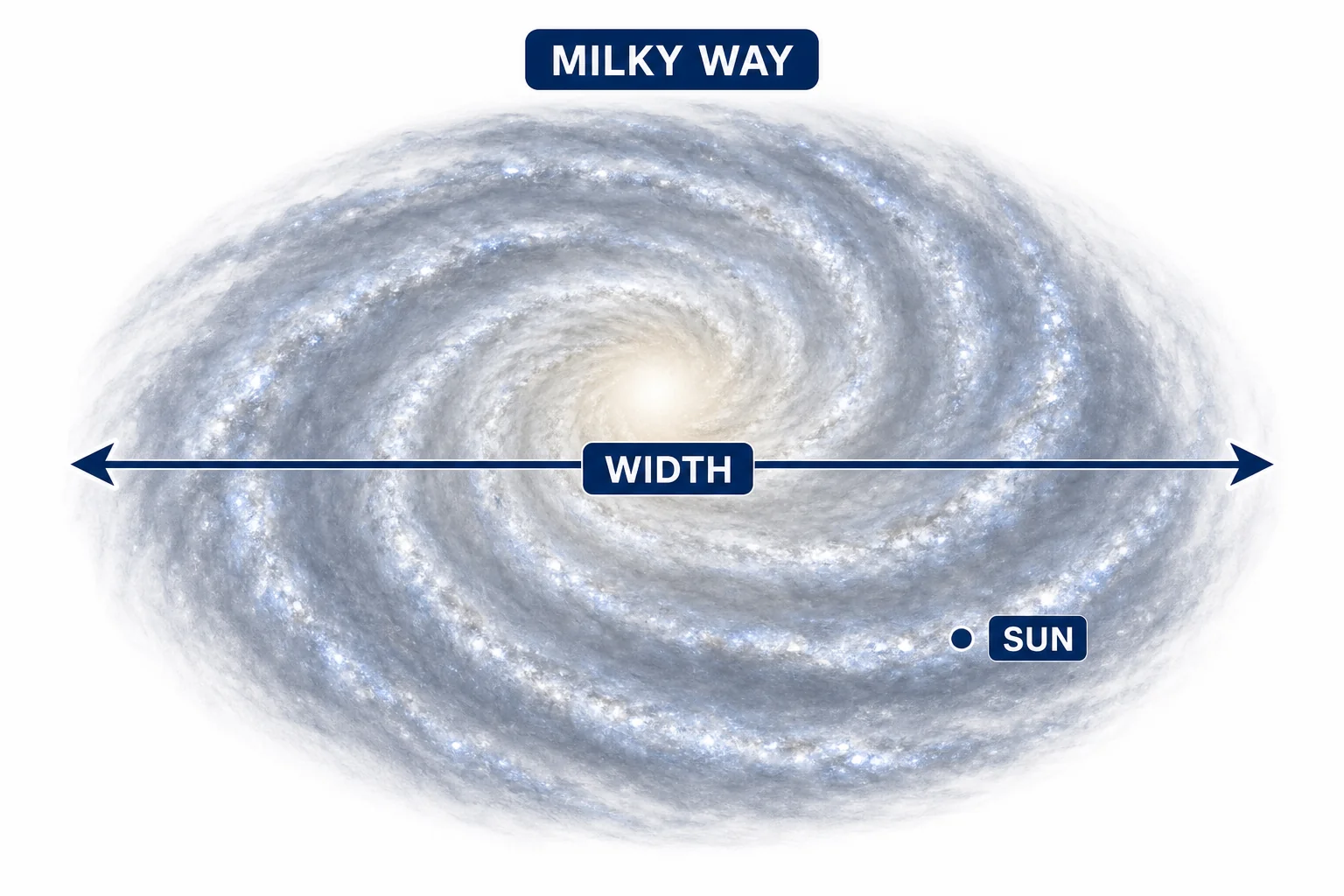
A top-down model of the Milky Way with the Sun marked in one spiral arm and a diameter arrow across the galaxy.
The Milky Way is about 100,000 light-years wide.
The Sun is one star among hundreds of billions in the Milky Way galaxy. The Milky Way is a flattened spiral of stars, gas, dust, and dark matter. It is about 100,000 light-years across. That means light would take about 100,000 years to cross the galaxy from one side to the other. Earth sits far from the center, on a smaller spiral arm. From inside the galaxy, we see the Milky Way as a pale band across the night sky. We cannot fly outside it to take a picture, so astronomers combine many kinds of evidence. They measure star positions, gas motion, and light from other spiral galaxies. This model helps place our solar system in a much larger home. On this step of the ladder, a light-year becomes a practical unit rather than an extreme one.

A galaxy is a city of stars, and our Sun is one small address.

Galaxies make clusters
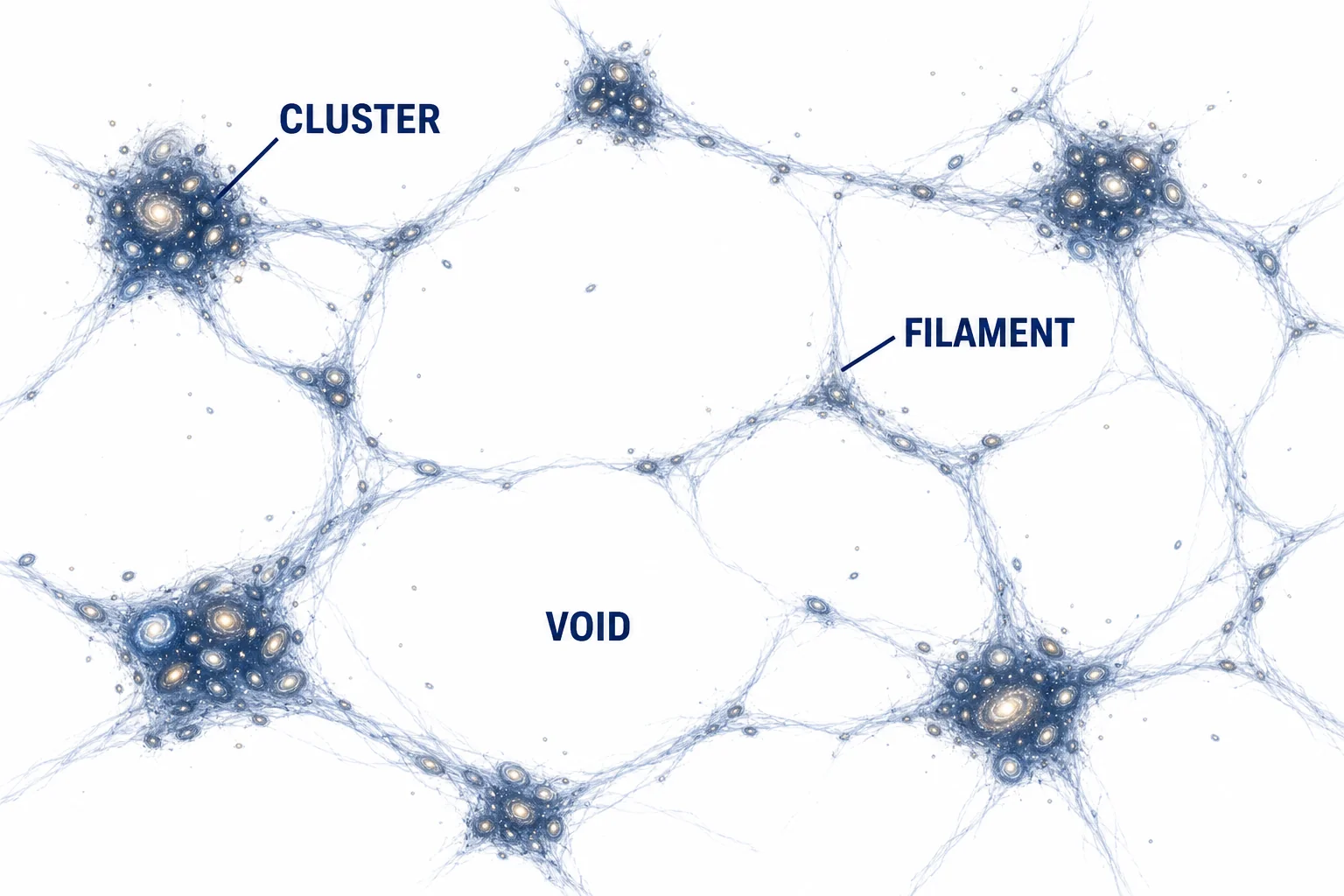
A cosmic web diagram showing galaxy clusters connected by filaments with large empty voids between them.
Galaxy clusters form a cosmic web.
Galaxies are not spread evenly like dots on graph paper. Gravity gathers them into groups, clusters, and long filaments. The Milky Way is part of the Local Group, which includes the Andromeda galaxy and many smaller galaxies. Larger galaxy clusters can contain hundreds or thousands of galaxies. Between clusters are huge spaces called voids, where galaxies are much rarer. On the largest maps, the universe looks like a cosmic web. Bright strands of galaxies surround darker empty regions. These maps are made by measuring where galaxies are and how their light has shifted as space expands. This scale is hard to imagine because galaxies themselves become the dots. A single dot on a cosmic web map may represent billions of stars. The ladder has moved from planets to stars, then to galaxies, and now to structures made of galaxies.

At the largest mapped scales, whole galaxies act like points in a pattern.

The observable edge
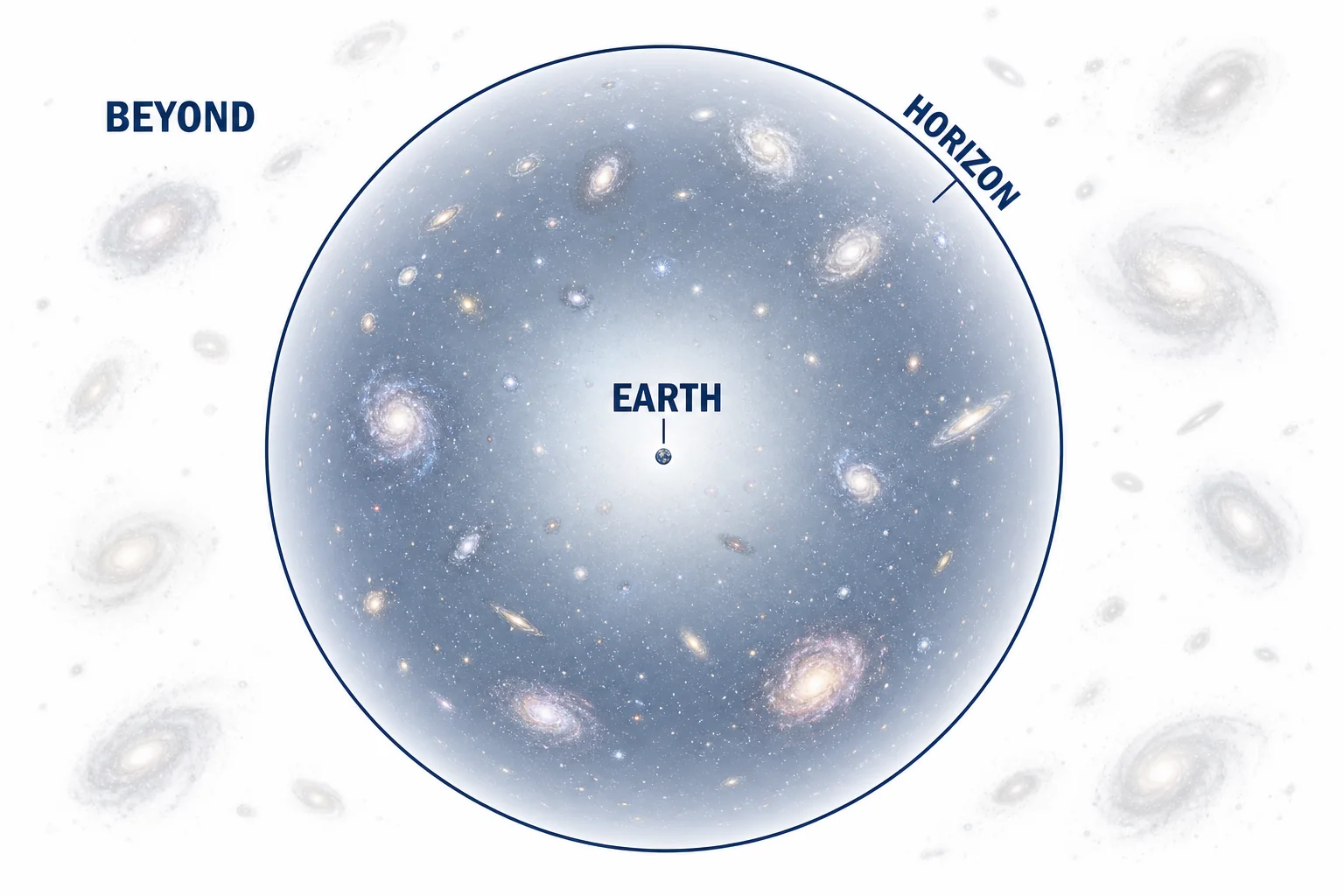
A diagram of the observable universe as a sphere around Earth, with a horizon marking the farthest light we can receive.
The observable universe is a horizon, not a wall.
The observable universe is the region whose light has had time to reach us since the early universe. Its diameter is about 93 billion light-years. This does not mean light traveled for 93 billion years. The universe is about 13.8 billion years old, and space expanded while the light was on its way. A distant galaxy can now be much farther away than the distance its light traveled at the time it left. Beyond the observable universe, there may be more galaxies and space, but their light has not reached us. Some light never will. As space expands, very distant regions can become separated from us faster than their new light can close the gap. This creates a horizon. It is not a wall or an edge of space. It is a limit on what information can reach Earth.

We can study only the universe that can send light or other signals to us.

Vocabulary

Light-year
The distance light travels in one year, about 9.46 trillion kilometers.
Observable universe
The part of the universe whose light or signals have had time to reach Earth.
Galaxy
A large system of stars, gas, dust, and dark matter held together by gravity.
Galaxy cluster
A group of many galaxies held near one another by gravity.
Cosmic horizon
A limit on how far we can see because light takes time to travel and space expands.
Expansion of space
The stretching of distances between faraway galaxies over time.

In the Classroom

Build a scale ladder

25 minutes | Grades 6-8

Students list Earth, Moon, Sun, Neptune, the nearest star, the Milky Way, and the observable universe. They choose a scale for each step and explain why one scale cannot show every level well.

Light travel time timeline

20 minutes | Grades 6-8

Students make a timeline that compares light from the Moon, Sun, Neptune, nearby stars, and distant galaxies. They connect each time to the idea that looking far away means seeing older light.

Horizon model

30 minutes | Grades 7-8

Students use a circle around a point to model the observable universe around Earth. They add galaxies inside and outside the circle, then explain why the circle is a limit on information, not the edge of space.

Key Takeaways

  • The observable universe is about 93 billion light-years across.
  • A light-year is a distance, not a time.
  • Large distances mean we see faraway objects as they were in the past.
  • Space expanded while ancient light traveled toward us.
  • The observable universe is not the same as the whole universe.