How Fast Are You Moving Right Now
You feel completely still right now. But you are hurtling through space at hundreds of thousands of kilometers per hour. Enter your latitude and discover just how fast you are really moving.
Your Location
You are at latitude 40.7° N
Scale 1 of 4
Earth's Rotation
1,265 km/h
0.35 km/s / 351 m/s
Depends on your latitude. At the equator, the surface moves fastest. At the poles, rotational speed is zero.
faster than the speed of sound
Scale 2 of 4
Around the Sun
107,208 km/h
30 km/s / 29,780 m/s
Earth's orbital speed around the Sun is constant at about 29.78 km/s. It does not depend on where you stand.
faster than the ISS in orbit
Scale 3 of 4
Around the Milky Way
792,000 km/h
220 km/s / 220,000 m/s
Our entire solar system orbits the Milky Way's center. One full orbit takes about 225 million years.
0.0734% of the speed of light
Scale 4 of 4
Through the Universe
2,160,000 km/h
600 km/s / 600,000 m/s
The Milky Way itself is pulled toward the Great Attractor, a massive gravitational anomaly 250 million light-years away.
0.20% of the speed of light
Your Total Cosmic Speed
Adding all motions together, you are moving at approximately 2,160,000 km/h through the universe right now. That is 0.20% of the speed of light.
Scale is logarithmic. Directions of motion differ, so the total is an approximation. The cosmic flow toward the Great Attractor dominates all other contributions.
Why do we not feel any of this?
Motion only feels real when it changes. Earth's rotation, orbit, and galactic journey are all remarkably constant, so there is no force pushing you. You feel weightless in free fall for the same reason. Not because there is no gravity, but because everything around you accelerates at the same rate. Our cosmic speeds have barely changed in millions of years, so to us they feel like nothing at all.
Multiple Frames of Reference
Earth's Rotation
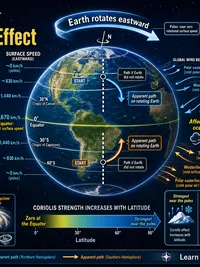
Earth rotates once every 24 hours. Points at the equator travel roughly 1,670 km/h. At the poles, you spin in place and your rotational speed is zero. Your latitude determines your share of Earth's rotational speed.
Orbital Speed
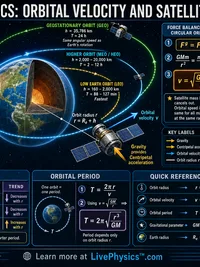
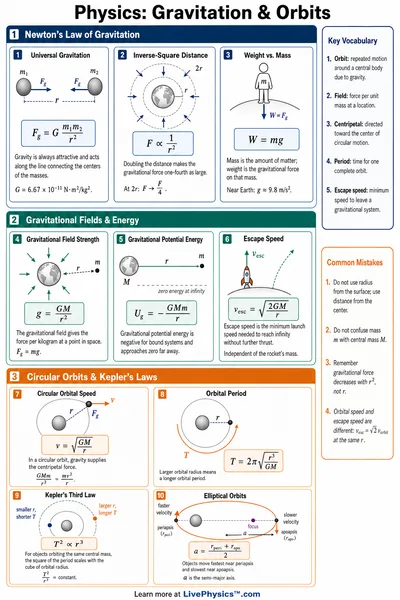
Earth orbits the Sun at about 107,000 km/h (29.78 km/s). This speed is the same for everyone on Earth regardless of latitude. We complete one full orbit every 365.25 days, covering nearly a billion kilometers.
Galactic Motion
Our entire solar system orbits the center of the Milky Way at about 220 km/s (roughly 800,000 km/h). One full galactic orbit takes about 225 million years, sometimes called a cosmic year.
The Physics Behind the Numbers
Rotational Speed Formula
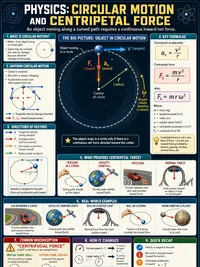
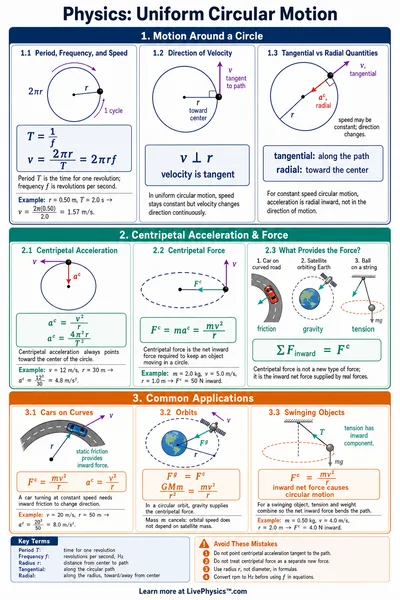
Earth's surface speed at a given latitude follows from basic circular motion. The circumference at latitude L is 2 x pi x R x cos(L), where R is Earth's radius (6,371 km). Dividing by the length of a day (86,400 seconds) gives speed in km/s. At the equator (L = 0), cos(0) = 1 and speed is maximum. At the poles (L = 90), cos(90) = 0 and speed is zero.
Reference Frames
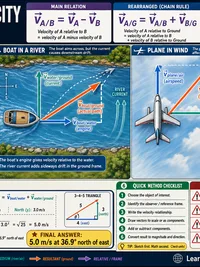
All motion is relative. When we say Earth orbits the Sun at 29.78 km/s, we mean relative to the Sun. When we say the Sun orbits the Milky Way at 220 km/s, we mean relative to the galactic center. Each larger frame adds another layer of motion. The "total" speed depends entirely on what you measure against.
Why Speeds Add Approximately
In reality, these motions point in different directions and change over time. Earth's rotation axis is tilted 23.5 degrees from its orbital plane. The solar system's orbital plane is tilted relative to the galactic plane. A true instantaneous total requires vector addition with specific angles. The values shown here represent typical magnitudes at each scale.