Sign in to save

Bookmark this page so you can find it later.

Sign in to save

Bookmark this page so you can find it later.

Biology middle-school May 24, 2026

How Do Plants Drink Water Without Pumps?

Water moves because leaves let it go
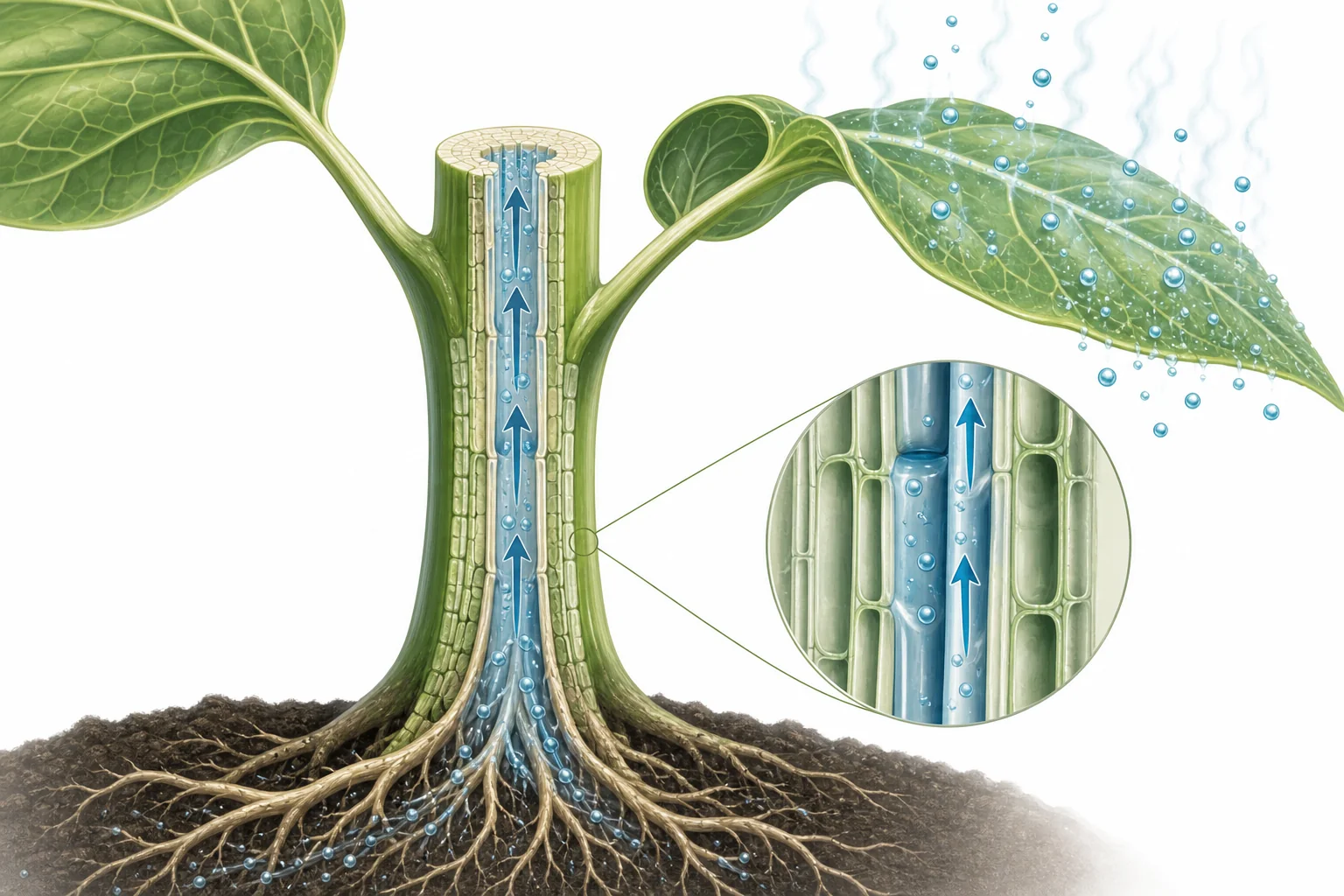
A plant showing water entering roots, moving up the stem, and leaving through leaf openings

Plants lose water from their leaves, and that loss helps pull more water up from the roots. Water sticks to itself and to the walls of tiny tubes inside the plant. Together, these effects move water upward without a heart or pump.

Big Idea. NGSS MS-LS1-3 connects plant transport to the idea that body systems work together as interacting parts.

A tall tree can lift water from soil to leaves that are many meters above the ground. It does this without a pump, a heart, or muscles. The trick is not one force. It is a chain of small effects that work together. Roots take in water from moist soil. Thin tubes inside the stem guide the water upward. Leaves let some water escape into the air. That escape creates a pull on the water behind it, like a long line of people holding hands. Water can do this because its molecules cling to each other and to the tube walls. In class, this idea connects plant structure to function. It also helps explain why plants wilt, why watering matters, and why dry air changes how fast leaves lose water. You can compare this to simple flow models in the LivePhysics classroom tools.

Roots take in water
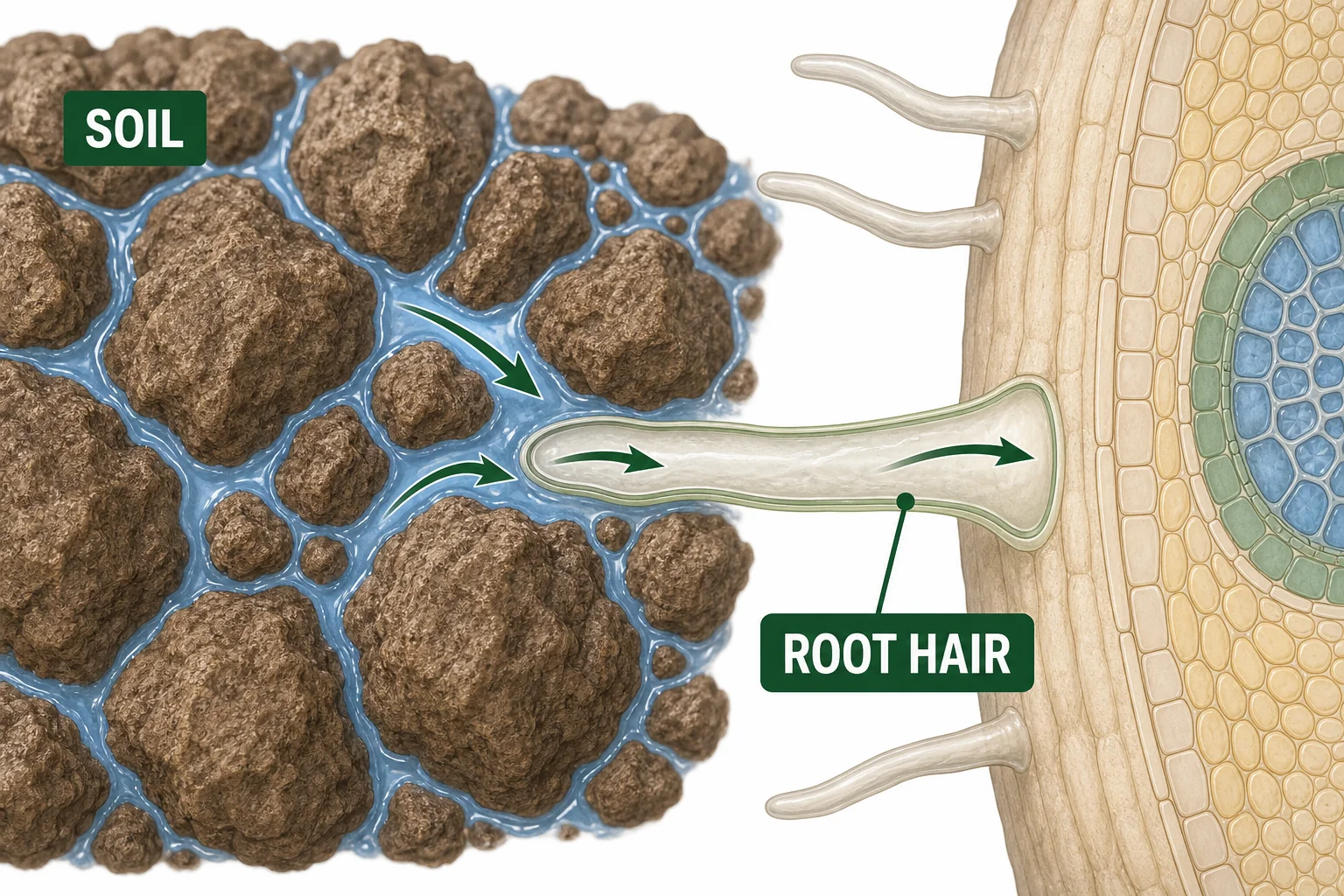
Close view of root hairs touching damp soil particles and water droplets moving into the root
Root hairs increase contact with damp soil
Water starts in the spaces between soil particles. Root hairs reach into those spaces and give the plant a large contact area. A root hair is a tiny extension of a root cell. It is thin enough to fit between grains of soil. Water enters because the inside of the root has dissolved materials, such as sugars and mineral ions. Water tends to move toward areas with more dissolved material. This helps water cross into root cells and then into the center of the root. From there, water enters the plant’s transport tubes. Roots also anchor the plant, but their drinking job depends on contact with damp soil. If soil dries out, the chain breaks near the start. The plant may still have leaves and stems, but the water supply becomes too weak to replace what leaves lose.

Roots do not suck like straws. They absorb water where root cells touch damp soil.

Xylem forms tiny pipes
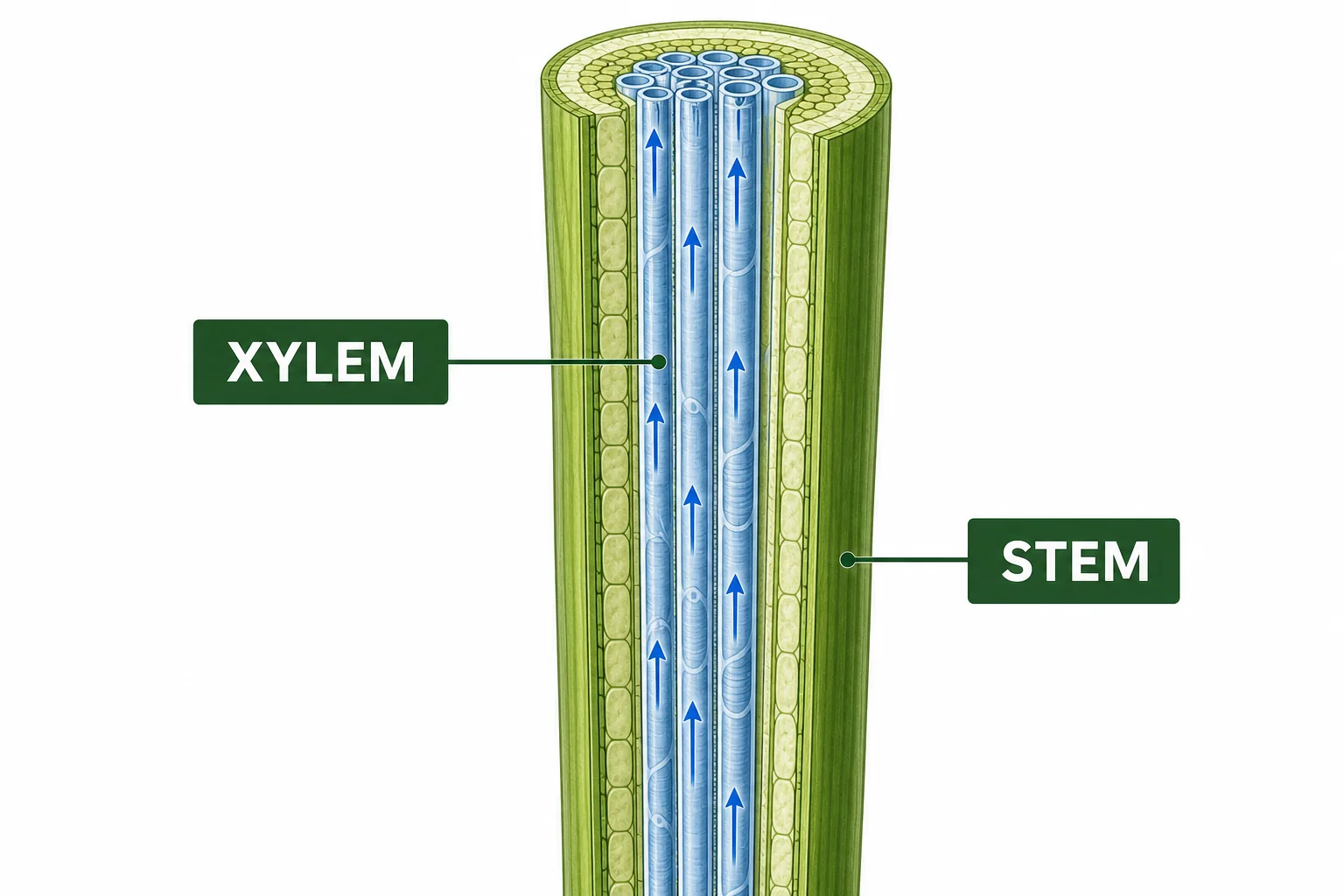
Cutaway of a plant stem showing long xylem tubes carrying water upward
Xylem tubes carry water from roots to leaves
After water enters the root, it moves into xylem. Xylem is plant tissue made of long, hollow cells. These cells are dead when mature, so they form open tubes instead of living barriers. In a stem, many xylem tubes run side by side from roots toward leaves. They are narrow, but they can carry a continuous column of water. Xylem walls contain strong material that helps the tubes stay open under tension. That matters because the water is often being pulled, not pushed. A pump pushes fluid by adding pressure behind it. A plant usually moves water by creating tension above it. The xylem must resist collapse while that tension acts. In woody plants, xylem also becomes part of wood. A tree trunk is both a support structure and a water transport system.

Xylem is the plant’s main upward water pathway.

Leaves create the pull
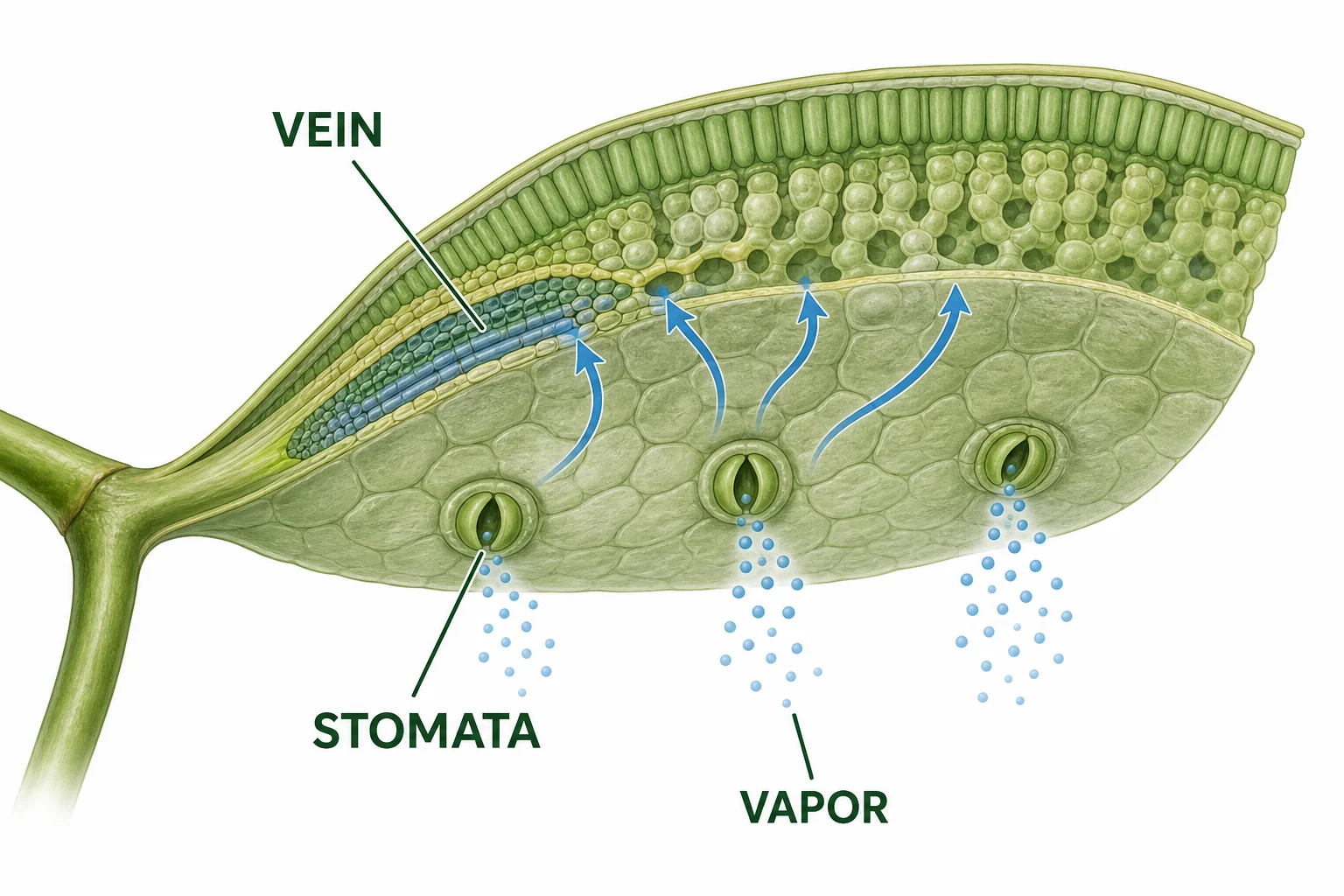
Leaf cross section showing water vapor leaving stomata and water being pulled toward the leaf
Transpiration starts the upward pull
Leaves are where the strongest pull begins. A leaf needs carbon dioxide from the air for photosynthesis. To get it, the leaf opens tiny pores called stomata. When stomata open, water vapor can escape from wet cell surfaces inside the leaf. This loss of water is called transpiration. As water leaves, more water is drawn toward the empty spaces in the leaf. That pull reaches into the xylem. If the water column stays connected, the pull can extend down the stem and into the roots. The plant is not choosing to waste water. It is trading water loss for gas exchange. On hot, dry, or windy days, transpiration can speed up. Many plants respond by closing stomata for part of the day. This slows water loss, but it can also slow photosynthesis.

Water leaving the leaf helps pull the next water molecules upward.

Water molecules hold together
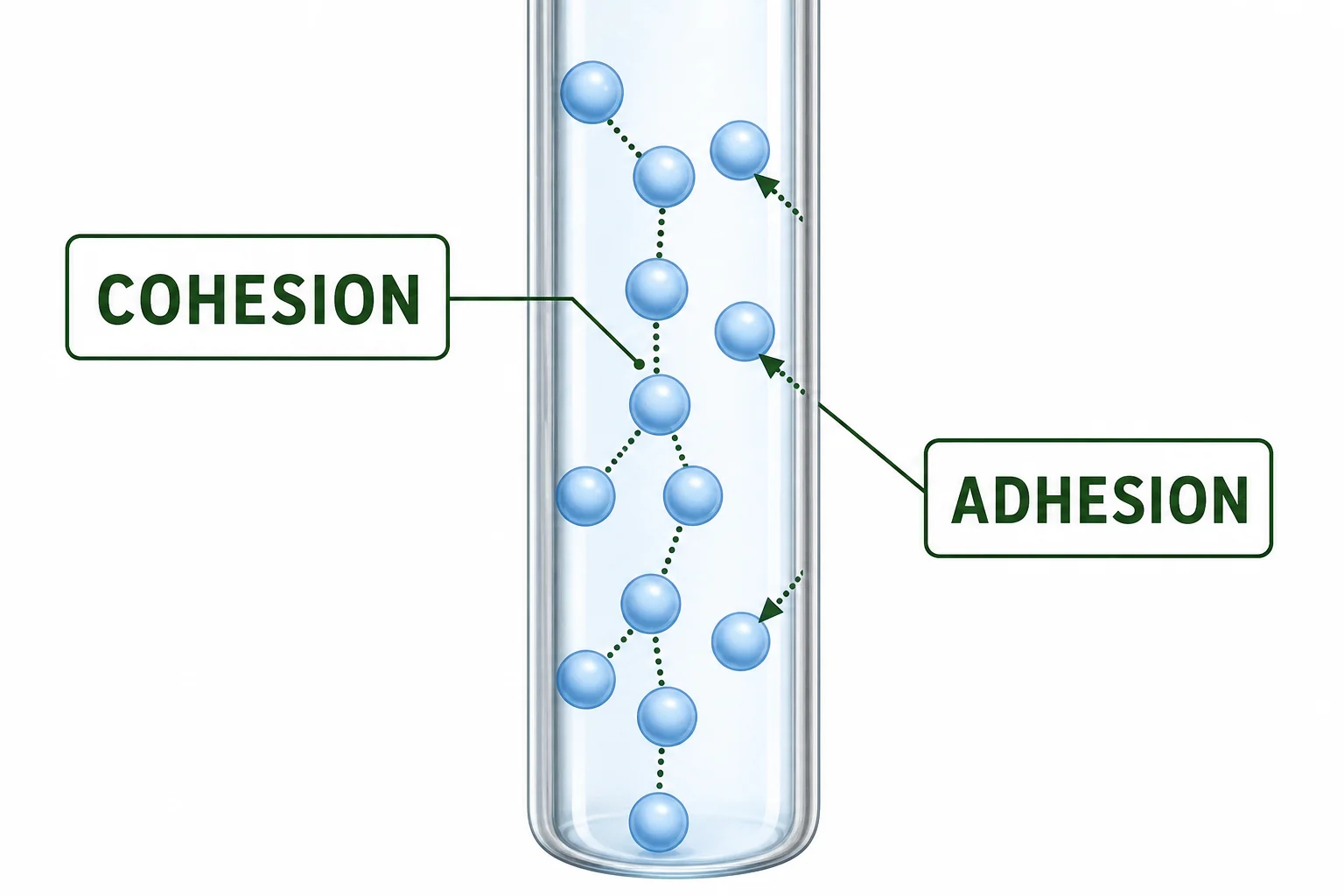
Magnified xylem tube showing water molecules sticking to each other and to the tube wall
Cohesion and adhesion help keep water connected
The pull from leaves would not work if water broke apart easily. Water molecules are polar, which means one side is slightly negative and the other side is slightly positive. Because of this, nearby water molecules attract each other. This attraction is called cohesion. Cohesion helps water stay in a continuous column inside xylem. Water also sticks to the walls of the xylem. That attraction is called adhesion. Adhesion helps water climb along the sides of narrow tubes. In very thin tubes, cohesion and adhesion create capillary action. Capillary action can lift water a short distance by itself. In tall plants, it is not enough alone. It works with transpiration pull. The plant’s water transport is a team effect. Leaf pull, cohesion, adhesion, and narrow xylem tubes all matter.

Water can be pulled upward because it stays linked inside narrow tubes.

No pump, but still a system
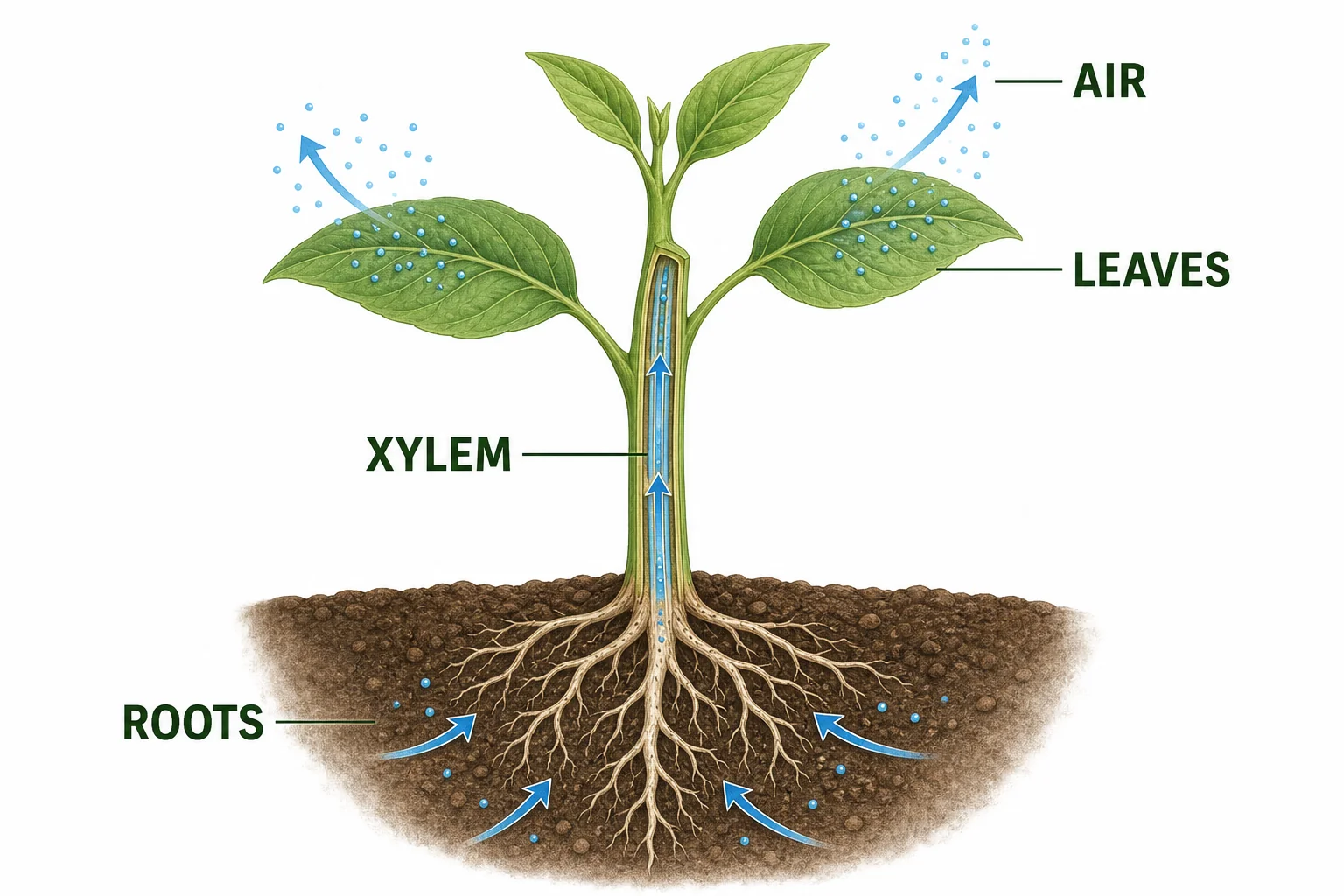
Whole plant diagram showing water entering roots, moving up xylem, and leaving leaves as vapor
Plant water movement is a connected system
A plant drinks because several parts work together. Roots absorb water from soil. Xylem provides the path. Leaves lose water to air and create the pull. Water’s properties keep the column from falling apart. This is why a change in one part affects the whole plant. Dry soil limits water entering the roots. Closed stomata reduce the pull from the leaves. Damaged xylem blocks the pathway. Hot, dry air increases water loss. Students can model the system with a celery stem in colored water, a paper towel strip, or a narrow glass tube. Each model shows only part of the process. The full plant system is more complex, but the basic idea stays the same. Water moves upward when structure, air, soil, and molecular attractions work together.

Plants move water without a pump by linking roots, stems, leaves, and water’s properties.

Vocabulary

Xylem
Plant tissue made of hollow tubes that carry water and minerals upward from roots.
Transpiration
The loss of water vapor from leaves, mostly through tiny pores.
Stomata
Small openings in leaves that let gases move in and out.
Cohesion
The attraction between water molecules that helps them stay together.
Adhesion
The attraction between water molecules and another surface, such as a xylem wall.
Capillary action
The movement of water through very narrow spaces because of cohesion and adhesion.

In the Classroom

Celery xylem color test

30 minutes plus overnight observation | Grades 6-8

Place celery stalks with leaves in cups of colored water. Students observe where the color appears and connect the stained paths to xylem transport.

Paper towel capillary race

20 minutes | Grades 6-8

Dip strips of different paper towels into shallow colored water. Students measure how far water climbs in a set time and compare the role of narrow spaces.

Transpiration bag lab

25 minutes plus waiting time | Grades 6-8

Cover a leafy branch or houseplant leaf cluster with a clear plastic bag and seal it loosely around the stem. Students look for water droplets and discuss how leaves release water vapor.

Key Takeaways

  • Plants do not use pumps to lift water.
  • Roots absorb water from damp soil through contact with root hairs.
  • Xylem forms narrow tubes that carry water upward.
  • Transpiration from leaves creates a pull on the water column.
  • Cohesion, adhesion, and capillary action help water stay connected as it moves.