Plant Needs, Pollination & Seed Dispersal Lab
Grow a virtual plant by choosing sunlight and water levels, meet the pollinators that help flowers make seeds, and discover the five ways seeds travel to new homes.
Guided ExperimentPlant Needs Investigation
If a plant gets no sunlight, what do you predict will happen to its health after 4 weeks?
Write your hypothesis in the Lab Report panel, then click Next.
Controls
Plant Conditions
Set conditions and simulate!
Try sunlight 4, water 3 for optimal growth
Data Table
(0 rows)| # | Week | Sunlight (bars) | Water (bars) | Plant Height (cm) | Health Status | Notes |
|---|
Reference Guide
What Plants Need
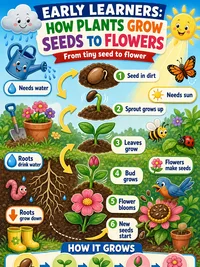
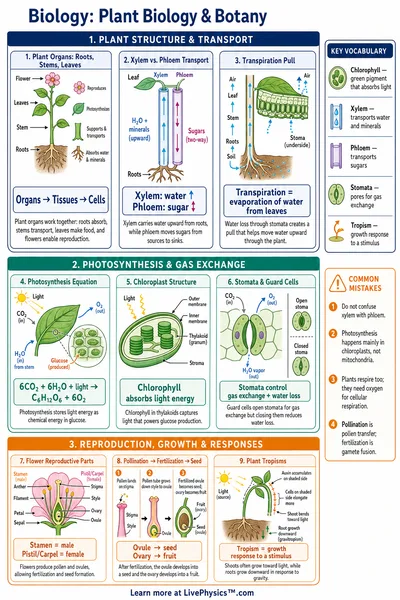
Plants need four basic things to grow, sunlight, water, air (carbon dioxide), and nutrients from soil.
- Sunlight - powers photosynthesis to make food
- Water - carries nutrients and keeps cells firm
- Air (CO2) - raw material for photosynthesis
- Nutrients - minerals from soil for growth
Too little or too much of any ingredient leads to poor growth or wilting. The right balance keeps a plant healthy.
Pollination
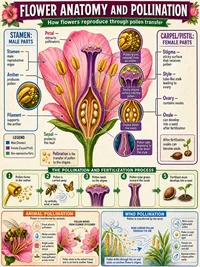
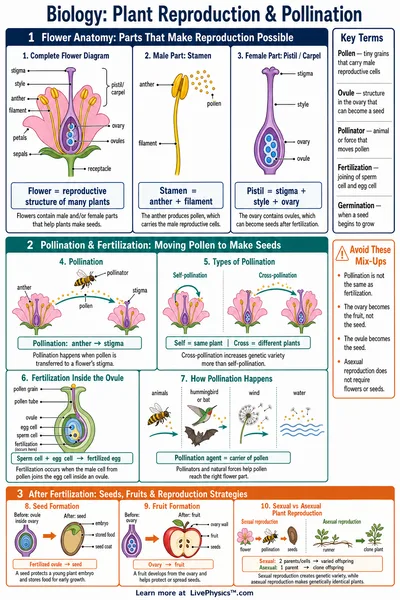
Pollination is the transfer of pollen from the male part of a flower to the female part. This is needed for seeds to form.
Pollinators carry pollen between flowers
- Bees collect pollen while gathering nectar
- Butterflies pick up pollen as they feed
- Hummingbirds transfer pollen with their beaks
- Wind carries lightweight pollen through the air
Common Pollinators
Different flowers attract different pollinators based on their color, shape, and scent
- Bees - attracted to blue, yellow, and white flowers
- Butterflies - prefer flat, clustered flowers
- Hummingbirds - seek tubular red or orange flowers
- Wind - pollinates grasses and many trees
Without pollinators, most flowering plants could not reproduce and many food crops would fail.
Seed Dispersal Methods
Seeds need to travel away from the parent plant to find space, light, and nutrients. Plants have evolved several clever dispersal strategies
- Wind - fluffy or winged seeds float on air currents
- Water - buoyant seeds float to new shores
- Animals (fur) - hooked seeds hitch a ride on passing animals
- Animals (eaten) - seeds pass through digestive systems
- Self-dispersal - pods explode and fling seeds outward