Sign in to save

Bookmark this page so you can find it later.

Sign in to save

Bookmark this page so you can find it later.

Biology middle-school May 24, 2026

How Do Your Lungs Trade Oxygen for Carbon Dioxide?

Tiny air sacs make a fast gas swap
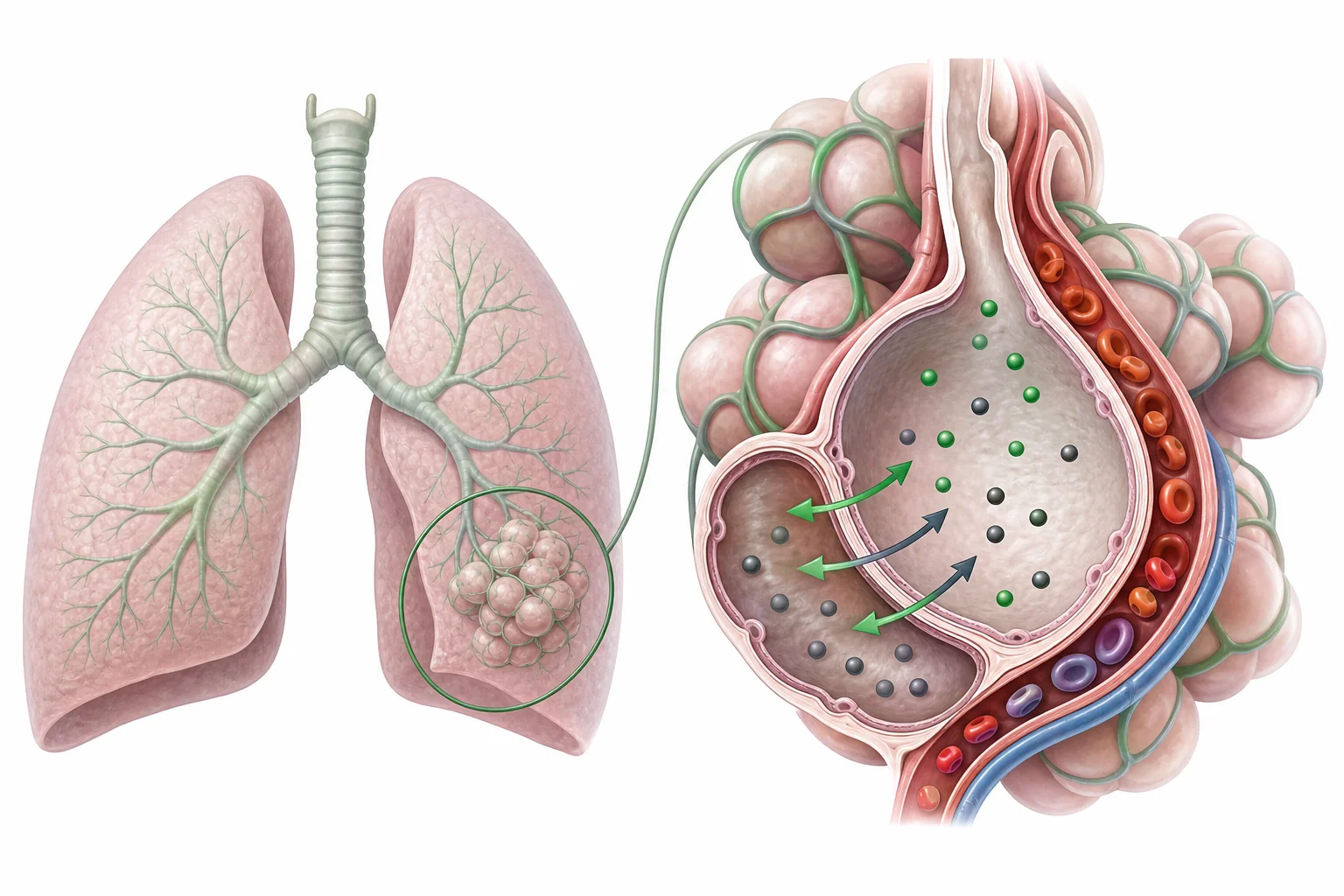
Diagram of lungs branching into tiny air sacs with nearby blood vessels where oxygen enters blood and carbon dioxide leaves blood

Your lungs bring fresh air into tiny air sacs deep inside your chest. Oxygen moves from the air into your blood, while carbon dioxide moves from your blood into the air sacs. You breathe out to remove the carbon dioxide.

Big Idea. NGSS MS-LS1-3 connects body systems to the way lungs and blood vessels work together to move gases through the body.

Every cell in your body needs oxygen to release energy from food. Every cell also makes carbon dioxide as waste. Your lungs are the place where your body trades one gas for the other. The trade happens in millions of tiny air sacs called alveoli. Each air sac has a very thin wall and sits beside a web of tiny blood vessels. Air is on one side. Blood is on the other. Oxygen and carbon dioxide move across this thin barrier by diffusion, which means they move from where there is more of a gas to where there is less. This swap works because your lungs have a large surface area, your blood keeps moving, and red blood cells carry oxygen away. Breathing is only part of the story. Air flow and blood flow both have to reach the same place for the swap to work well.

Air reaches the alveoli
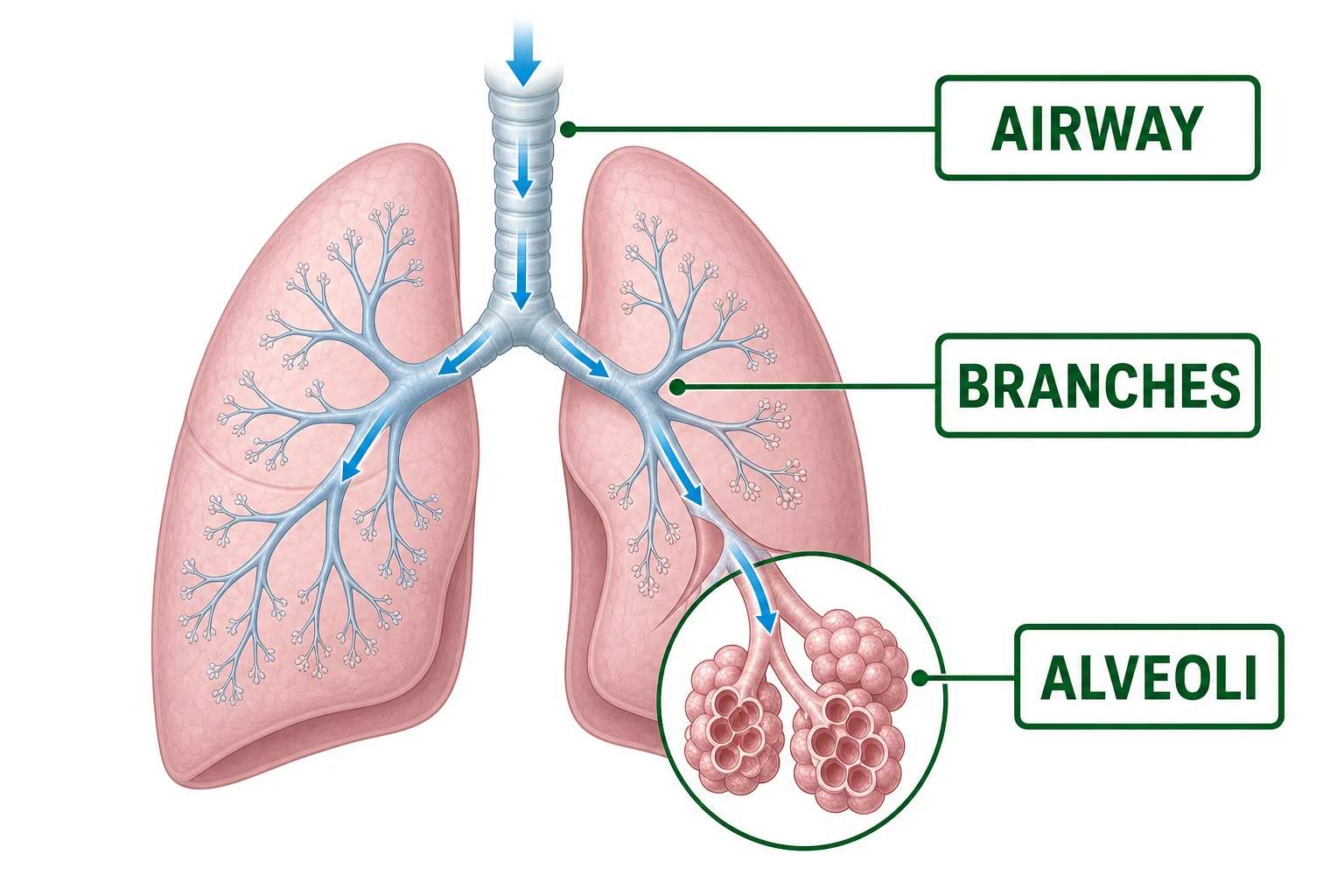
Branching airway diagram showing the trachea, bronchi, bronchioles, and clusters of alveoli at the ends
Airways branch until they reach alveoli
When you breathe in, air travels through a branching path. It enters through your nose or mouth, moves down the windpipe, and splits into smaller tubes inside the lungs. These tubes end in clusters of alveoli. The shape is a little like a tree with bunches of grapes at the tips. This branching design matters. It spreads air across a huge number of small spaces instead of keeping it in one large chamber. More small spaces means more surface where gas can move. The alveoli do not pull oxygen into the body by force. They create a place where fresh air sits close to blood. The distance between air and blood is so small that gas molecules can cross quickly. Ventilation means moving air in and out. It refreshes the air in the alveoli so oxygen stays higher there than in the blood arriving from the body.

Breathing moves fresh air to the surface where gas exchange happens.

A huge surface in a small space
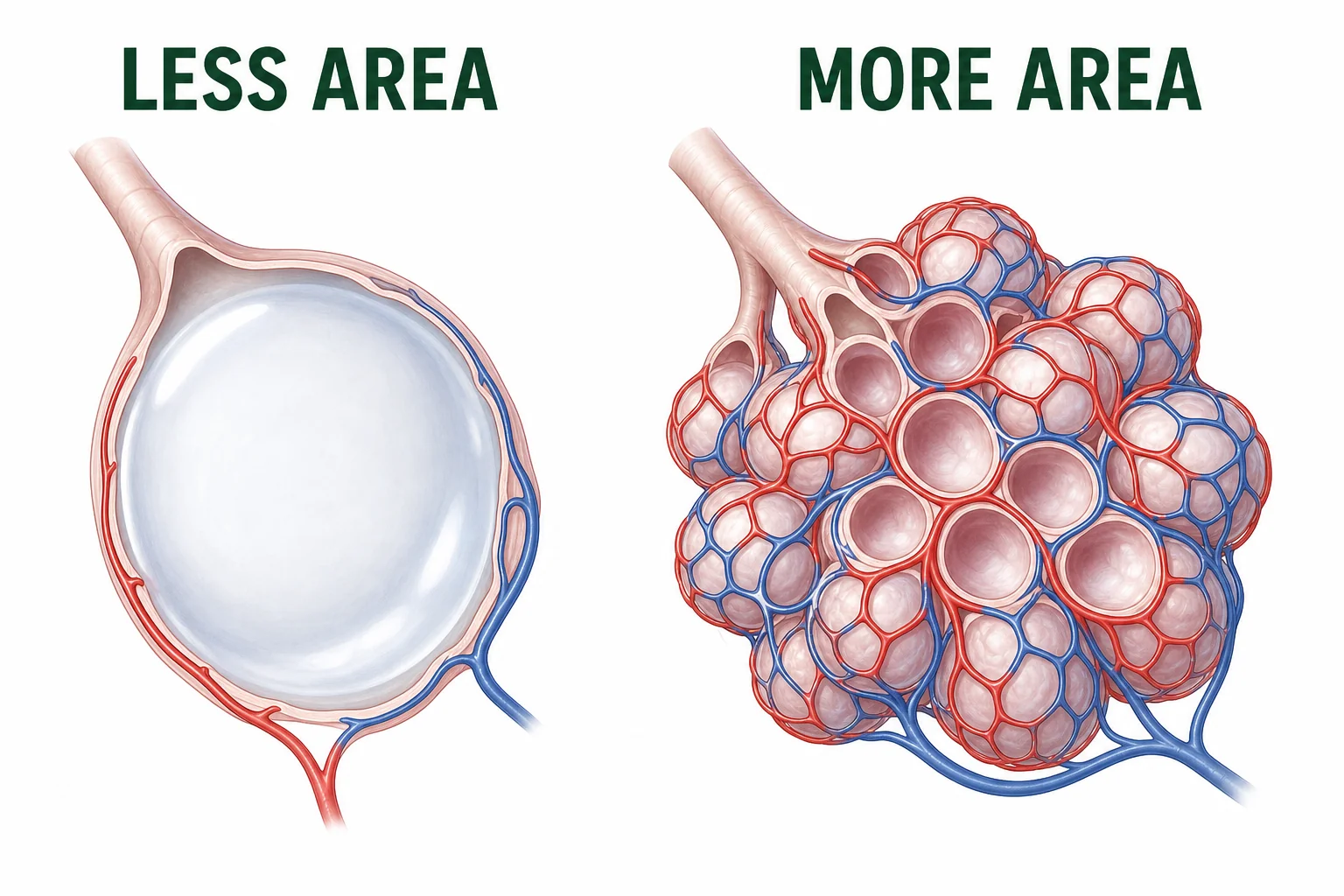
Comparison of one large air sac and many small alveoli showing how many small sacs create more contact area with capillaries
Many small sacs give more surface for exchange
Alveoli are tiny, but there are hundreds of millions of them in human lungs. Together they create a large surface area for gas exchange. Surface area is the amount of exposed space where contact can happen. A single large air pocket would have much less contact with blood than many tiny pockets with the same total volume. This is why the alveoli shape is useful. Each air sac is wrapped by capillaries, which are the smallest blood vessels. Blood spreads out around the air sacs instead of flowing through one thick pipe. This gives oxygen many chances to enter the blood and gives carbon dioxide many chances to leave. In middle school life science, this is a clear example of structure and function. The structure is many small, thin air sacs. The function is fast exchange of gases between the body and the outside air.

More alveoli means more surface where oxygen and carbon dioxide can cross.

Diffusion moves the gases
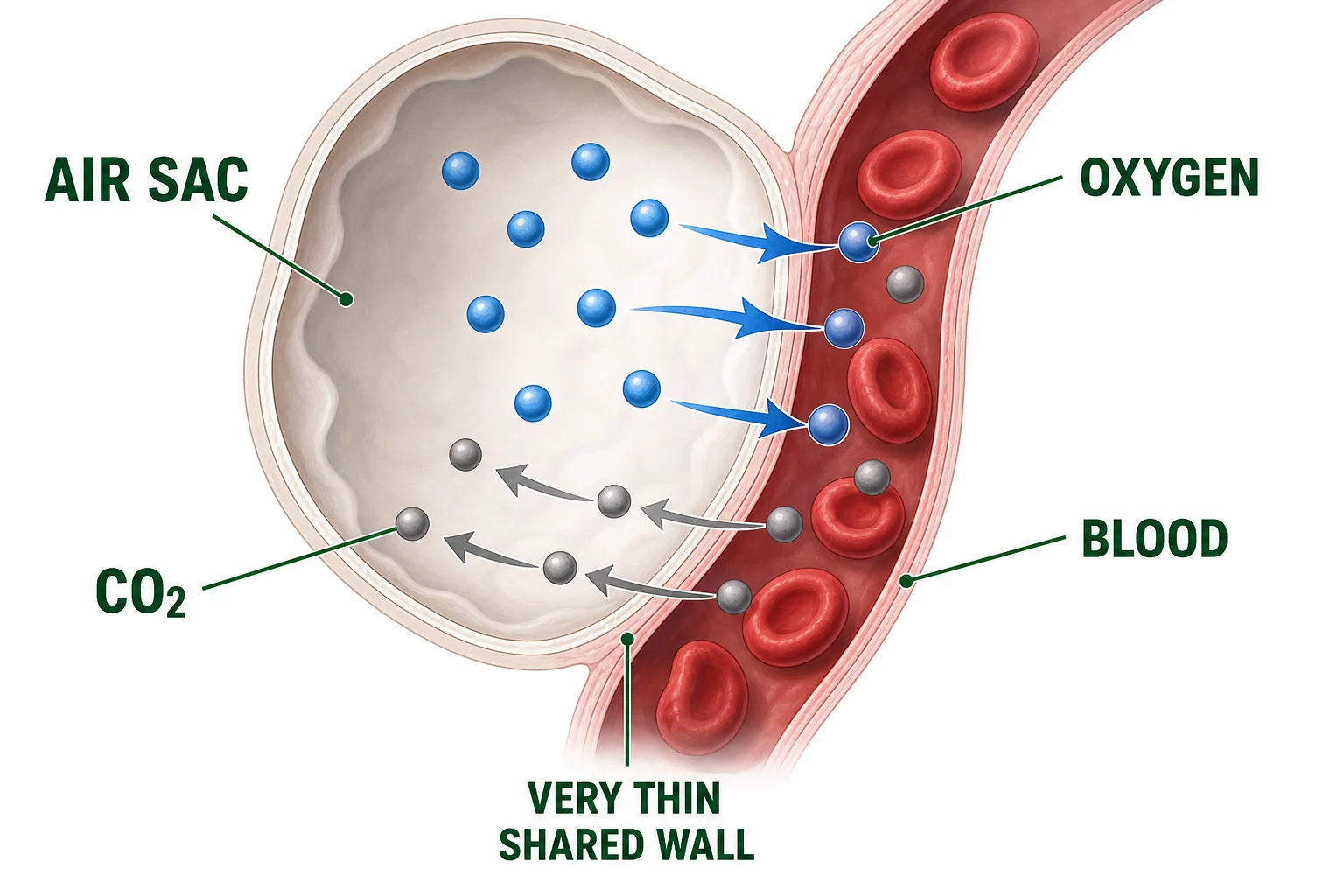
Close-up of an alveolus wall next to a capillary showing oxygen moving into blood and carbon dioxide moving into the air sac
Diffusion moves each gas down its difference
Gas exchange depends on diffusion. Molecules are always moving. If there is more oxygen in the alveoli than in the nearby blood, more oxygen molecules move into the blood than move back into the air sac. The net movement is from higher amount to lower amount. Carbon dioxide follows the same rule in the opposite direction. Blood arriving at the lungs has picked up carbon dioxide from body tissues, so it has more carbon dioxide than the air in the alveoli. Carbon dioxide moves into the air sac and is removed when you breathe out. The membrane between air and blood is extremely thin. It is only about one cell layer from alveolus to capillary, plus a shared support layer. A thin barrier makes diffusion faster because molecules do not have far to travel. This is why thick mucus or fluid can make gas exchange harder.

Diffusion works best when the barrier is thin and the gas difference is strong.

Blood carries oxygen away
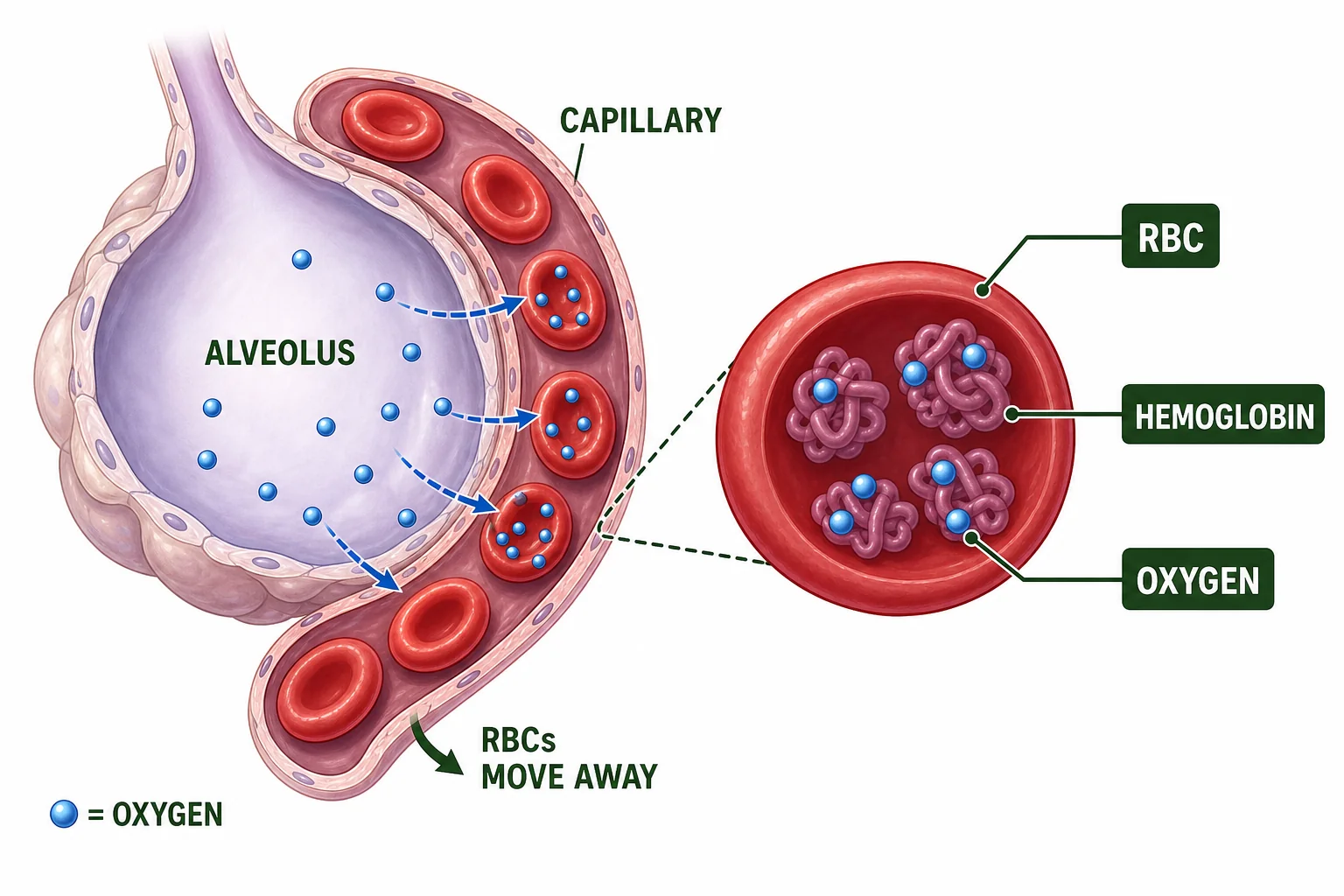
Red blood cells in a capillary near an alveolus showing hemoglobin binding oxygen and carrying it away
Hemoglobin helps blood load oxygen
Oxygen does not just float through the blood plasma for long. Most oxygen binds to hemoglobin, a protein inside red blood cells. Hemoglobin contains iron, which helps it hold oxygen in the lungs and release oxygen in body tissues. This binding is important because it keeps the oxygen level in the blood near the alveoli lower than it would be otherwise. That helps more oxygen keep diffusing in. Red blood cells act like moving delivery trucks. They pick up oxygen at the lungs, travel through arteries, and deliver oxygen to cells. At the same time, blood carries carbon dioxide back toward the lungs. Some carbon dioxide travels in plasma, some binds to hemoglobin, and much of it is carried in a changed chemical form in the blood. The key point is simple. Moving blood keeps the exchange going by carrying gases away from and toward the lungs.

Hemoglobin helps blood carry much more oxygen than plasma alone.

Air flow and blood flow must match
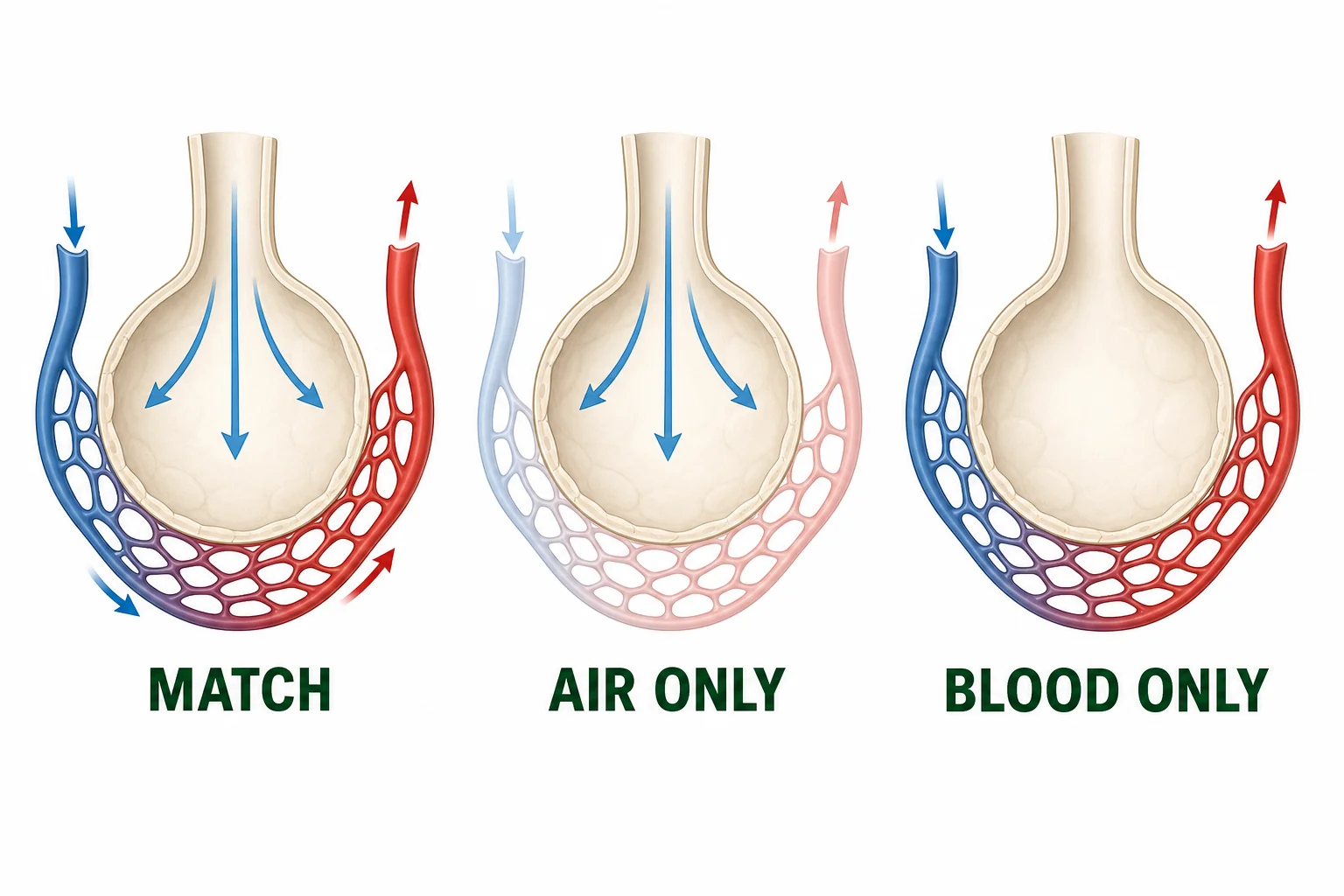
Three alveoli examples showing matched air and blood flow, air without enough blood flow, and blood without enough air flow
Gas exchange needs air flow and blood flow together
Ventilation is air flow to the alveoli. Perfusion is blood flow through the capillaries around the alveoli. Gas exchange works best when both reach the same alveoli at the same time. If an alveolus gets air but little blood, oxygen has nowhere useful to go. If blood flows past an alveolus with little fresh air, the blood cannot pick up much oxygen. Your body can adjust some airways and blood vessels to improve the match. This matching is one reason the lungs are not just passive bags. They are living organs with tissues that respond to conditions. Exercise shows the system working well. You breathe faster and deeper, and your heart pumps more blood through the lungs. More ventilation and more perfusion help oxygen enter the blood and help carbon dioxide leave it faster.

The best gas swap happens where fresh air meets moving blood.

Vocabulary

Alveoli
Tiny air sacs in the lungs where oxygen enters the blood and carbon dioxide leaves the blood.
Diffusion
The movement of molecules from an area where there are more of them to an area where there are fewer of them.
Capillary
A very small blood vessel with thin walls that allow materials to move between blood and nearby tissues.
Hemoglobin
A protein in red blood cells that binds oxygen and helps carry it through the body.
Ventilation
The movement of air into and out of the lungs.
Perfusion
The flow of blood through tiny blood vessels in a tissue, including the capillaries around alveoli.

In the Classroom

Model the thin membrane

20 minutes | Grades 6-8

Students compare how quickly a drop of food coloring spreads through a thin paper towel versus a folded stack. Use the model to discuss why a thin alveolus wall helps gases move quickly.

Surface area with bubbles

25 minutes | Grades 6-8

Students compare one large balloon to many small balloons that hold about the same total air. They estimate which setup has more outside surface and connect it to alveoli.

Ventilation and perfusion sorting

15 minutes | Grades 6-8

Give groups cards showing alveoli with different amounts of air flow and blood flow. Students sort them from best to worst gas exchange and explain their reasoning.

Key Takeaways

  • Gas exchange happens in tiny air sacs called alveoli.
  • Many alveoli create a large surface area for diffusion.
  • Oxygen diffuses from alveoli into blood, while carbon dioxide diffuses from blood into alveoli.
  • Hemoglobin in red blood cells binds oxygen and carries it through the body.
  • Air flow and blood flow must meet in the same place for gas exchange to work well.