Cellular Respiration Lab
Investigate how cells extract energy from organic molecules. Measure CO₂ production and O₂ consumption under different conditions, compare aerobic and anaerobic pathways, and calculate the respiratory quotient (RQ) for different substrates.
Guided ExperimentAerobic vs Anaerobic Respiration
How will CO₂ production and O₂ consumption differ when oxygen is available versus when it is absent? What happens to ATP yield?
Write your hypothesis in the Lab Report panel, then click Next.
Controls
Results
Aerobic vs Anaerobic Comparison
Data Table
(0 rows)| # | Trial | Condition | Substrate | Temperature(°C) | CO₂ Rate(μmol/min) | O₂ Rate(μmol/min) | RQ | ATP Yield |
|---|
Reference Guide
Aerobic Respiration
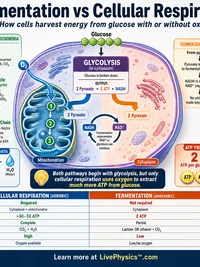
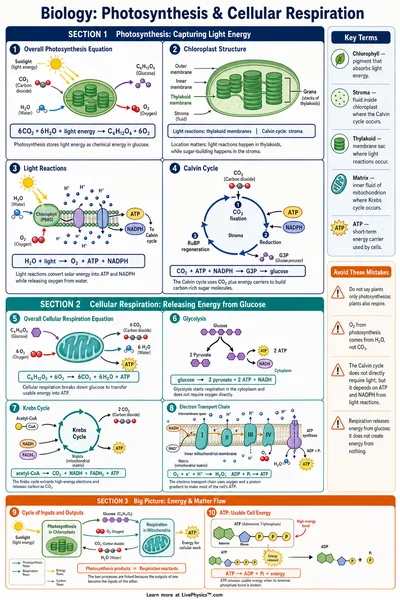
Aerobic respiration is the complete oxidation of glucose (or other substrates) in the presence of oxygen to produce CO₂, H₂O, and ATP.
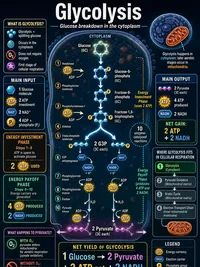
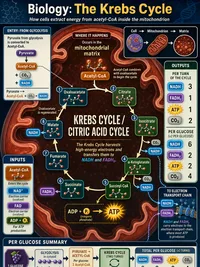
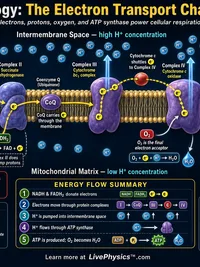
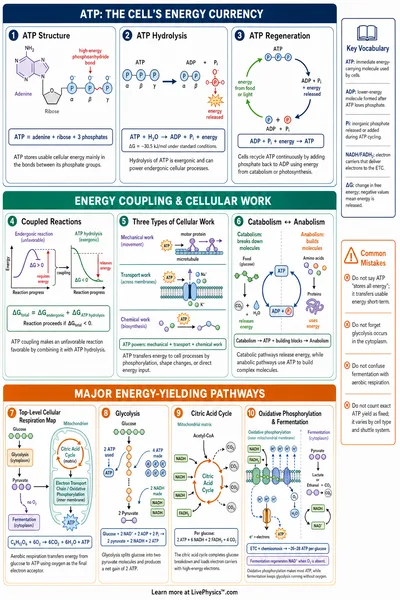
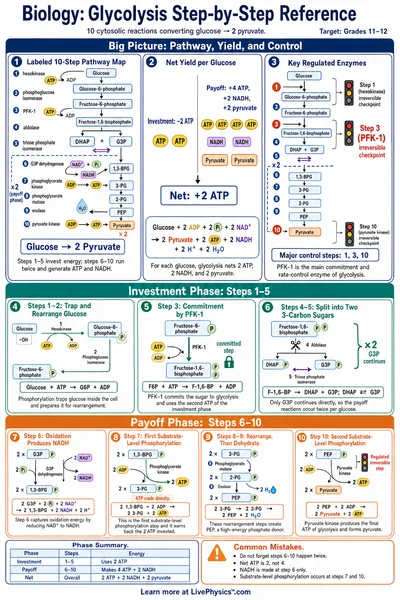
The process involves glycolysis, the Krebs cycle, and the electron transport chain. It is the most efficient pathway, yielding up to 36-38 ATP per glucose molecule.
Anaerobic Pathways
Without oxygen, cells resort to fermentation, which yields far less ATP.
Ethanol fermentation (yeast) produces CO₂ and ethanol. Lactic acid fermentation (muscle cells) produces lactate with no CO₂. Only 2 ATP per glucose is generated through glycolysis alone.
Respiratory Quotient
The respiratory quotient (RQ) is the ratio of CO₂ produced to O₂ consumed. It reveals which substrate is being metabolized.
Glucose has RQ = 1.0 (equal CO₂ and O₂). Fat has RQ ≈ 0.7 (more O₂ needed per CO₂). Protein has RQ ≈ 0.8. A mixed diet typically gives RQ ≈ 0.85.
Temperature and Metabolism
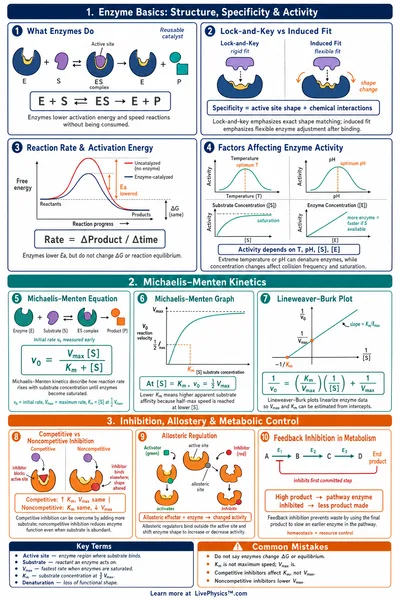
Cellular respiration is enzyme-catalyzed, so its rate depends strongly on temperature.
The Q₁₀ rule states that reaction rates roughly double per 10°C rise. However, above the optimal temperature (about 37°C for mammals), enzymes denature and rates plummet. This creates a characteristic bell-shaped curve for respiration rate vs temperature.