Respiratory System Breathing Lab
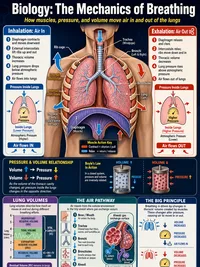
Adjust breathing rate and activity mode to see how the lungs deliver oxygen and remove carbon dioxide. Watch the animated lung diagram, track alveolar gas pressures, and record how SpO2 and minute ventilation change across rest, light activity, and exercise.
Guided ExperimentBreathing Rate and O2 Delivery
If you increase breathing rate from rest to exercise levels, how do you predict O2 consumption and blood SpO2 will change?
Write your hypothesis in the Lab Report panel, then click Next.
Breathing Animation
14 bpmGas Exchange
Controls
Lung Volume Trace
last 10 sData Table
(0 rows)| # | Trial | Mode | Breath Rate(bpm) | Tidal Volume(mL) | O₂(mL/min) | CO₂(mL/min) | SpO₂(%) |
|---|
Reference Guide
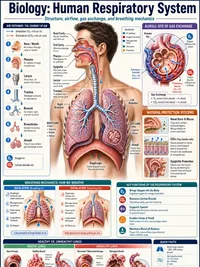
Lung Volumes
Key lung volume measurements used in this lab
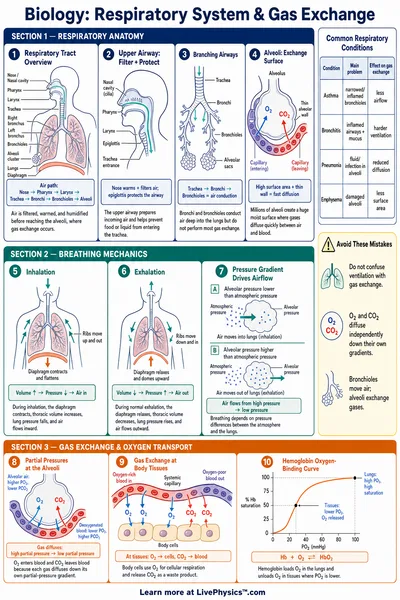
- Tidal Volume (TV). Air moved in or out during one normal breath. Rest, 500 mL. Exercise, up to 2000 mL.
- Dead Space. ~150 mL of air that fills the airways but never reaches the alveoli and cannot participate in gas exchange.
- Functional Residual Capacity (FRC). ~2400 mL of air remaining in the lungs after a normal passive exhale.
- Residual Volume. ~1200 mL always left in the lungs even after maximum exhalation.
Alveolar Ventilation
Only air reaching the alveoli can exchange gas with the blood. Alveolar ventilation (VA) tells us how much of each breath is useful
At rest, VA = (500 - 150) x 14 = 4900 mL/min. During exercise at 30 bpm with 2000 mL tidal volume, VA = (2000 - 150) x 30 = 55,500 mL/min.
Breathing faster with a small tidal volume is less efficient than breathing deeper because dead space is a fixed cost per breath.
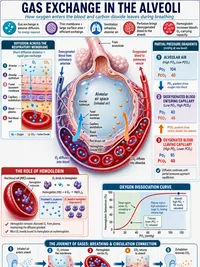
Gas Exchange
In the alveoli, O2 diffuses from air into the blood and CO2 diffuses from the blood into the air. The driving force is the partial pressure difference.
- Alveolar PO2. Normal ~100 mmHg. Drops with hypoventilation. Rises briefly with hyperventilation.
- Alveolar PCO2. Normal 35-45 mmHg. Rises above 45 with hypoventilation (hypercapnia). Falls below 35 with hyperventilation.
- Simplified Alveolar Gas Equation. PAO2 = FiO2 x (760 - 47) - PaCO2 / RQ, where FiO2 = 0.21 and RQ = 0.8.
Ventilation Status
The status badge in the Gas Exchange panel reflects the clinical significance of the current breathing pattern
- Normal. Adequate alveolar ventilation maintains PaO2 above ~90 mmHg and PaCO2 between 35-45 mmHg.
- Hypoventilating. Breath rate below 8 bpm. CO2 accumulates (hypercapnia), pH falls (respiratory acidosis), and SpO2 drops.
- Hyperventilating. Breath rate above normal for the mode. CO2 is washed out (hypocapnia), pH rises, causing tingling and dizziness.