Sign in to save

Bookmark this page so you can find it later.

Sign in to save

Bookmark this page so you can find it later.

Biology elementary May 21, 2026

Why Do Plants Need Sunlight?

How leaves turn light into plant food
A green plant receiving sunlight, taking in water through roots and air through leaves to make food for growth.

Plants need sunlight because it gives them energy to make food inside their leaves. They use air, water, and light to make a simple sugar that helps them grow. Without enough light, most plants cannot make enough food to stay healthy.

Big Idea. NGSS 5-LS1-1 asks students to support the idea that plants get the materials they need for growth mainly from air and water, with sunlight providing energy.

A plant may look still, but its leaves are busy during the day. Sunlight helps power a process called photosynthesis. In this process, the plant uses light, water, and carbon dioxide from the air to make glucose, a sugar the plant can use. The plant also releases oxygen into the air. This does not mean plants eat sunlight. Light is not food. It is energy that helps the plant build food from materials around it. That idea matters because it explains how energy enters many food chains. Grass uses sunlight to make sugar. A rabbit eats the grass. A fox may eat the rabbit. The energy started with the Sun and moved through living things. For elementary students, this connects to NGSS 5-LS1-1, which focuses on where plant matter comes from and how plants grow.

Light is plant energy
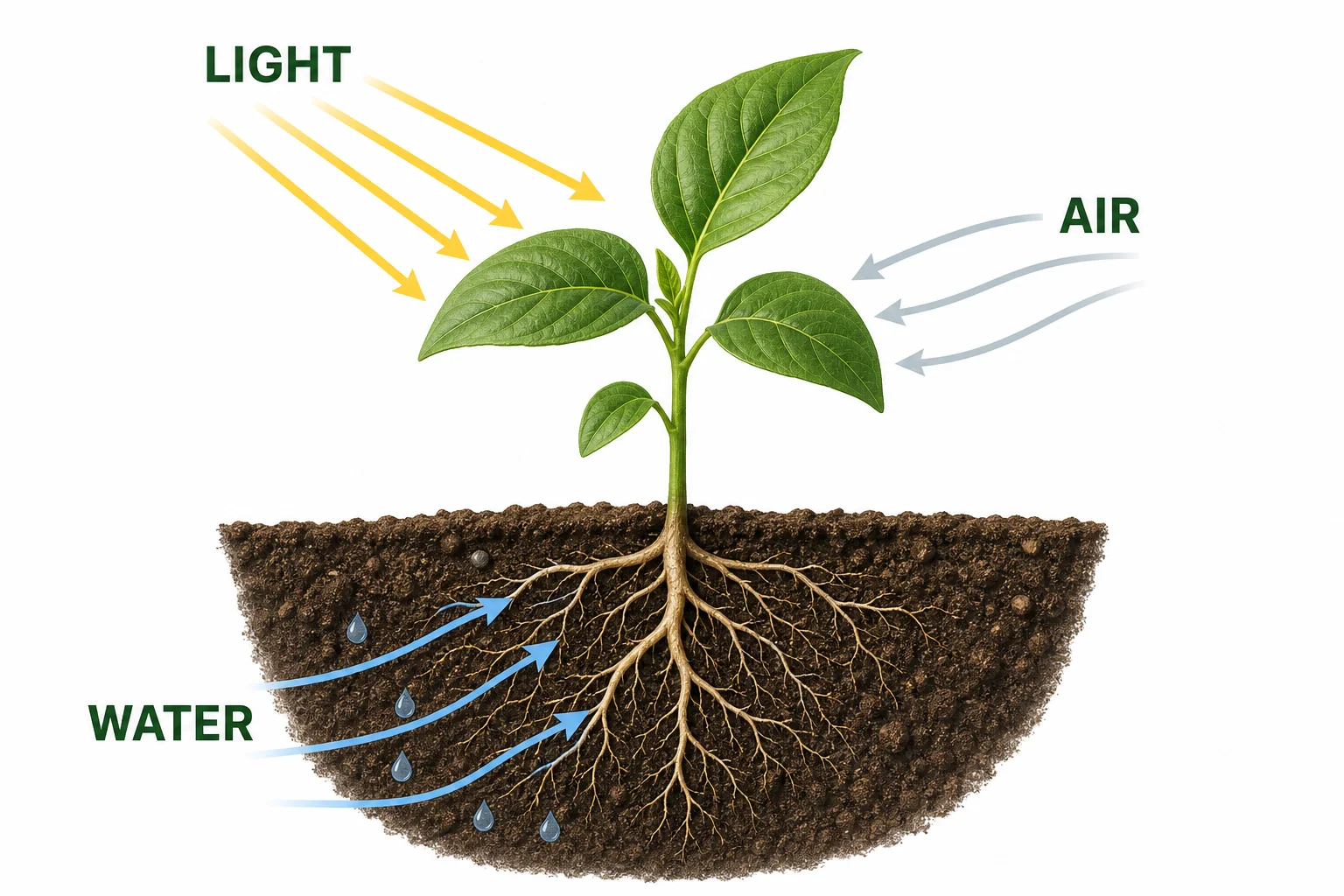
Sunlight shining on a leaf while roots take in water and leaves take in carbon dioxide.
Sunlight supplies energy for making plant food.
Plants need energy to live and grow. Animals get energy by eating food. Plants make their own food, but they still need an energy source to do it. Sunlight provides that energy. When light hits a leaf, tiny parts inside leaf cells capture some of the light energy. The plant uses that energy to combine water from the soil with carbon dioxide from the air. The product is glucose. Glucose is a kind of sugar. The plant can use it right away, store it, or build it into stems, roots, leaves, flowers, fruits, and seeds. This is why a plant kept in a dark closet usually turns pale and weak. It may have water and soil, but it cannot make enough food without light. Sunlight helps the plant do the work of building its own body.

Sunlight is the energy source, not the plant food itself.

Leaves are food factories
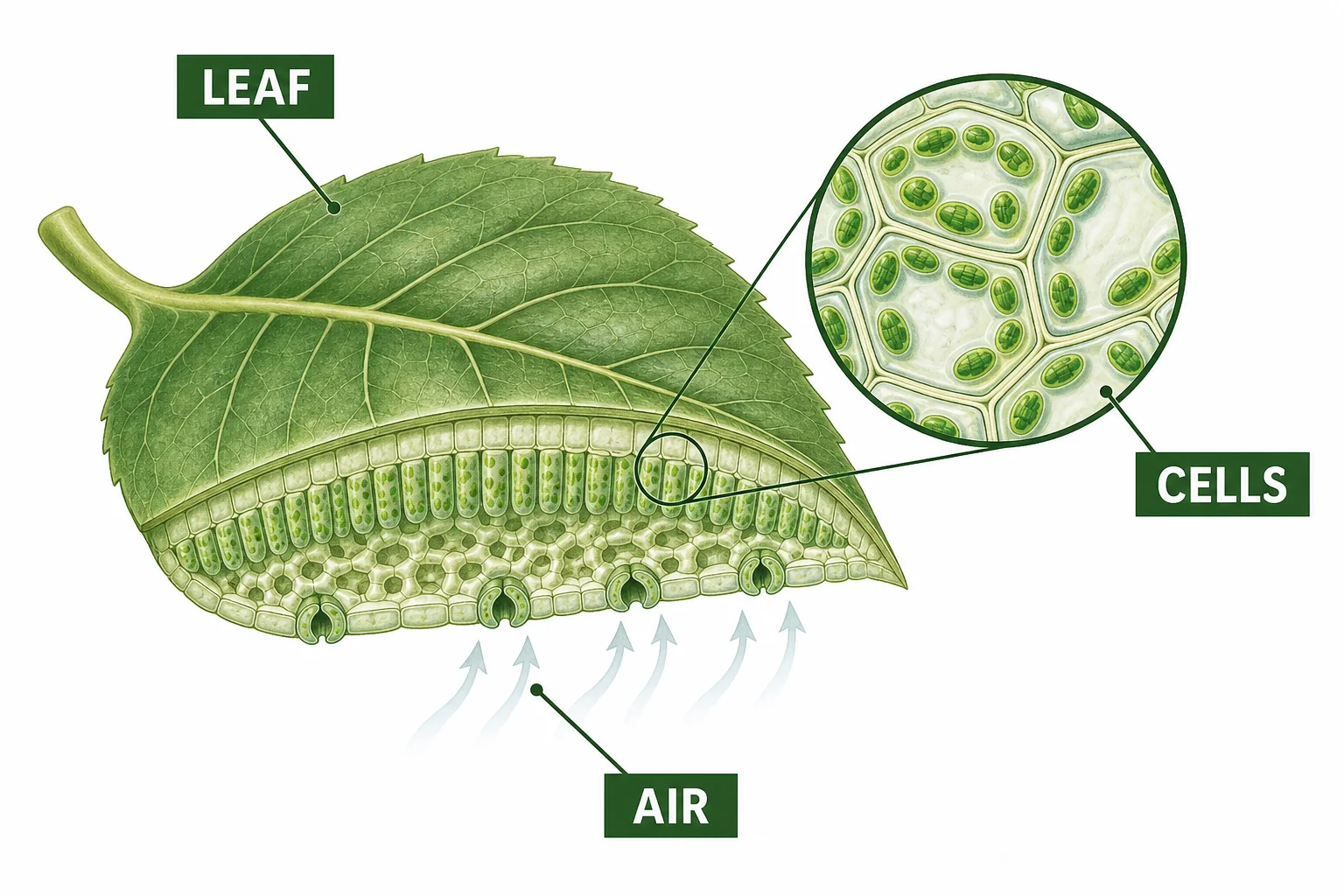
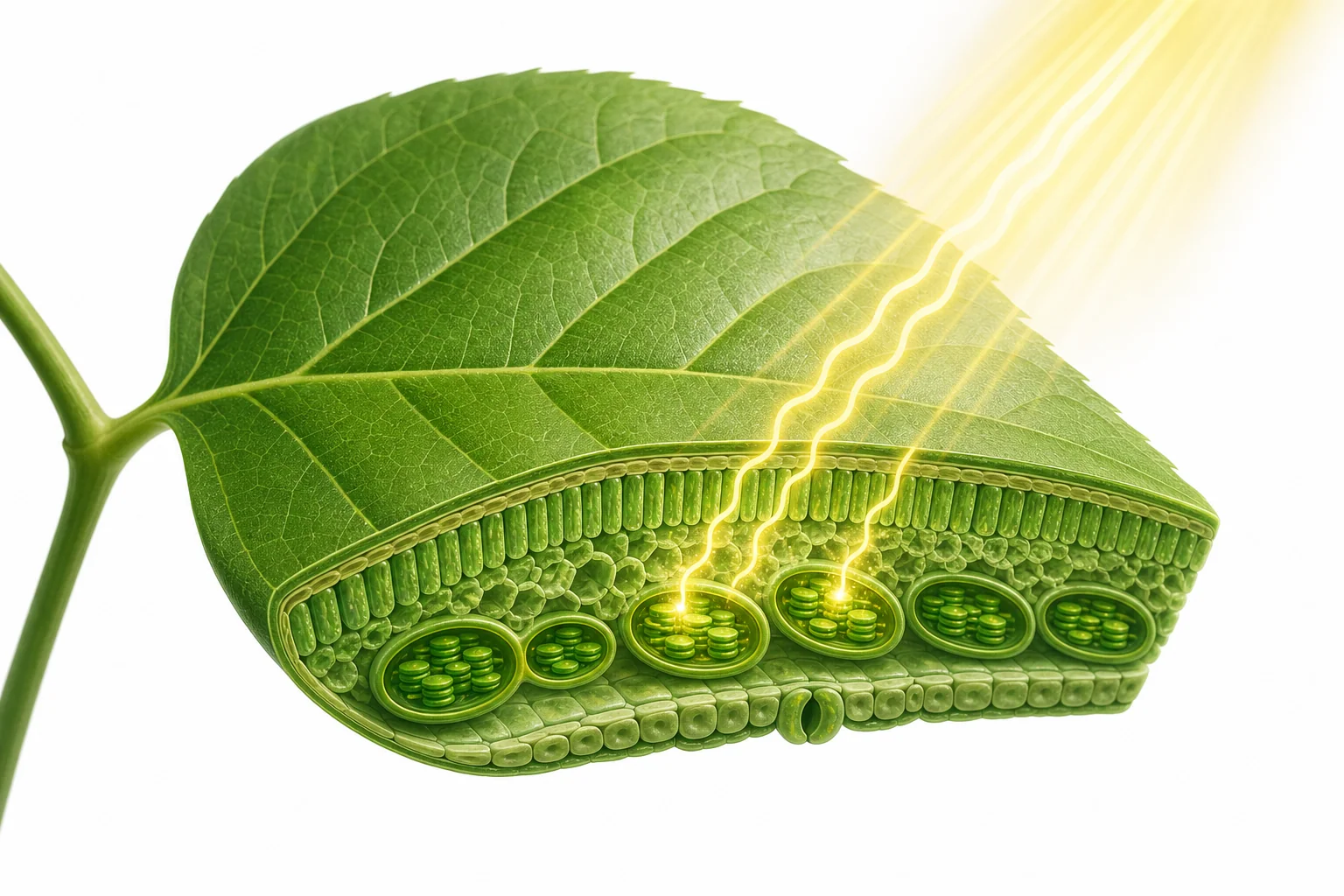
A cutaway view of a leaf showing chloroplasts inside cells and small openings for air.
Leaves collect light and take in air.
A leaf is shaped for collecting light. It is usually thin and wide, so sunlight can reach many cells. Inside many leaf cells are tiny green structures called chloroplasts. Chloroplasts contain chlorophyll, the green material that helps capture light energy. This is one reason many leaves look green. The leaf also has tiny openings that let carbon dioxide enter. Water travels up from the roots through the stem and into the leaf. When these parts work together, the leaf can make glucose. The plant does not need a mouth or stomach for this job. It uses its leaves, roots, stem, and air spaces. A healthy leaf is like a small factory that runs on sunlight. Each leaf helps make the food that supports the whole plant.

Leaves are built to gather light, air, and water.

What photosynthesis makes
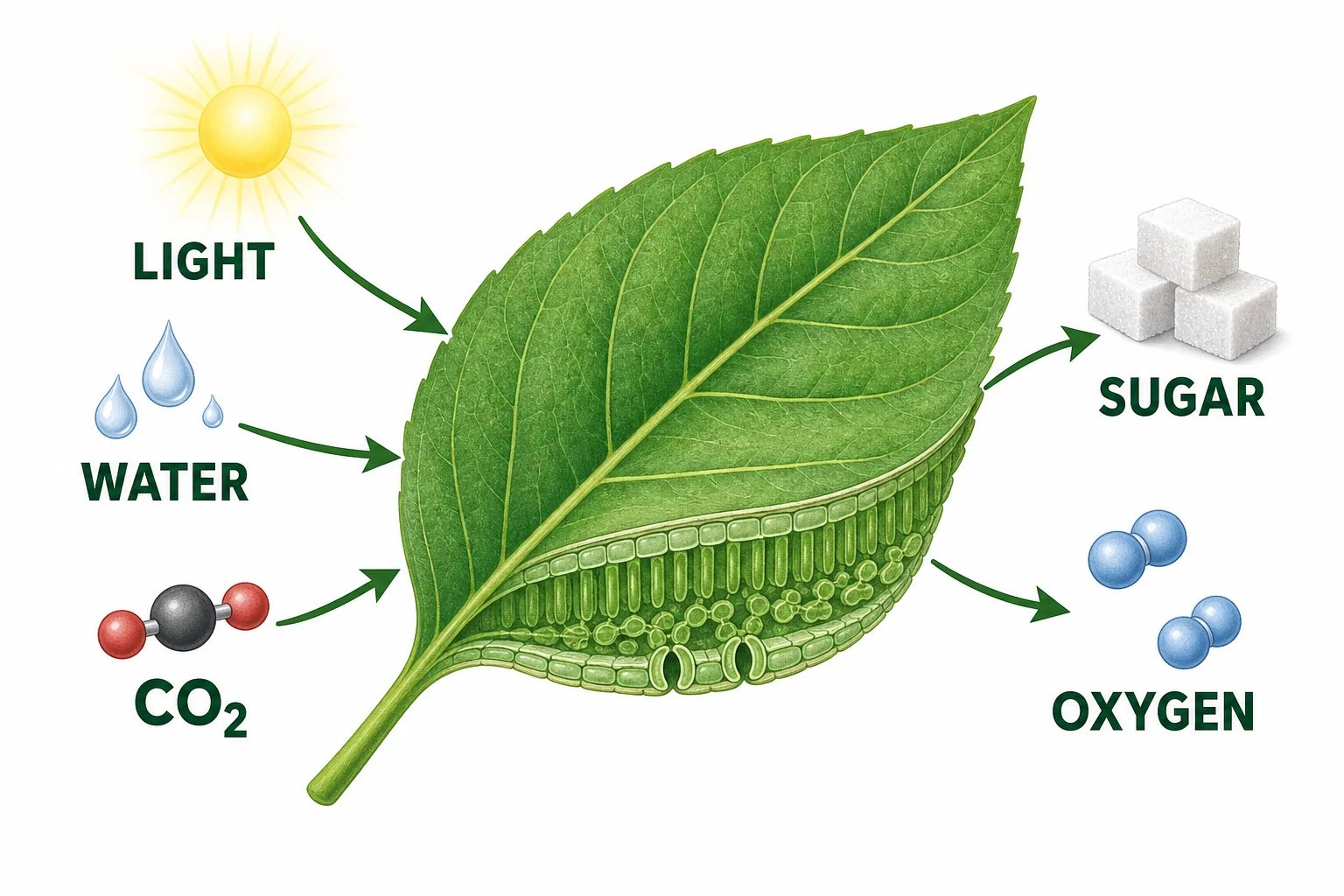
A simple photosynthesis diagram showing light, water, and carbon dioxide going into a leaf and glucose and oxygen coming out.
Photosynthesis makes sugar and oxygen.
Photosynthesis has two important results. First, the plant makes glucose. Glucose stores energy in a form the plant can use later. The plant can break down glucose to power its cells. It can also link sugars together to build stronger materials, such as the stuff in stems and wood. Second, the plant releases oxygen. Oxygen leaves the leaf through tiny openings and mixes with the air. This oxygen is important for many living things, including people. The simple classroom model is light plus water plus carbon dioxide make glucose and oxygen. The real process has many steps, but this model is enough to explain why sunlight matters. Without light, the plant cannot keep making glucose at the normal rate. Less glucose means less energy and less new plant matter.

Plants use sunlight to make glucose, a sugar that stores usable energy.

Chlorophyll catches light
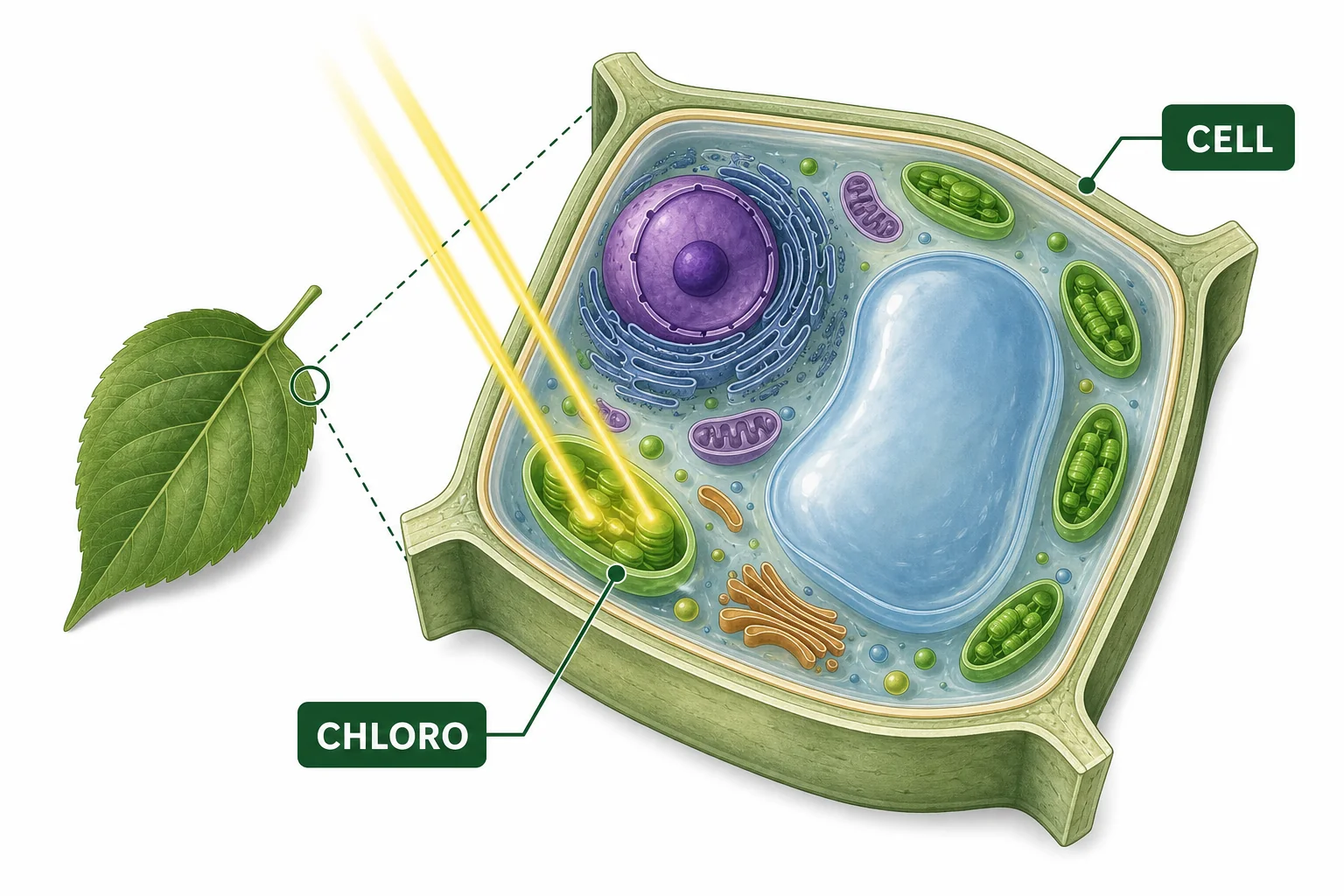
A magnified chloroplast with chlorophyll capturing light energy inside a leaf cell.
Chlorophyll helps leaves capture light.
Chlorophyll is the green material that helps plants capture light energy. It is found in chloroplasts inside many plant cells. Chlorophyll does not catch all colors of light in the same way. It uses some colors well and reflects much of the green light, which is why many leaves look green to our eyes. When light is captured, its energy helps start the steps of photosynthesis. Plants can grow under different amounts of light, but most need enough light for their kind. A cactus in a bright desert and a fern on a forest floor have different light needs. Both still depend on light. When a plant has too little light, it may grow tall and thin as it reaches toward a brighter place. Its leaves may also become pale because the plant is struggling to make enough food.

Chlorophyll helps turn captured light into chemical energy for the plant.

Sunlight starts food chains
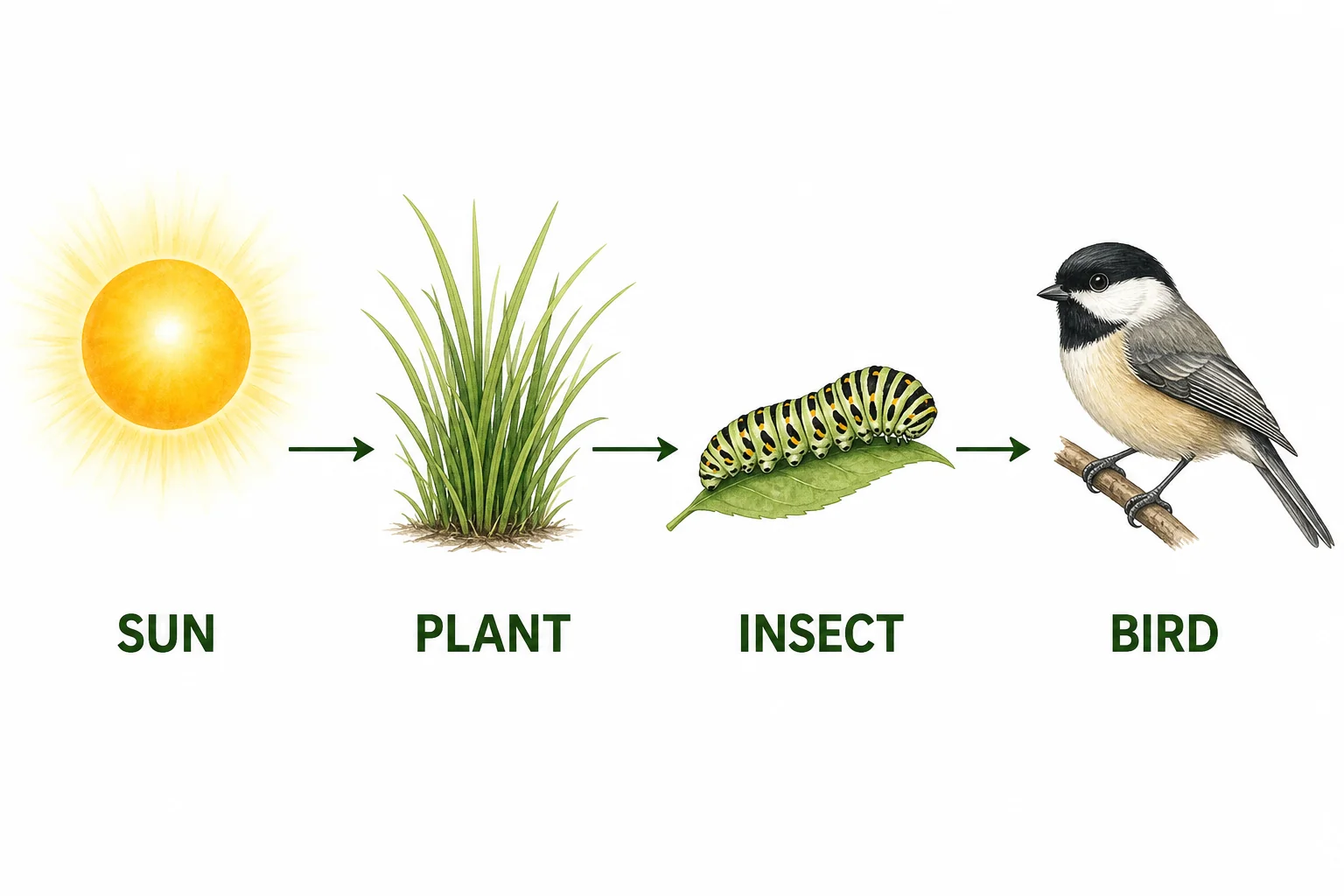
A simple food chain showing the Sun, grass, a caterpillar, and a bird with arrows showing energy flow.
Energy often begins with sunlight and plants.
Sunlight helps plants make glucose, and that affects more than the plant. Plants are producers. A producer makes its own food and becomes food for other living things. When a caterpillar eats a leaf, it gets some of the energy that the leaf stored in glucose. When a bird eats the caterpillar, some of that energy moves again. Energy flows through a food chain, but it often begins when a plant captures sunlight. This is why plants are so important in ecosystems. They provide food, shelter, and oxygen. They also build the plant matter that many animals depend on. In a garden, field, pond, or forest, sunlight and plants are connected to many living things. Understanding plants helps students understand how energy moves through nature.

Plants help move the Sun’s energy into ecosystems.

Vocabulary

Photosynthesis
The process plants use to make glucose from water and carbon dioxide using light energy.
Chlorophyll
The green material in plants that helps capture light energy.
Glucose
A simple sugar that plants make and use for energy and growth.
Carbon dioxide
A gas in the air that plants take in through their leaves.
Producer
A living thing, such as a plant, that makes its own food.

In the Classroom

Light and dark plant test

15 minutes to set up, 10 minutes daily | Grades 3-5

Place two similar small plants in different light conditions, while keeping water and container size the same. Students observe leaf color, height, and growth over one to two weeks, then explain how sunlight affected each plant.

Photosynthesis card sort

20 minutes | Grades 4-5

Give students cards for sunlight, water, carbon dioxide, glucose, oxygen, roots, stem, and leaves. Students sort the cards into inputs, plant parts, and products, then build a simple process model.

Food chain energy arrows

25 minutes | Grades 3-5

Students draw a food chain that begins with the Sun and a plant. They add arrows to show energy flow and write one sentence explaining why the plant comes near the start.

Key Takeaways

  • Plants need sunlight because light provides energy for making food.
  • Leaves use light, water, and carbon dioxide to make glucose.
  • Chlorophyll helps plants capture light energy.
  • Photosynthesis also releases oxygen into the air.
  • Plants help move energy from the Sun into food chains.