Sign in to save

Bookmark this page so you can find it later.

Sign in to save

Bookmark this page so you can find it later.

Chemistry high-school May 21, 2026

Why Do Fireworks Make Different Colors?

Atoms turn heat into colored light
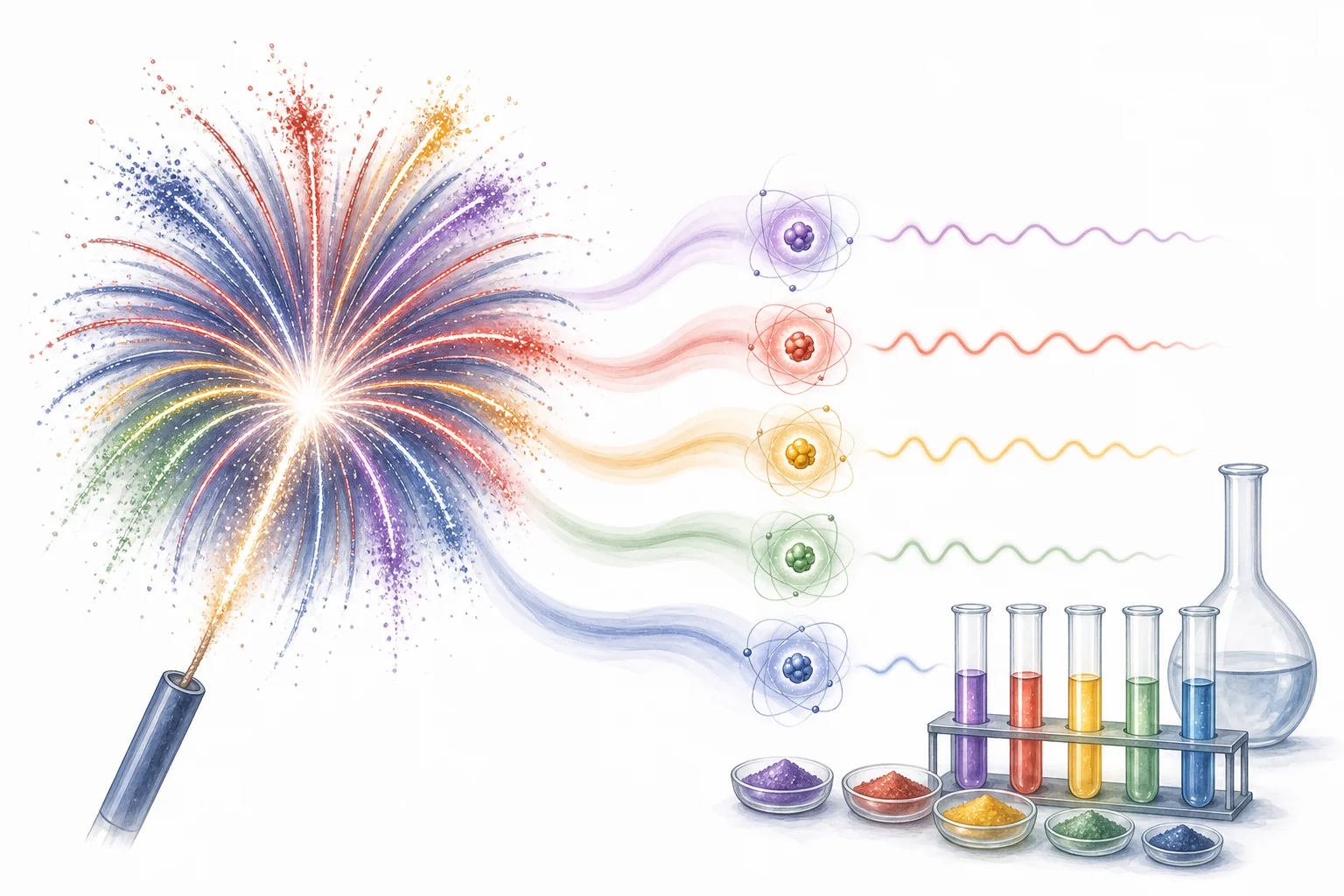
Diagram of fireworks bursts showing that different metal ions produce different colors of light

Fireworks get their colors from different ingredients mixed into the powder. When the firework burns, heat makes those ingredients give off light. Each ingredient gives off certain colors, so the recipe controls what you see.

Big Idea. NGSS HS-PS4-1 supports modeling light as waves whose energy can be linked to color and atomic emission.

A firework is a short chemistry experiment in the sky. Inside the shell are fuel, oxygen-rich chemicals, binders, and small color-producing compounds. When the shell bursts, the mixture burns quickly. That heat does more than make a loud sound. It gives energy to atoms and ions in the color compounds. For a tiny moment, their electrons move to higher energy levels. When the electrons drop back down, they release photons. The photon energy sets the light color we see. Red, green, blue, and yellow come from different metal ions and different electron transitions. This is the same idea behind flame tests in chemistry class and atomic emission spectra in astronomy. You can connect color to wave behavior with a wave speed calculator when you use $c=\lambda f$ for light.

The recipe sets the color
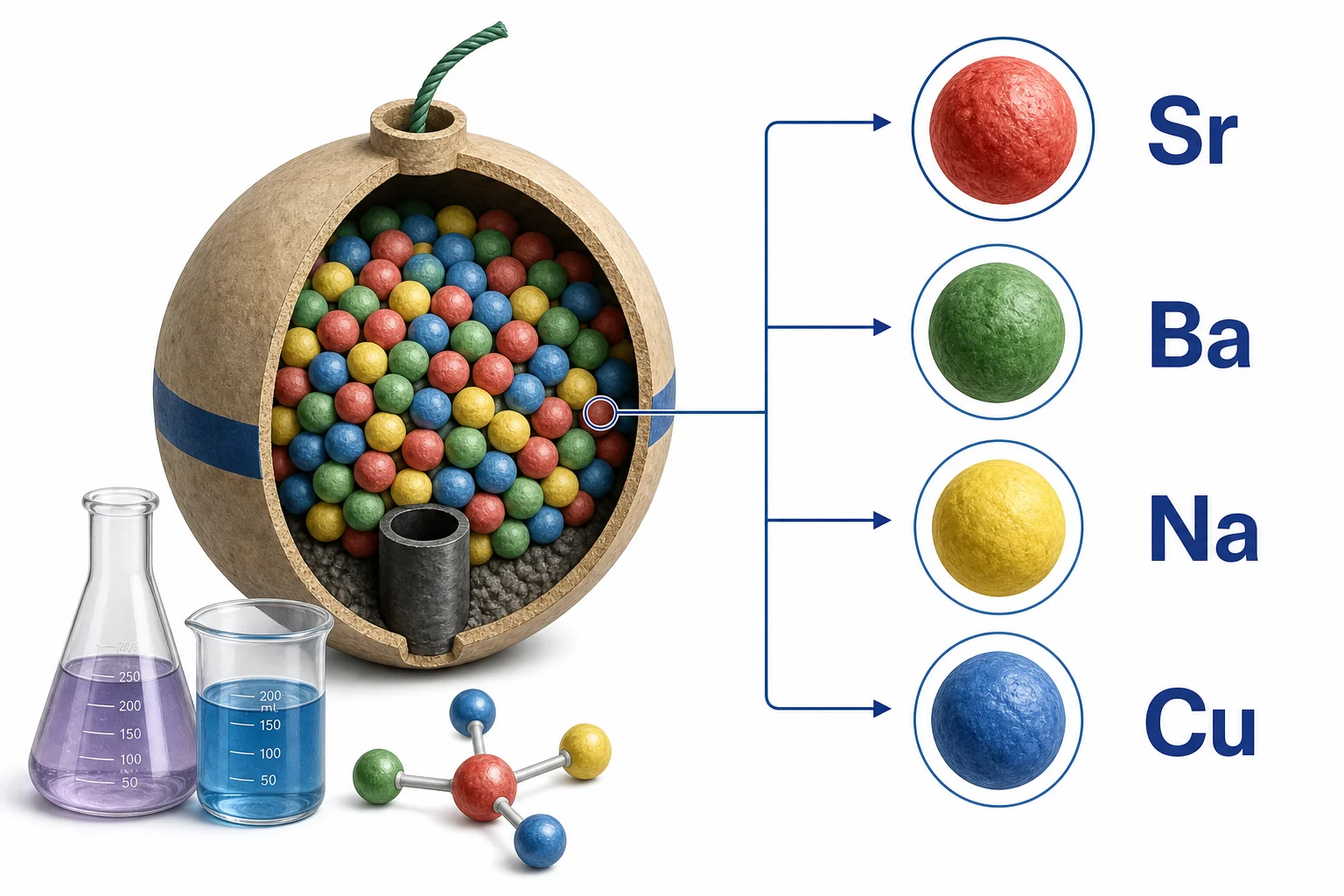
Cutaway diagram of a firework shell showing stars that contain different metal salts for color
Color comes from the chemical mixture inside each star
A firework shell is built in layers. The outer shell holds small pellets called stars. Each star contains fuel, an oxidizer, a binder, and a color compound. The color compound is often a metal salt. Strontium compounds make red. Barium compounds make green. Sodium compounds make yellow. Copper compounds can make blue. The fuel and oxidizer provide heat. The binder holds the star together until it burns. When the burst charge opens the shell, the stars fly outward and ignite. Each burning star acts like a moving flame test. The visible pattern depends on how the stars were packed, but the color depends mostly on the metal ions inside them. Firework makers choose combinations carefully because some colors need a narrow temperature range. Blue is especially hard because copper compounds can break apart if the flame gets too hot.

The color is part of the recipe, not a random effect.

Heat excites electrons
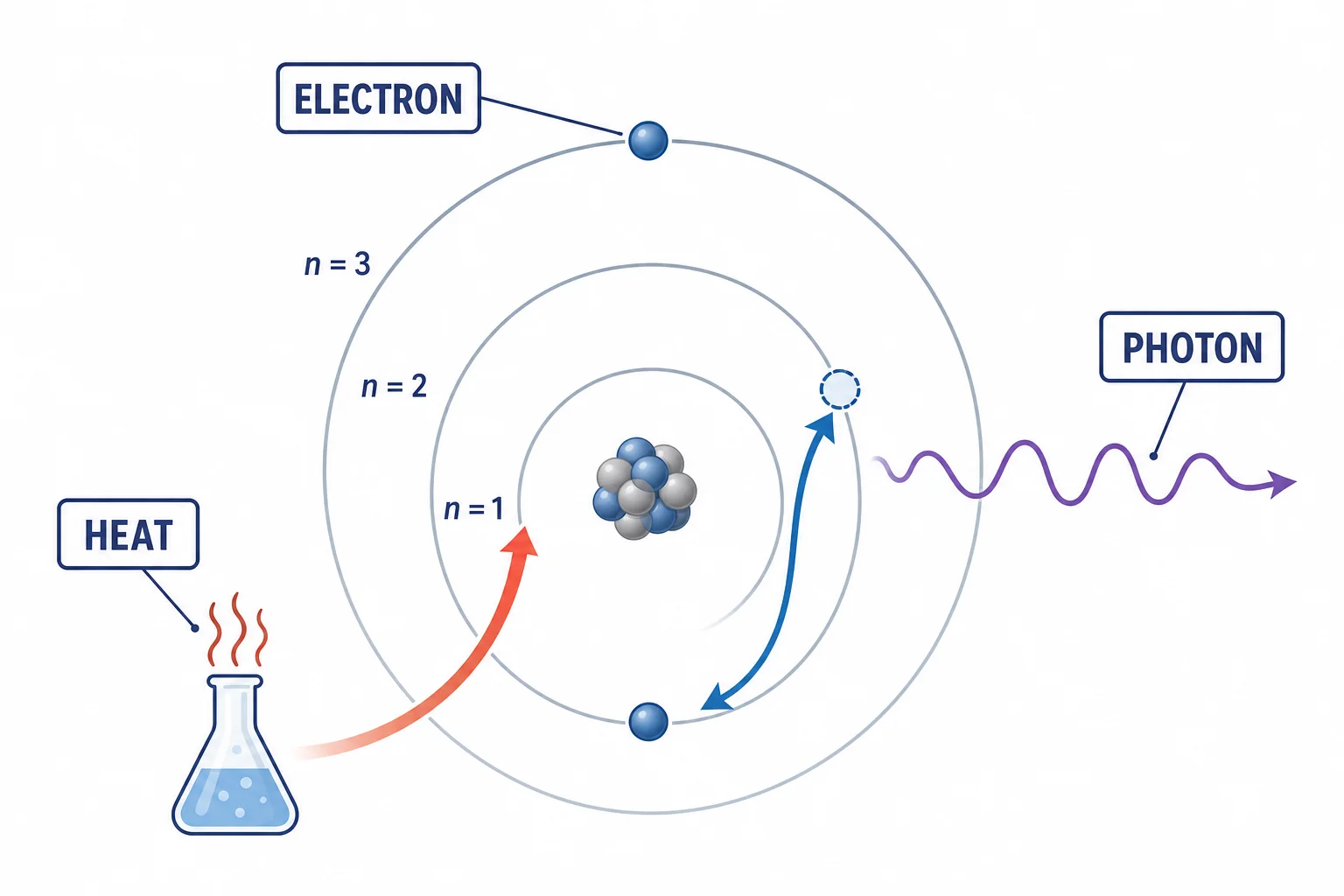
Energy level diagram showing an electron absorbing heat energy and then emitting a photon
Electrons release photons when they drop to lower energy levels
The bright color starts at the atomic scale. At room temperature, electrons in an atom or ion usually occupy lower energy levels. These levels are not random. They are allowed energy states set by the structure of the atom. When a firework star burns, heat and collisions give energy to the particles in the metal compound. Some electrons absorb just enough energy to move to higher allowed levels. This state does not last long. The electron soon falls back to a lower level. The lost energy leaves as a photon, which is a packet of light. If the photon energy falls in the visible range, your eyes detect it as color. A large energy drop makes higher energy light, often toward violet or blue. A smaller energy drop makes lower energy visible light, often toward orange or red.

Light color records the size of an electron energy change.

Photons carry color
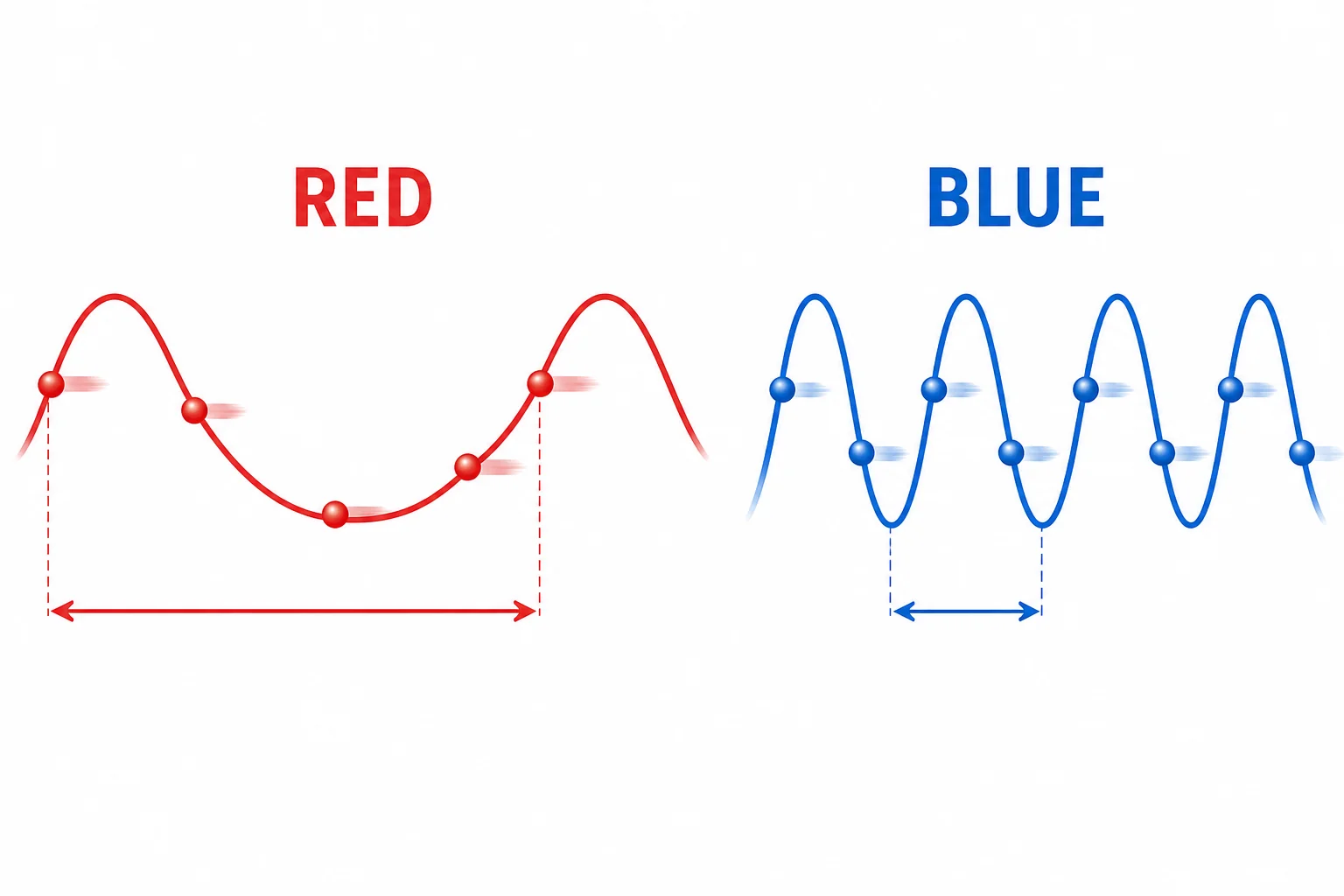
Comparison of red and blue light waves showing that blue has shorter wavelength and higher frequency
Photon energy depends on frequency
A photon has energy, and that energy is related to the light wave’s frequency. The relationship is $E=hf$, where $h$ is Planck’s constant and $f$ is frequency. Higher frequency light has higher photon energy. Since light in air travels at nearly the same speed for every visible color, frequency and wavelength are linked by $c=\lambda f$. Blue light has a shorter wavelength and higher frequency than red light. That means a blue photon carries more energy than a red photon. Firework colors are not made by paint or dye. They are made when atoms and ions release photons with certain energies. Your eye and brain sort those photon energies into color signals. If many photons of one color reach your eye at once, the burst looks bright and pure.

Blue photons carry more energy than red photons.

Each element has a spectrum
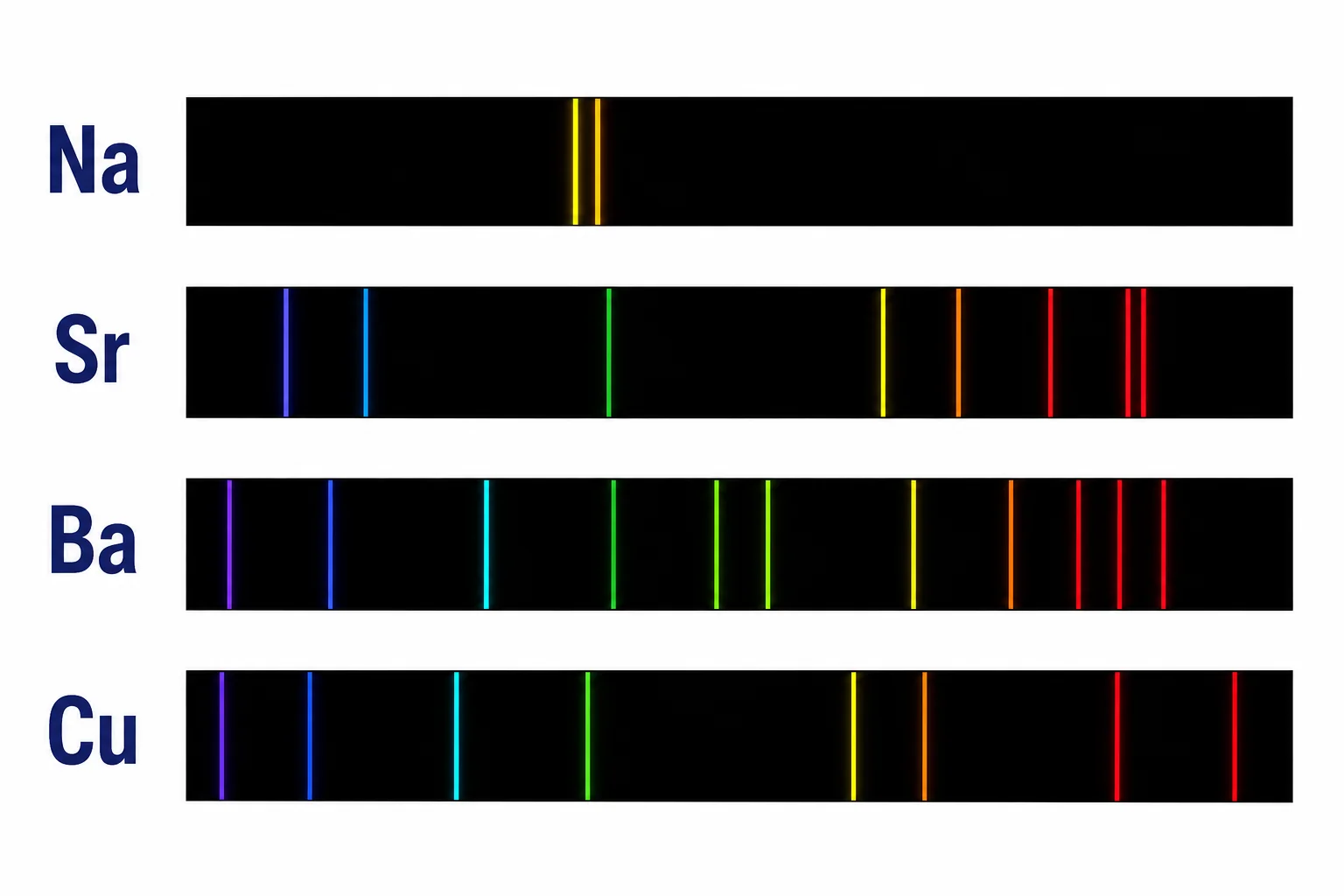
Emission spectra shown as colored lines for sodium, strontium, barium, and copper
An emission spectrum is a color pattern from one element or ion
Each element has its own set of allowed electron energy levels. Because of that, each element gives off a pattern of specific wavelengths when it is excited. This pattern is called an atomic emission spectrum. It works like a barcode for atoms. In a flame test, sodium gives a strong yellow line. Strontium gives red lines. Barium gives green lines. Copper compounds can give blue-green light. A firework is more complex than a clean lab spectrum because many reactions happen at once. The flame temperature, the oxygen supply, and nearby chlorine compounds can change which particles form. Still, the main idea holds. Different atoms and ions release different photon energies. Scientists use the same principle to identify elements in stars, gas clouds, lamps, and laboratory samples.

A spectrum can identify the atoms that made the light.

Mixtures make the show
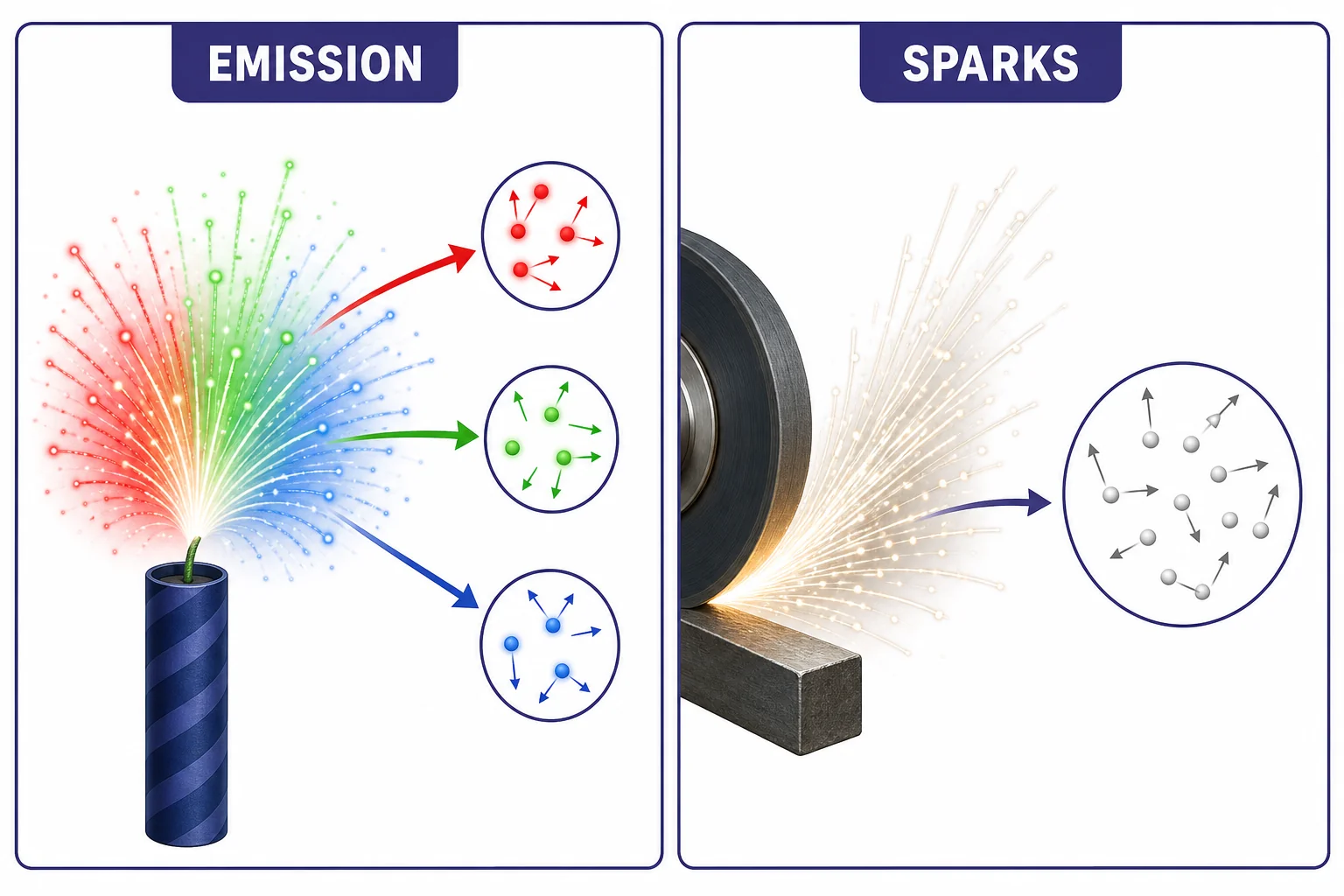
Diagram comparing colored emission from metal ions with white sparks from hot metal particles
Fireworks combine emission, heat glow, and shell design
A finished fireworks display uses many chemical and physical effects at once. Different stars can be packed into one shell to make rings, palms, or layered bursts. Some stars contain mixtures that burn from one color to another as the outer layer is used up. White sparks often come from hot metal particles, such as aluminum, magnesium, or titanium. These particles can glow because they are extremely hot, which is called incandescence. That is different from the line colors made by electron transitions in metal ions. Smoke, moisture, and distance can also change what viewers see. If the air is smoky, blue and violet light may be harder to see. If the chemical mix is too hot or too cool, some colors fade. Good color depends on both atomic physics and careful chemical engineering.

The final color depends on chemistry, temperature, and the path light takes to your eyes.

Vocabulary

Photon
A small packet of light energy.
Electron transition
A change in an electron’s energy level inside an atom or ion.
Emission spectrum
A pattern of wavelengths released by excited atoms or ions.
Metal ion
A metal atom that has gained or lost electrons and has an electric charge.
Wavelength
The distance from one point on a wave to the matching point on the next wave.

In the Classroom

Flame test color chart

25 minutes | Grades 9-12

Students observe teacher-led flame tests or a safe video set and record the colors from different metal salts. They connect each color to the idea that atoms and ions release specific photon energies.

Energy and wavelength ranking

20 minutes | Grades 9-12

Students rank red, yellow, green, and blue light by wavelength, frequency, and photon energy. They use $c=\lambda f$ and $E=hf$ to explain why the rankings reverse for wavelength and frequency.

Build a spectrum model

30 minutes | Grades 9-12

Students use colored pencils or strips of paper to model emission lines for several elements. They compare the patterns and explain how a spectrum can identify an unknown sample.

Key Takeaways

  • Firework colors come mainly from metal ions in the firework stars.
  • Heat gives electrons energy, and electrons release photons when they drop back down.
  • Photon energy is linked to frequency, so different photon energies appear as different colors.
  • Each element has a characteristic emission spectrum.
  • The final color also depends on temperature, mixtures, smoke, and firework design.
Content generated with AI assistance and reviewed by the LivePhysics editorial team. See sources below for original references.