Periodic Table Families Explorer
Discover the periodic table through its families. Each family shares similar properties because its members have the same number of outer electrons. Click any element or family pill to see what they have in common and where you find them in everyday life.
Element Families
Click any element or family pill to begin exploring.
Select a Family
Click any element on the table or choose a family above to explore its properties and real-world uses.
Reference Guide
Element Families Overview
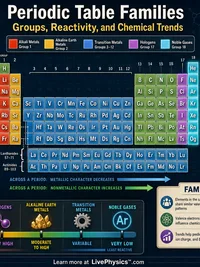
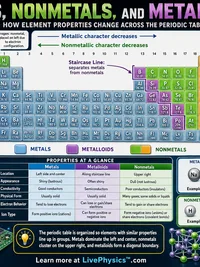
Metals (left side)
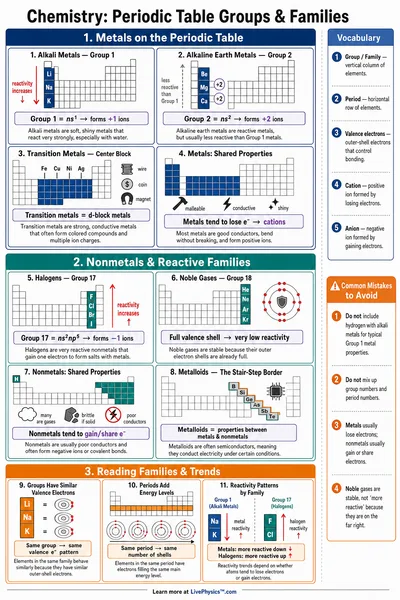
Alkali metals (Group 1), alkaline earth metals (Group 2), and transition metals (Groups 3-12) make up most of the table. They are shiny, conduct electricity, and lose electrons in chemical reactions.
Nonmetals (right side)
Halogens (Group 17), noble gases (Group 18), and reactive nonmetals (Groups 14-16) sit on the right. Most are gases at room temperature and gain electrons rather than lose them.
Metalloids (staircase)
Elements along the diagonal staircase border share traits of both metals and nonmetals. Silicon is the most important semiconductor and the basis of all computer chips.
Reading the Periodic Table
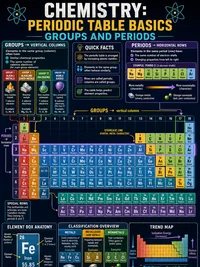
Periods (rows)
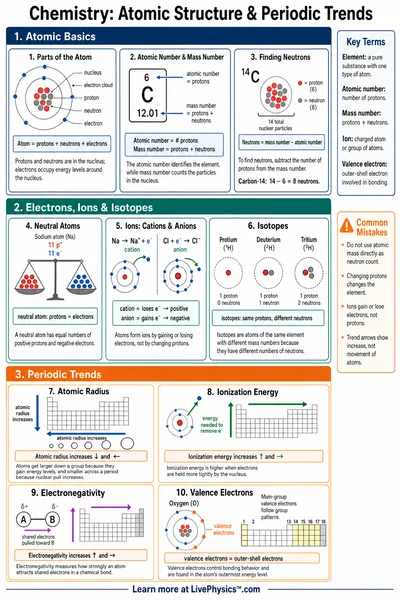
Each horizontal row is a period. Elements in the same period have the same number of electron shells. Period 1 has 1 shell, period 2 has 2 shells, and so on up to period 7.
Groups (columns)
Each vertical column is a group numbered 1 to 18. Elements in the same group have the same number of outer (valence) electrons. This is why they share similar chemical behavior.
Atomic number
The small number at the top of each cell is the atomic number. It counts the protons in the nucleus and increases from left to right, top to bottom across the table.
Why Families Share Properties
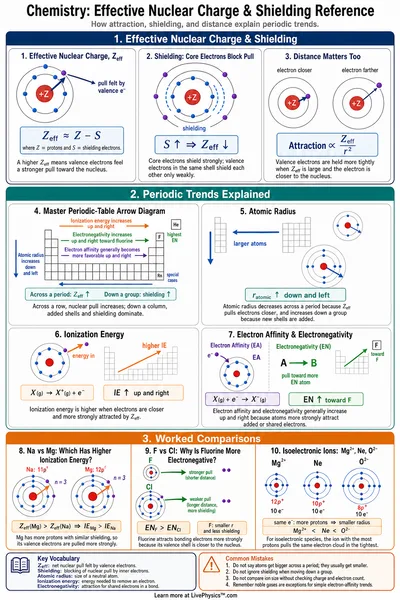
Elements in the same family (group) have the same number of valence electrons, the electrons in the outermost shell. Valence electrons are responsible for almost all chemical reactions.
- Group 1 (alkali metals) each have 1 valence electron they give away easily, making them very reactive.
- Group 17 (halogens) each have 7 valence electrons and need just 1 more to complete their outer shell.
- Group 18 (noble gases) have full outer shells (8 electrons) and almost never react.
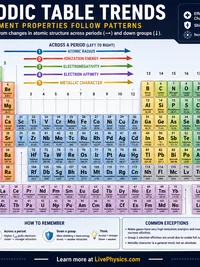
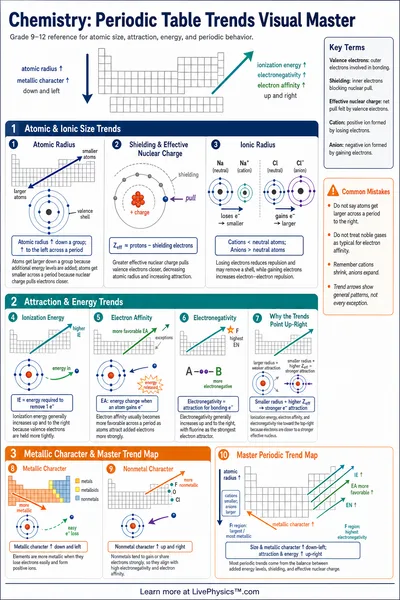
Moving down a group, atoms get larger as more electron shells are added. This changes how strongly the outer electrons are held, which is why reactivity increases down Group 1 but decreases down Group 17.