Understanding Atoms, Molecules and Ions Builder
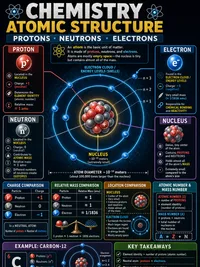
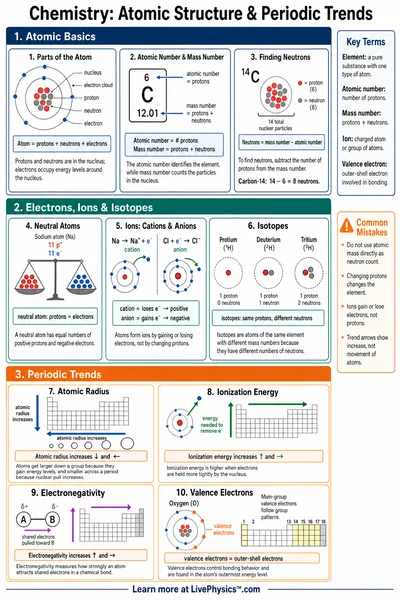
The number of protons gives an atom its identity. Change that number by one, and the atom becomes a different element, no matter how many neutrons or electrons it has.
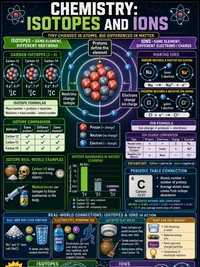
Neutrons add mass without changing the element name. Atoms of one element can have different neutron counts, called isotopes, and some isotopes are unstable because their nuclei break apart over time.
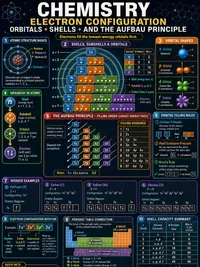
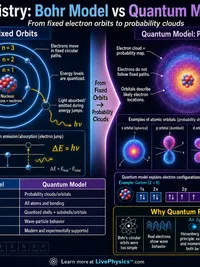
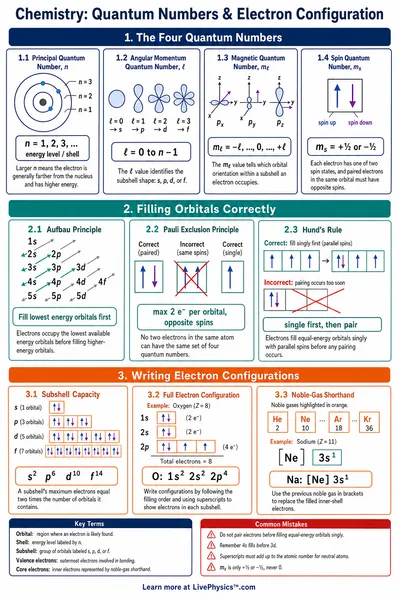
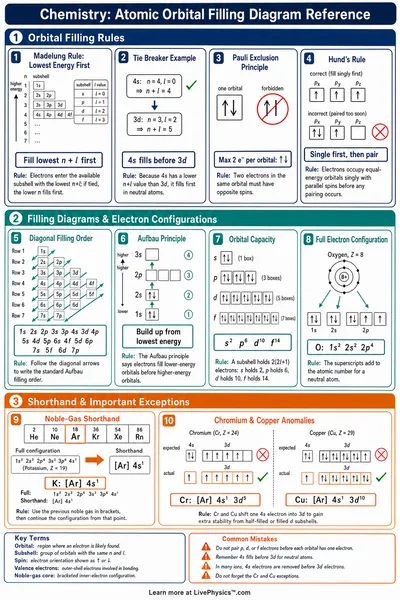
Electrons occupy regions around the nucleus that have different energies. A Bohr diagram shows these as shells, which is useful for beginners, though real electron behavior is more complex than neat circular paths.
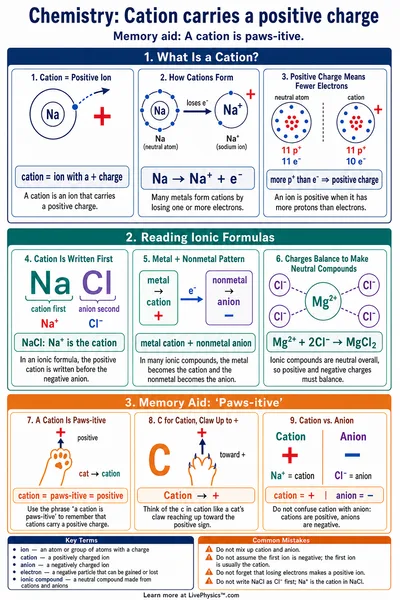
A neutral atom has equal numbers of protons and electrons. If electrons are removed, the atom has more positive charge, while extra electrons give it a negative charge.
Atoms do not form ions simply because they want a full outer shell. They form ions when losing or gaining electrons leads to a lower energy arrangement, and the full shell rule is a helpful pattern for many common elements.
Metals often lose outer electrons because those electrons are held less tightly. Nonmetals often gain electrons, so a metal ion and a nonmetal ion can attract each other through opposite charges.
An ionic solid is not made of separate pairs that float alone. In sodium chloride, each positive sodium ion is surrounded by negative chloride ions in a repeating crystal lattice, which helps explain why salt forms hard crystals.
Covalent bonds form when atoms share electrons. The shared electrons are pulled by both nuclei, and unequal pulling can make one end of a bond slightly negative while the other end is slightly positive.
A molecular formula tells how many atoms are present, but it does not always show their arrangement. Carbon dioxide and water have very different shapes, and shape affects properties such as polarity, melting point, and how substances mix with water.
Some atoms share more than one pair of electrons. Oxygen gas has a double bond, while nitrogen gas has a triple bond, and stronger shared bonds usually need more energy to break.
Electron configurations reveal patterns across the periodic table. Elements in the same column often have similar outer electron arrangements, which is why they tend to make similar ion charges and bond in similar ways.
Keep proton count, neutron count, and electron count separate when using a builder. This distinction appears in real life in medical imaging, smoke detectors, batteries, water treatment, and the labels used to identify radioactive materials.