Sign in to save

Bookmark this page so you can find it later.

Sign in to save

Bookmark this page so you can find it later.

Computer Science middle-school May 24, 2026

Why Does My Phone Get Hot When I Play Games?

Fast graphics turn battery energy into heat

A phone running a game with simplified processor chips inside and heat spreading toward the case

Your phone gets hot because its chips use electricity to draw game scenes, run game rules, and send data to the screen. Some of that electricity turns into heat inside the phone. Faster games and brighter screens use more electricity, so the phone warms up more.

Big Idea. CSTA 2-CS-02 supports explaining how hardware choices affect speed, energy use, and user experience.

A game asks your phone to do many jobs at once. It tracks player input, runs the game world, draws 3D shapes, plays sound, uses the network, and lights the screen. The main chips that do this work are the CPU and GPU. They are tiny electronic circuits made from billions of switches called transistors. When those switches change between on and off, they use electrical energy. Some of that energy becomes useful work. Some becomes heat. Your hand feels that heat after it spreads through the phone frame, battery area, glass, and case. This is normal, but it has limits. If the phone gets too warm, the software slows the chips down to protect the parts and the battery. That slowdown is called throttling. The tradeoff is simple. More frames and richer graphics need more energy, and more energy use usually means more heat.

Games wake up the chips
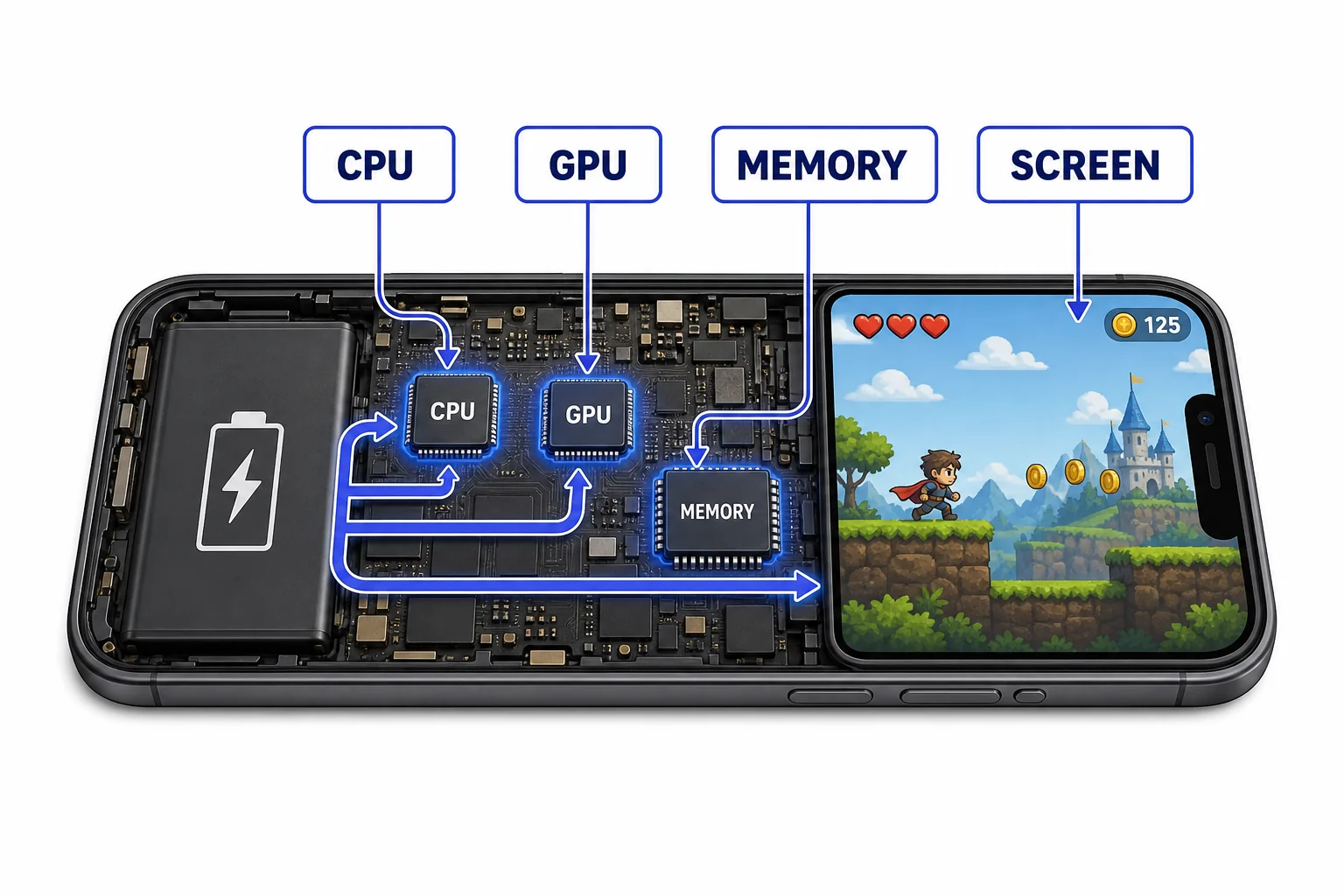
A cutaway phone showing the CPU, GPU, memory, screen, and battery active during a game
A game keeps several phone parts working at once
A phone is a small computer. During a simple task, many parts can stay quiet. A game keeps more parts busy. The CPU handles game rules, touch input, character movement, physics, and background tasks. The GPU draws images for the screen. Memory moves texture files, sound data, and position data back and forth. The display refreshes many times each second. Wireless chips may send game data to other players. Each part uses electrical energy while it works. The battery supplies that energy. The phone cannot turn all of it into perfect motion, sound, and light. Some energy always becomes heat. Game heat is easy to notice because the work lasts for many minutes. The thin phone body has little room for fans or large heat sinks, so the heat reaches the outside surface that you touch.

More active parts mean more energy use.

Switching makes heat
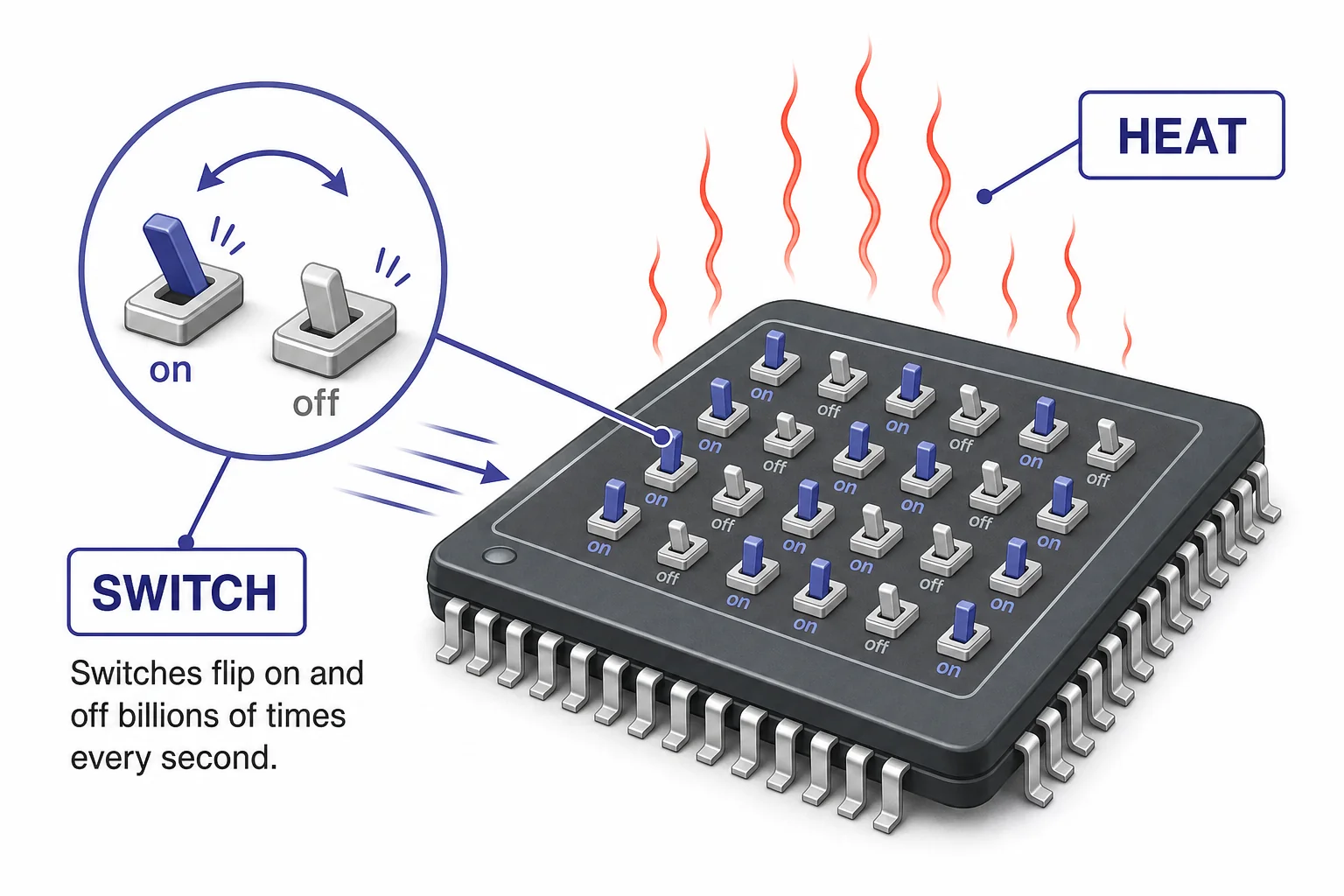
A magnified chip diagram showing many tiny transistor switches changing state and releasing heat
Billions of tiny switches add up to noticeable heat
The CPU and GPU are built from transistors. A transistor acts like a tiny switch that helps store or change information. In a game, many transistors switch billions of times each second. Each switch uses a tiny bit of energy. One switch is not enough to feel. Billions of switches, repeated many times, add up. This is called switching power. The chips also leak a small amount of electricity even when parts are not switching. The heat comes from electrical resistance and from the way real circuits lose energy as they change state. A game with complex lighting, shadows, and many objects needs more switching. Higher detail means the GPU must calculate more pixels and colors. More switching usually means more heat. That is why a phone may stay cool during reading but warm during a 3D game.

Tiny energy losses become large when billions of switches run fast.

Frame rate costs energy
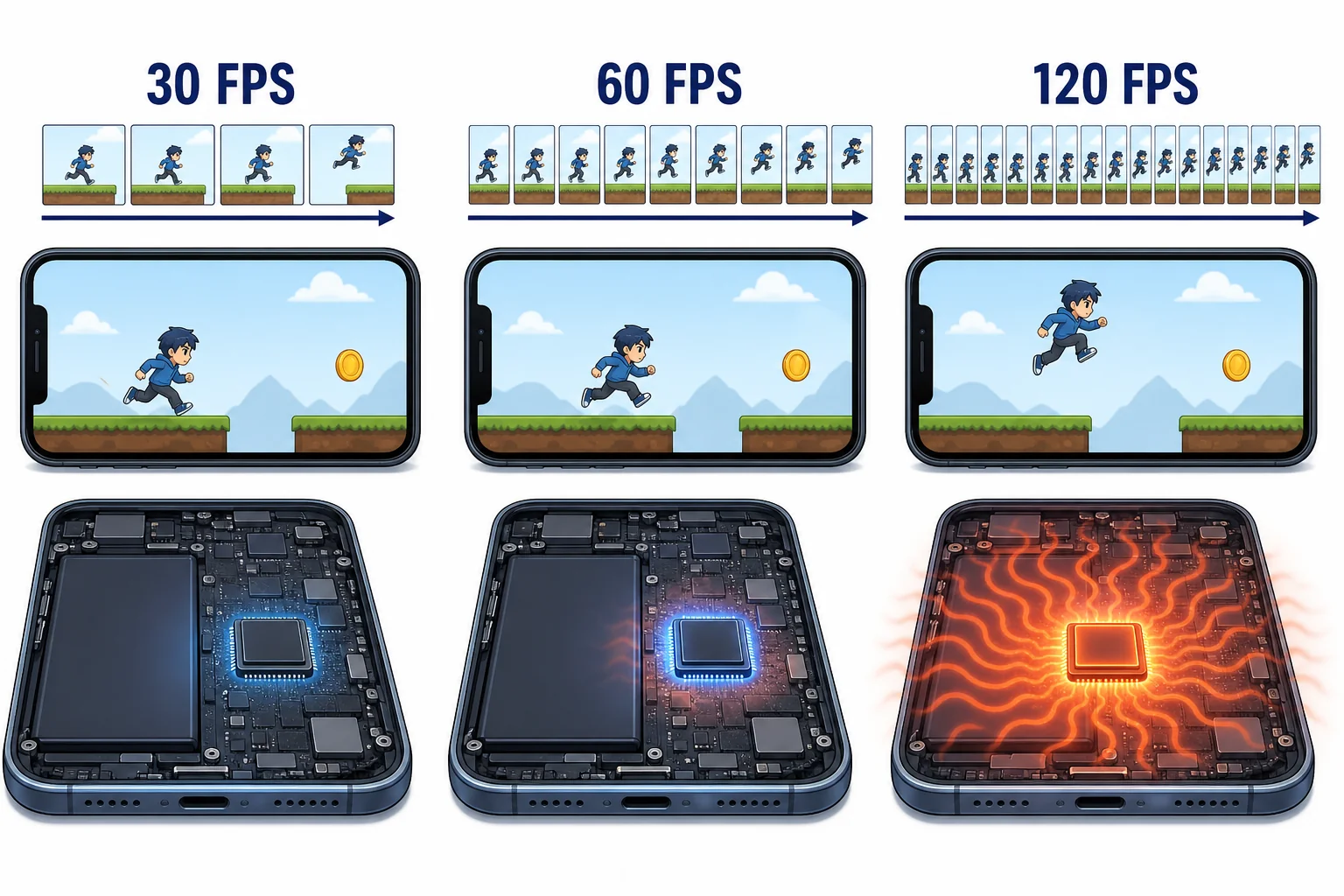
A comparison of 30, 60, and 120 frames per second with increasing chip activity and heat
More frames each second require more work
A frame is one complete picture sent to the screen. At 30 frames per second, the phone makes 30 pictures every second. At 60 frames per second, it makes twice as many. At 120 frames per second, it makes four times as many as 30. The game may feel smoother, but the phone must do more work in the same amount of time. The CPU must prepare game data faster. The GPU must draw pixels faster. The screen may also refresh faster. Higher frame rate can use much more energy, especially when the game scene is detailed. The phone may also raise chip speed to finish each frame on time. Higher speed often needs more electrical power. That is why lowering the frame rate, turning down graphics quality, or reducing screen brightness can make a phone cooler and help the battery last longer.

Smoother motion is not free. It takes extra energy.

Phones spread heat
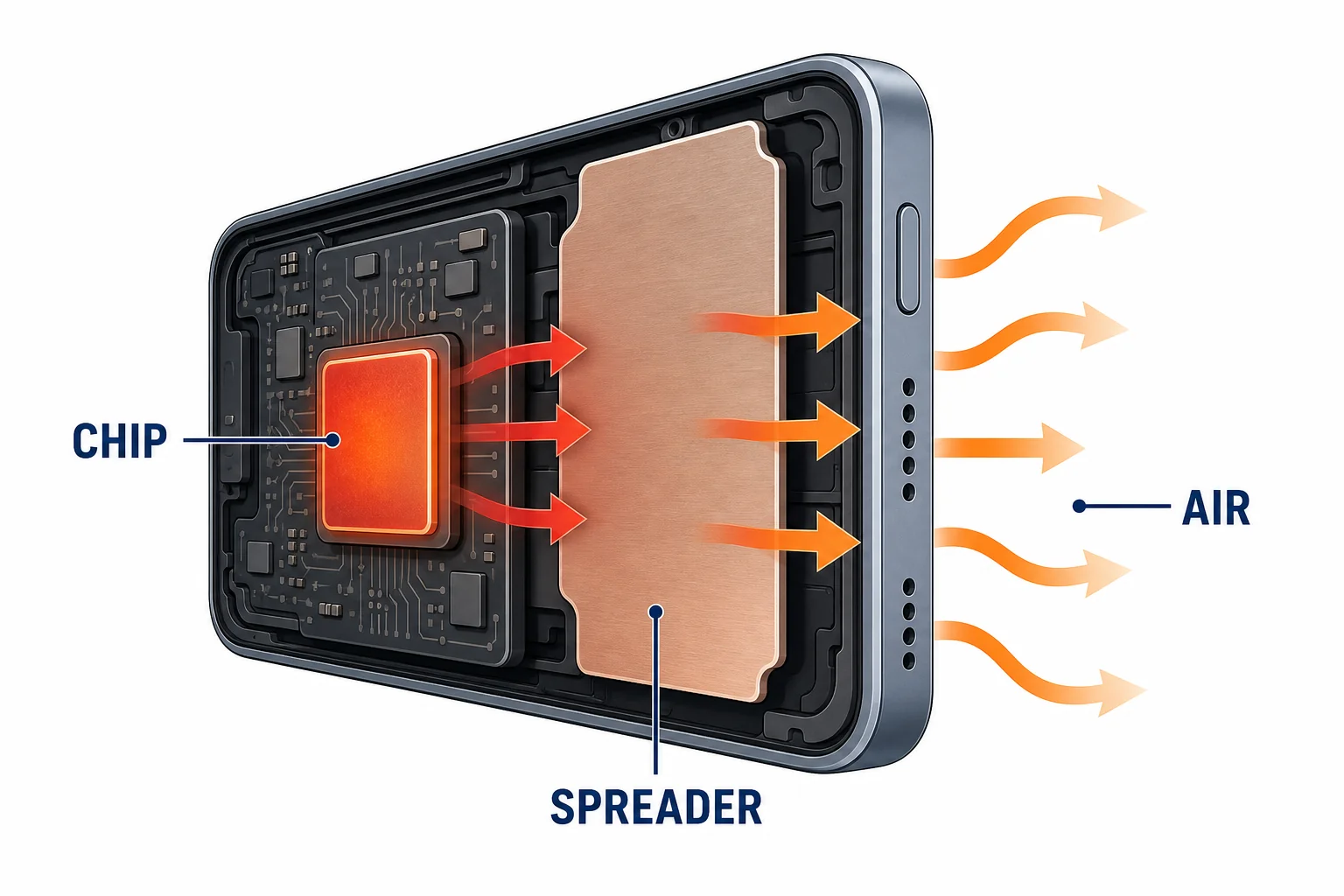
A phone cross section showing heat moving from the chip through a heat spreader to the frame and air
Heat spreads through the phone before leaving to the air
A phone has to move heat away from hot chips. Many phones use thin metal layers, graphite sheets, vapor chambers, or the phone frame to spread heat over a larger area. Spreading heat helps prevent one tiny spot from getting too hot. It also makes the outside of the phone feel warm over a wider area. Unlike a desktop gaming computer, most phones do not have a fan. They rely mostly on conduction, which moves heat through solid materials, and convection, which moves heat from the surface into the air. A thick case, a pillow, direct sun, or charging during play can make cooling harder. Charging adds its own heat because energy is moving into the battery. When the air around the phone is warm, heat leaves the phone more slowly. The same game can feel hotter on a summer day.

A warm case can mean the cooling path is doing its job.

Throttling protects the phone
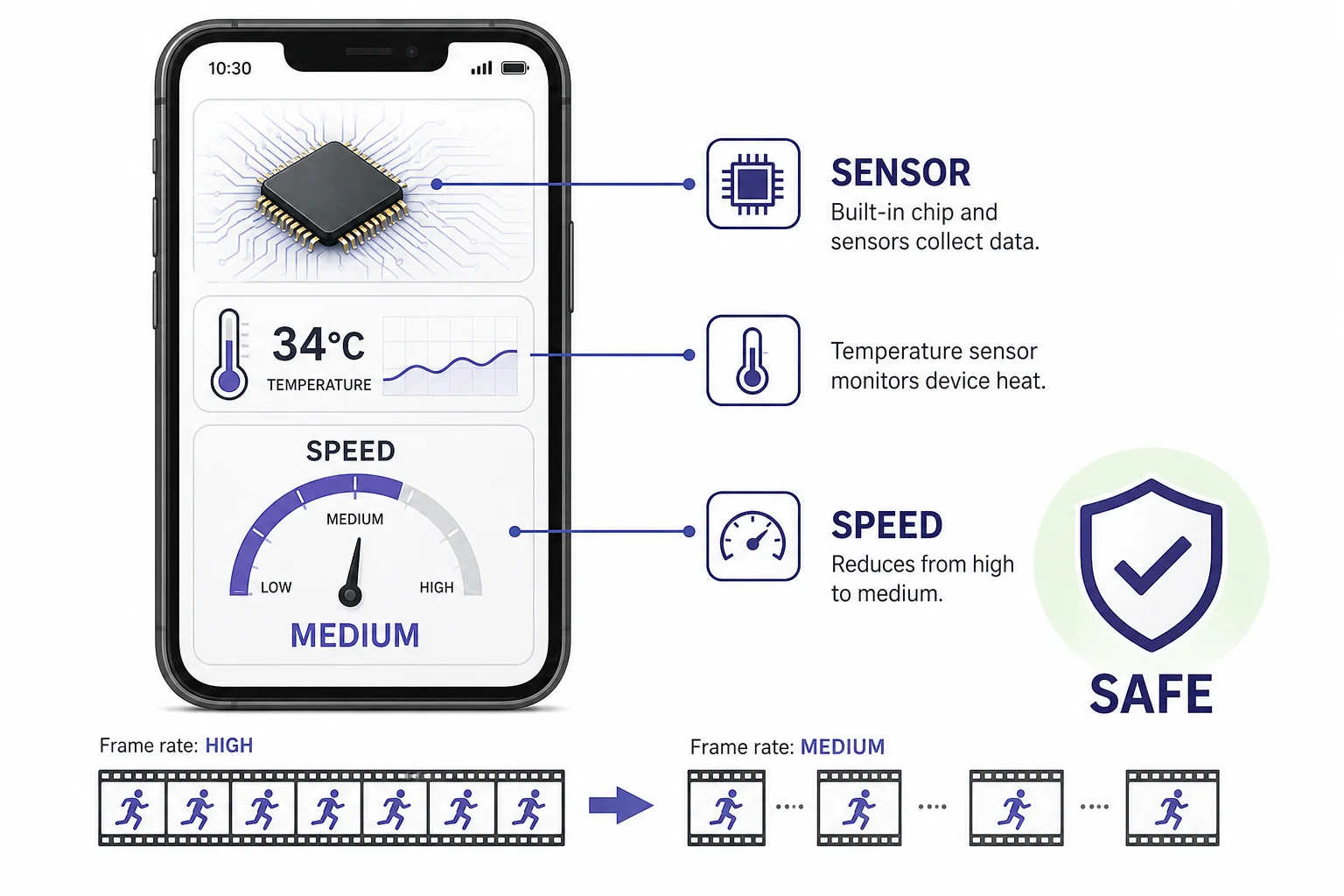
A temperature sensor inside a phone sending a signal that lowers chip speed and frame rate
Throttling slows the chips to keep temperatures in a safe range
Phones contain temperature sensors near important parts. The operating system watches those sensors while apps run. If the temperature rises too much, the phone can lower chip speed, limit the frame rate, dim the screen, pause charging, or close a task. This protective slowdown is called throttling. It can make a game stutter or feel less smooth. Throttling is not a random bug. It is a safety choice. Engineers design each chip and phone body with a heat budget. Thermal design power is a way to describe how much heat a design can handle during steady use. A phone can allow short bursts of high power, then slow down if the heat cannot leave fast enough. This is why a game may run very smoothly at first, then drop frames after several minutes.

Slowing down can protect the chips and battery.

Vocabulary

CPU
The main processor that runs instructions for game rules, touch input, and many system tasks.
GPU
A processor designed to draw images and handle many graphics calculations at the same time.
Transistor
A tiny electronic switch inside a chip that helps store and change digital information.
Frame rate
The number of complete pictures a device draws and shows each second.
Throttling
A protective slowdown that reduces speed or power when a device gets too warm.
Thermal design power
An estimate of how much heat a computer design is built to handle during normal heavy use.

In the Classroom

Frame rate tradeoff chart

20 minutes | Grades 6-8

Students compare 30, 60, and 120 frames per second using simple multiplication. They estimate how many frames a phone draws in 1 minute and discuss why more frames can use more battery.

Safe temperature investigation

25 minutes | Grades 6-8

Students observe how a phone or tablet feels before and after a graphics-heavy activity, without using apps that overheat devices. They record conditions such as brightness, case on or off, and charging status, then identify variables that affect heat.

Design a cooling path

30 minutes | Grades 6-8

Students sketch a phone cross section that moves heat from a chip to the outside air. They label conduction paths and explain why a thin device has less cooling space than a desktop computer.

Key Takeaways

  • Games use the CPU, GPU, screen, memory, and network more than many simple apps.
  • Transistor switching inside chips turns some battery energy into heat.
  • Higher frame rates and richer graphics usually need more electrical power.
  • Phones spread heat through thin materials because they usually have no fan.
  • Throttling slows the phone to keep parts and the battery in a safer temperature range.