Sign in to save

Bookmark this page so you can find it later.

Sign in to save

Bookmark this page so you can find it later.

Math middle-school May 21, 2026

Why Do Negative Numbers Make Sense?

Numbers below zero describe real opposites
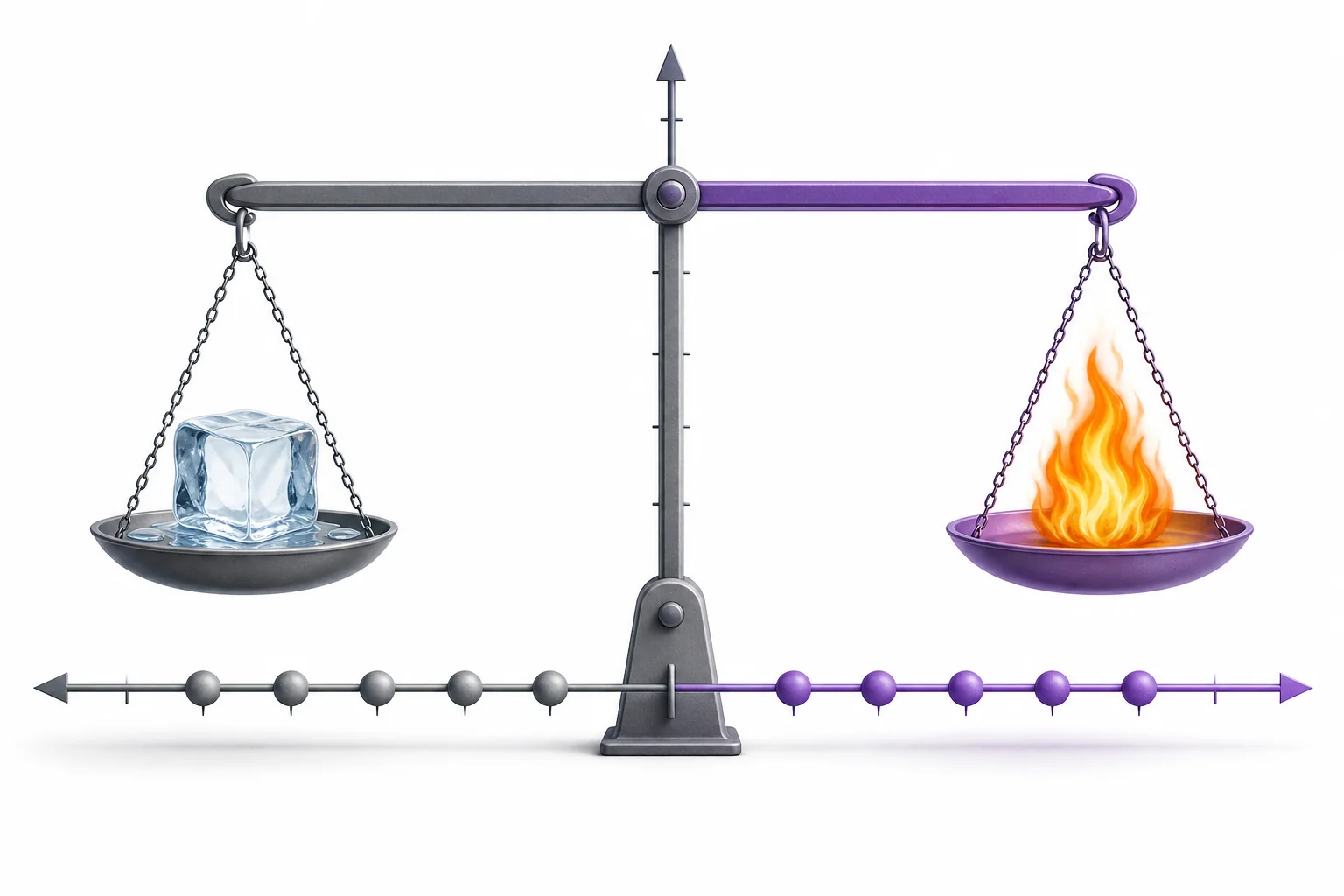
A number line centered at zero with positive numbers to the right, negative numbers to the left, and examples for temperature and money.

Negative numbers make sense because zero is not always the lowest possible amount. They describe values on the other side of zero, such as temperatures below freezing or money owed. On a number line, positive and negative numbers are opposites because they are the same distance from zero in different directions.

Big Idea. Common Core 6.NS.C.5 asks students to use positive and negative numbers to describe quantities in opposite directions from zero.

Negative numbers can feel strange at first because many early math examples count things you can hold. You can have 3 pencils, then 2 more, then 5 pencils. But life also has situations that move below zero. A winter temperature can drop below $0^\circ$C. A bank account can show that someone owes money. An elevator can travel below the ground floor. In each case, zero is a reference point, not an end. Negative numbers help us name positions, changes, and amounts on the other side of that reference point. The number line gives the idea a clear shape. Numbers to the right of zero are positive. Numbers to the left are negative. They follow the same spacing rules, which lets us compare them and calculate with them. Once negative numbers live on the number line, integer operations start to feel like movement instead of a trick.

Zero is a starting point
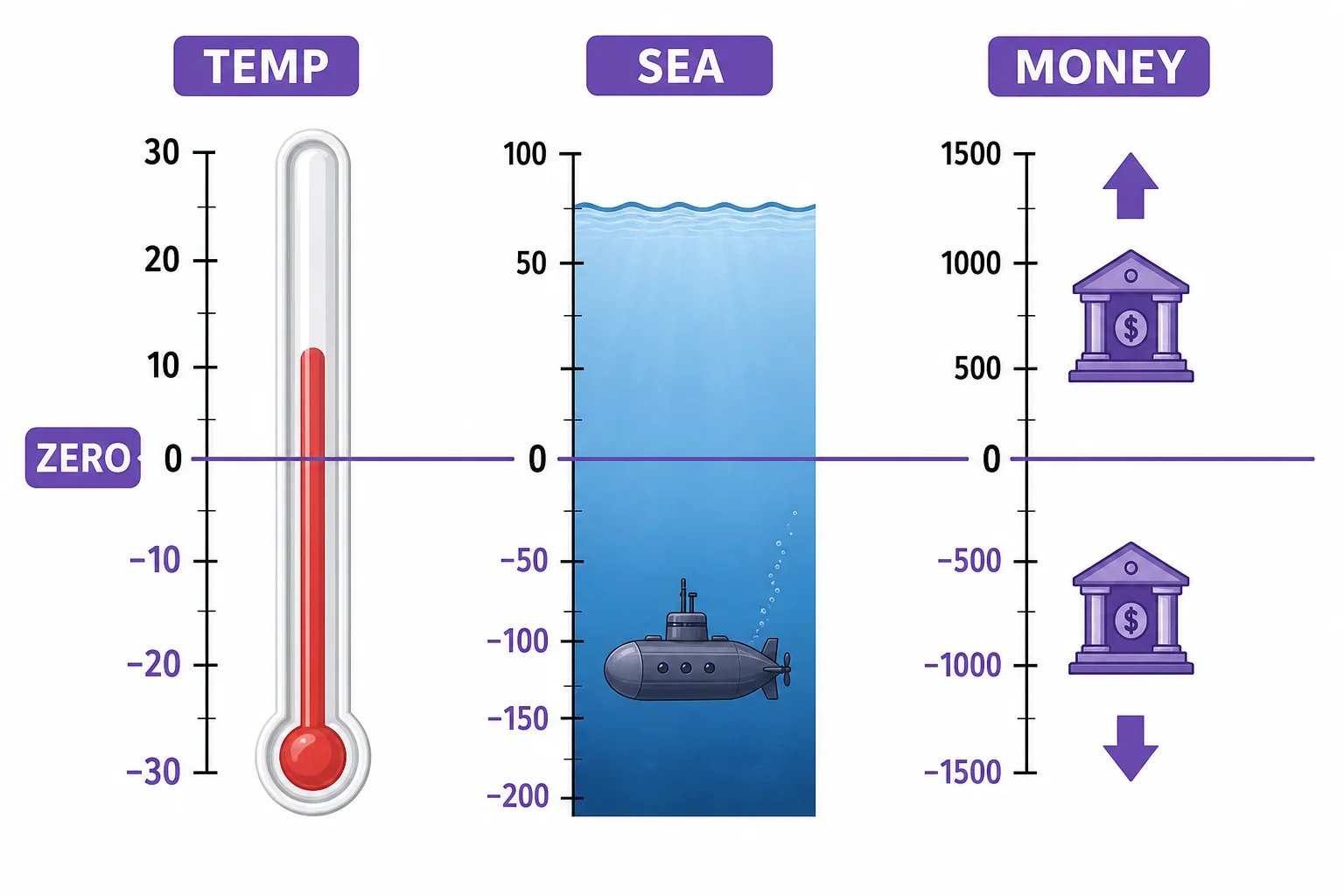
Three vertical scales show temperature, sea level, and money balance with values above and below zero.
Zero can mark a reference level
Zero often means none, but it can also mean a chosen starting point. On a thermometer, zero degrees Celsius is the freezing point of water. Air can still get colder, so the scale keeps going below zero. On a map, sea level can be called zero height. A submarine can be below sea level, while a mountain is above it. In money, a balance of zero means nothing is owed and nothing is available. A debt puts the balance below zero. These examples show the same structure. There is a reference level, then two opposite directions from it. Positive numbers measure one direction. Negative numbers measure the other. The meaning comes from the situation, not from the symbol alone. The minus sign tells you which side of the reference point the number belongs on.

A negative number means a value is on the opposite side of zero.

The number line gives negatives a home
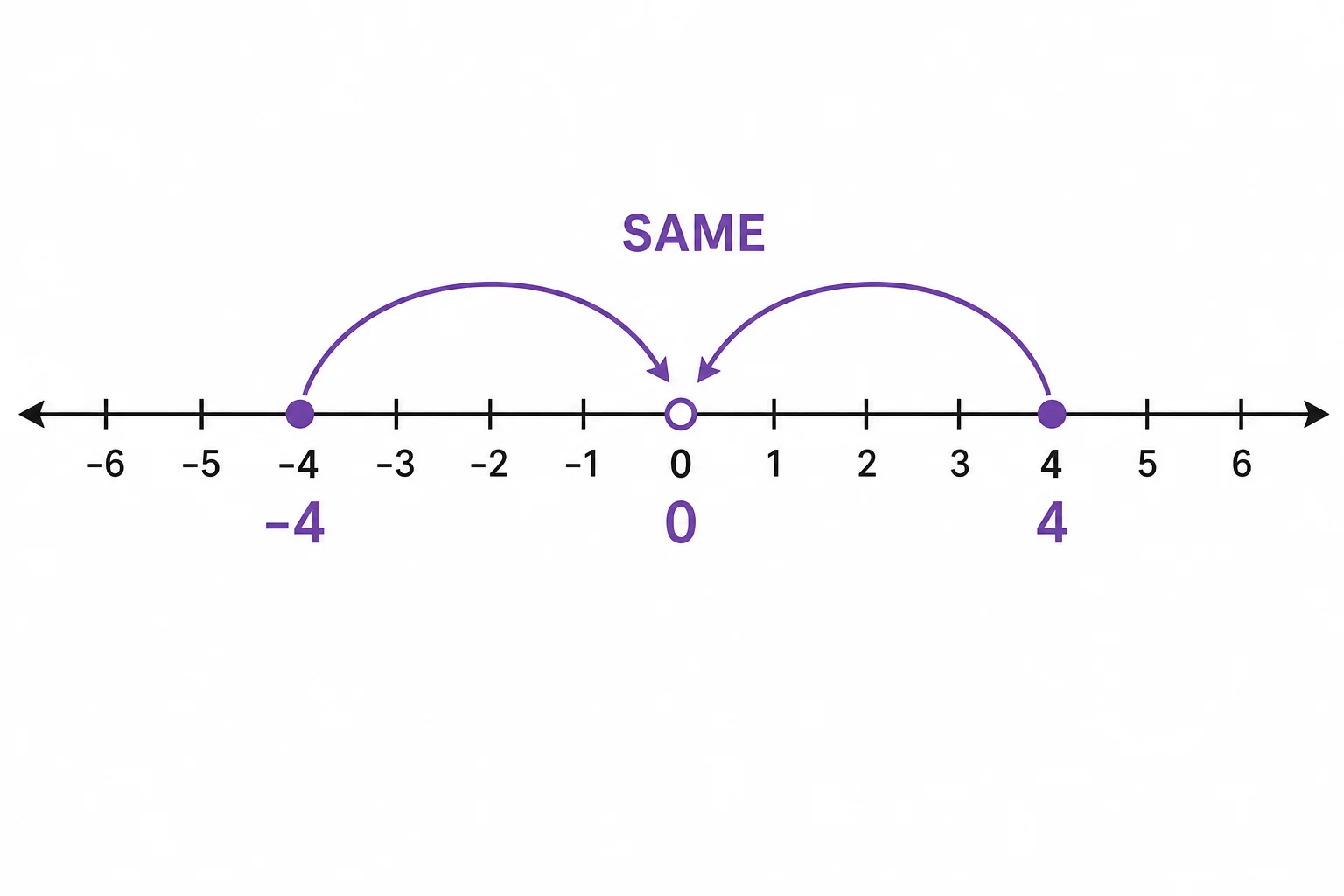
A horizontal number line from -6 to 6 shows -4 and 4 the same distance from zero in opposite directions.
Opposites are equal distances from zero
A number line turns negative numbers into positions you can see. Zero sits in the middle. Positive numbers go to the right, and negative numbers go to the left. The spacing stays even on both sides. That matters because distance from zero has meaning. The numbers 4 and -4 are both four units from zero, but they point in opposite directions. This is why they are called opposites. The same idea works for 7 and -7, or for $\frac{1}{2}$ and $-\frac{1}{2}$. The number line also helps with order. A number farther right is greater. So -2 is greater than -5 because -2 is closer to zero and sits to the right of -5. Negatives may look smaller because their symbols are longer, but their position decides their value.

On a number line, farther right always means greater.

Temperature makes the signs useful
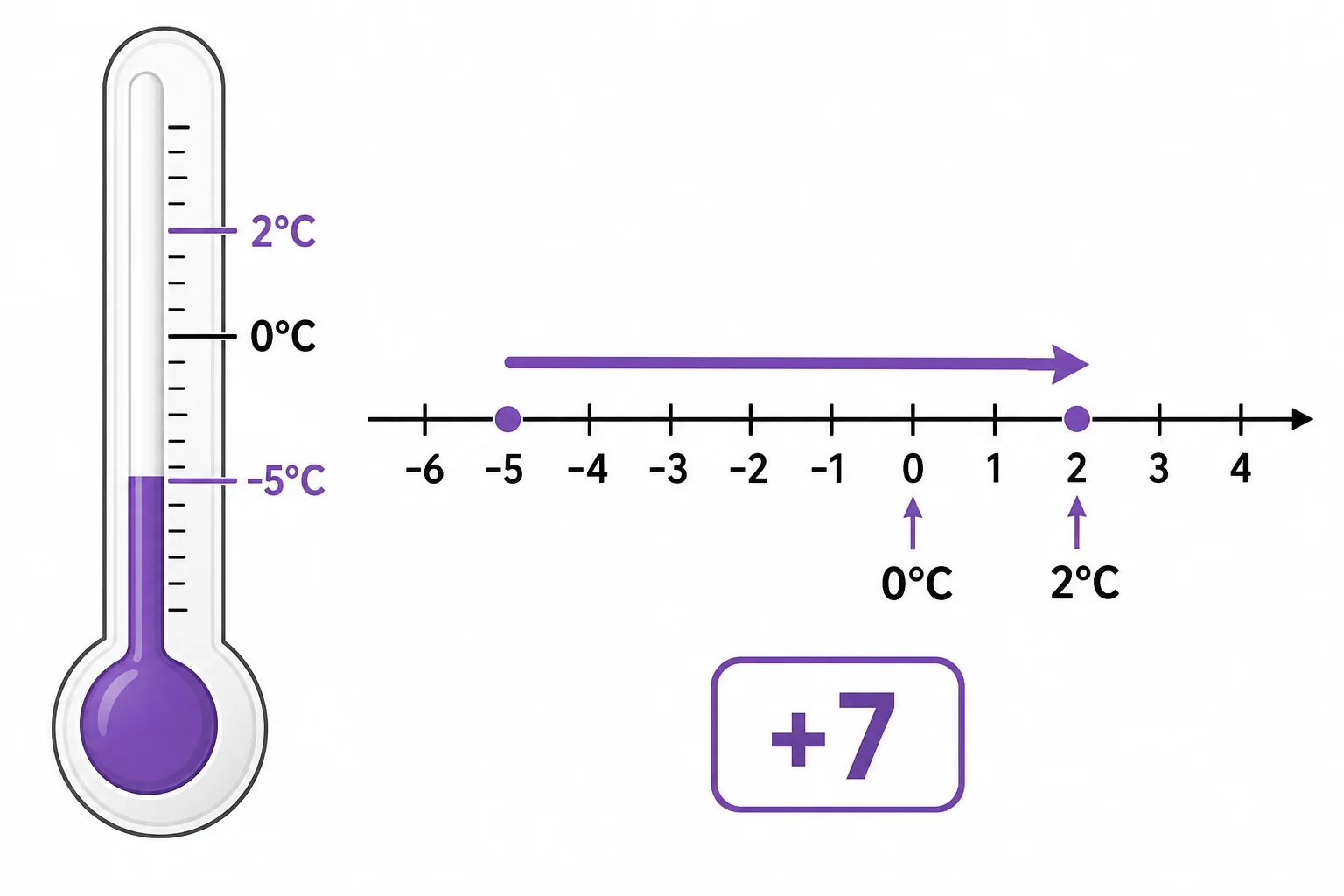
A thermometer and a matching number line show a temperature rising from -5 degrees Celsius to 2 degrees Celsius.
A rise from -5°C to 2°C is 7 degrees
Temperature is a strong example because the numbers describe a real scale that can cross zero. If the temperature is $3^\circ$C, the air is three degrees above the freezing point of water. If it is $-3^\circ$C, the air is three degrees below that point. The numbers have the same distance from zero, but they describe different conditions. A change in temperature is also easy to track. Moving from $-5^\circ$C to $2^\circ$C means the temperature rises 7 degrees. You count the steps on the number line from -5 up to 0, then from 0 up to 2. Moving from $4^\circ$C to $-1^\circ$C means the temperature falls 5 degrees. The sign tells direction, and the size tells how far from the reference point.

Temperature changes are distances moved along a scale.

Debt and credit are opposites
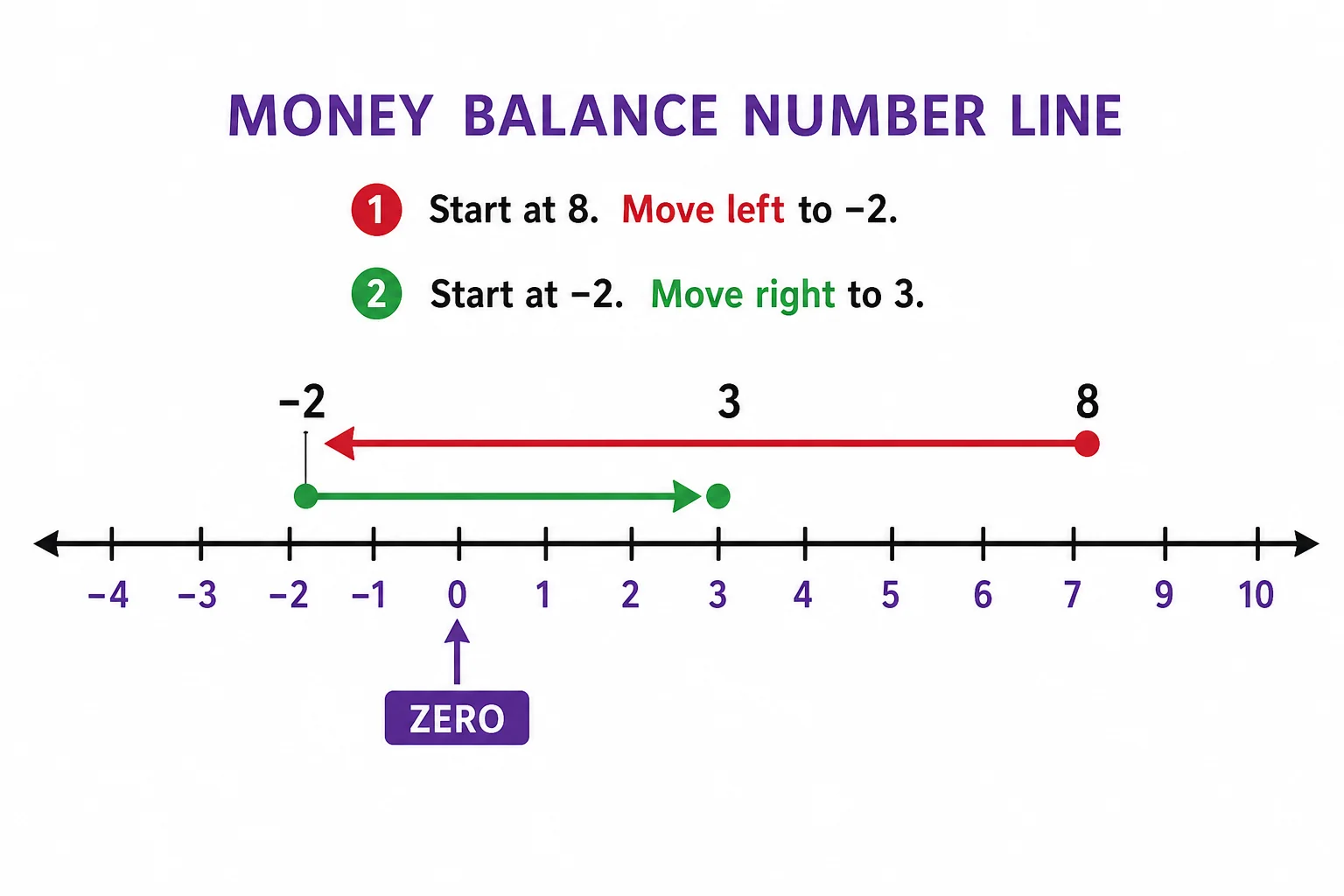
A money balance number line shows a starting balance of 8, a move left by 10 to -2, then a move right by 5 to 3.
Spending moves left, deposits move right
Money gives another clear meaning for negative numbers. Suppose a student has $8 in a lunch account. That can be written as +8, or just 8. If the student spends $10, the account does not stop at zero if the school allows borrowing. The balance becomes -2, which means $2 is owed. A deposit of $5 moves the balance up from -2 to 3. The account crosses zero because the debt is paid first, then $3 remains as credit. The number line can show each move. Spending moves left. Depositing moves right. This model also explains why adding a positive number to a negative balance can either reduce debt or create credit. The operation is not random. It follows movement along the line.

A negative balance is a real amount in the opposite direction from credit.

Operations are movements
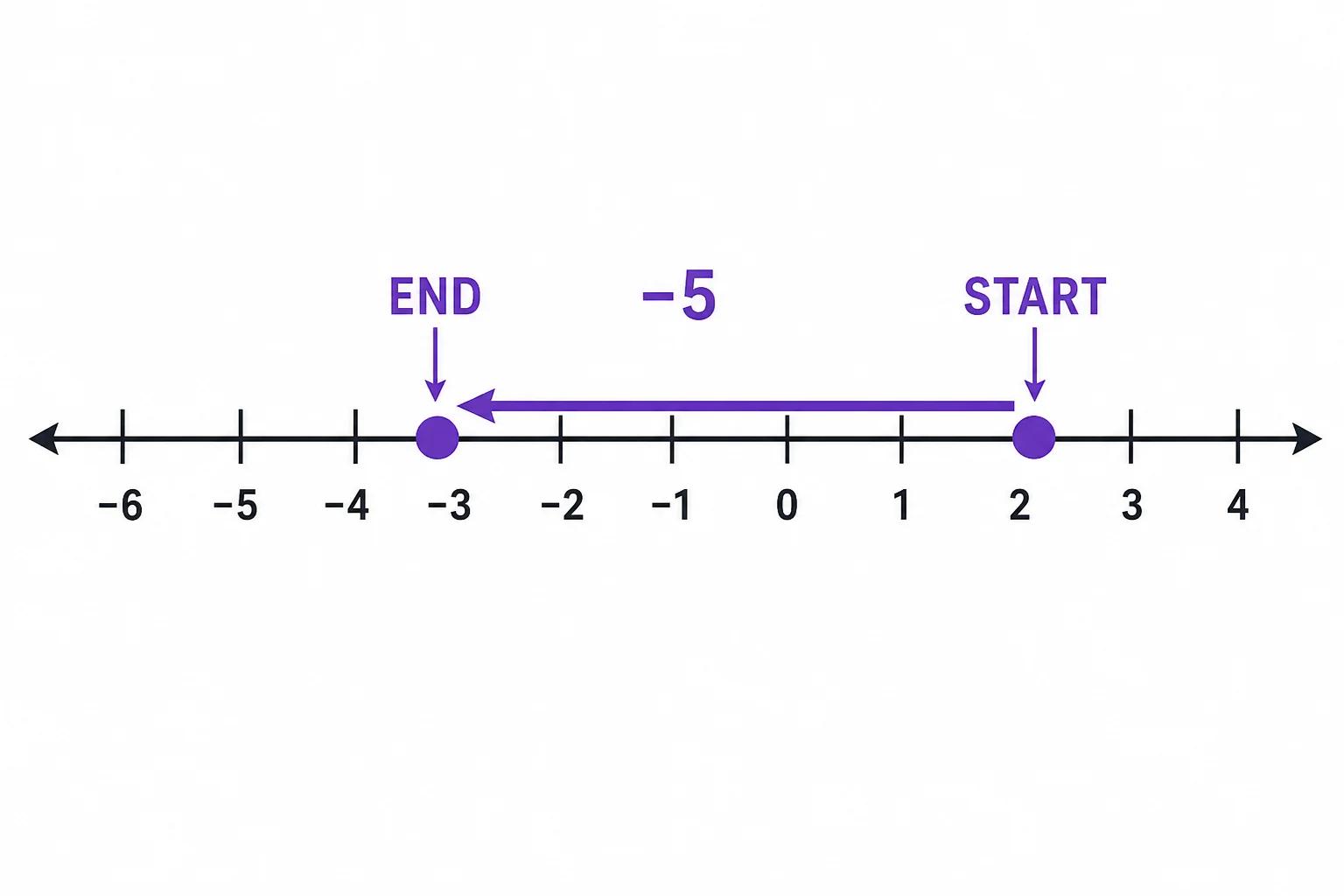
A number line shows addition of a negative number as a move left from 2 to -3.
Adding a negative moves left
Integer operations make more sense when they are treated as movements. Adding a positive number moves right. Adding a negative number moves left. For example, $2 + (-5)$ starts at 2 and moves 5 units left, landing at -3. Subtraction can be understood as finding the change between two positions. The expression $-1 - 4$ starts at -1 and moves 4 units left, landing at -5. Multiplication with negatives can be introduced as repeated movement. Three groups of -2 means moving left 2 units three times, so $3 \times (-2) = -6$. Later, students learn why a negative times a negative is positive. One way to see it is with patterns. As one factor decreases by 1, the products change by equal steps. The rules keep the number system consistent.

Integer rules describe consistent movement on the number line.

Vocabulary

Negative number
A number less than zero, placed to the left of zero on a number line.
Positive number
A number greater than zero, placed to the right of zero on a number line.
Integer
A whole number, its opposite, or zero, such as -3, 0, and 5.
Opposites
Two numbers the same distance from zero in different directions, such as 6 and -6.
Absolute value
The distance a number is from zero, without regard to direction.
Reference point
A chosen zero level used to describe values above and below it.

In the Classroom

Human number line

20 minutes | Grades 6-8

Tape a number line on the floor from -10 to 10. Students stand on starting values and move left or right to model integer addition and subtraction.

Temperature change cards

25 minutes | Grades 6-8

Give pairs of students starting temperatures and change cards, such as rise 6 degrees or drop 4 degrees. Students calculate final temperatures and explain each move using a number line.

Balance story problems

30 minutes | Grades 6-8

Students write short account balance stories using deposits, spending, credit, and debt. They trade stories with a partner and solve them with integer equations.

Key Takeaways

  • Negative numbers describe values below or opposite a chosen zero point.
  • The number line shows positive and negative numbers as positions.
  • Opposite numbers are the same distance from zero in different directions.
  • Temperature, elevation, and money balances all use negative numbers naturally.
  • Integer operations can be understood as movements left and right on a number line.