Sign in to save

Bookmark this page so you can find it later.

Sign in to save

Bookmark this page so you can find it later.

Math middle-school May 21, 2026

Why Is Pi Everywhere in Circles?

The constant hiding in every round shape
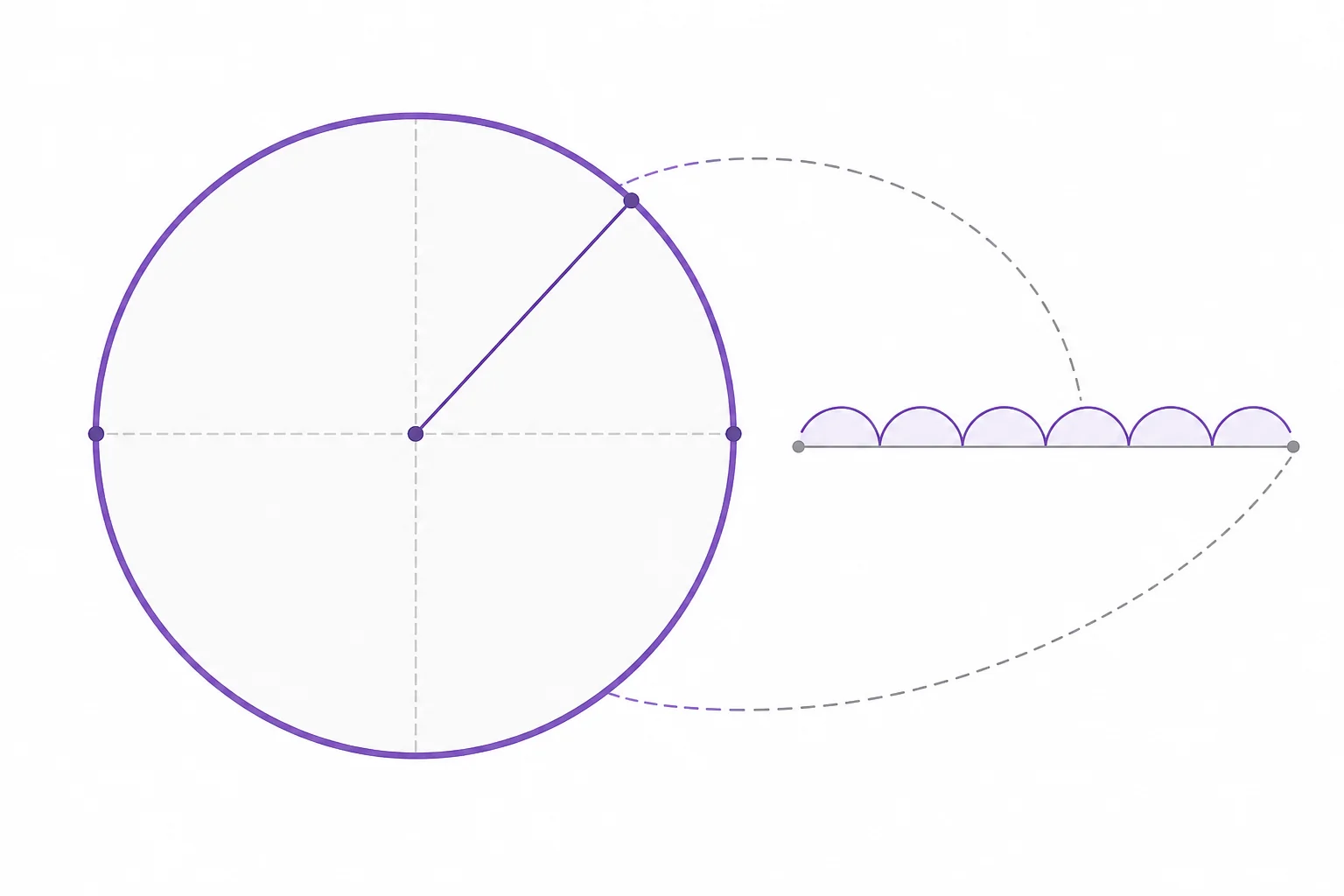
Several circles of different sizes with matching diameter and circumference measurements that show the same pi relationship.

Pi is the same number for every circle because the distance around a circle divided by the distance across it always gives the same value. That value is a little more than 3, so the circumference is a little more than three diameters. Pi also appears in circle area because a circle can be rearranged into a shape that is close to a rectangle.

Big Idea. Common Core 7.G.B.4 connects pi to circle circumference and area formulas that students can use to solve real problems.

A circle can be tiny like a button or huge like a Ferris wheel, but one number keeps showing up. Measure the distance around the circle. Then measure the distance straight across its center. Divide the first measurement by the second. You will get a number close to 3.14 every time. That number is pi, written as π. It is not a trick from a textbook. It comes from the shape itself. Circles are scaled copies of each other, so their around and across measurements grow in the same way. Pi also appears when we find area. The formula $A=\\pi r^2$ tells us how much flat space is inside the circle. The formula $C=\\pi d$ tells us how far it is around. This article uses measurement, cutting, and reasoning to show why one number belongs to every circle.

Around compared with across
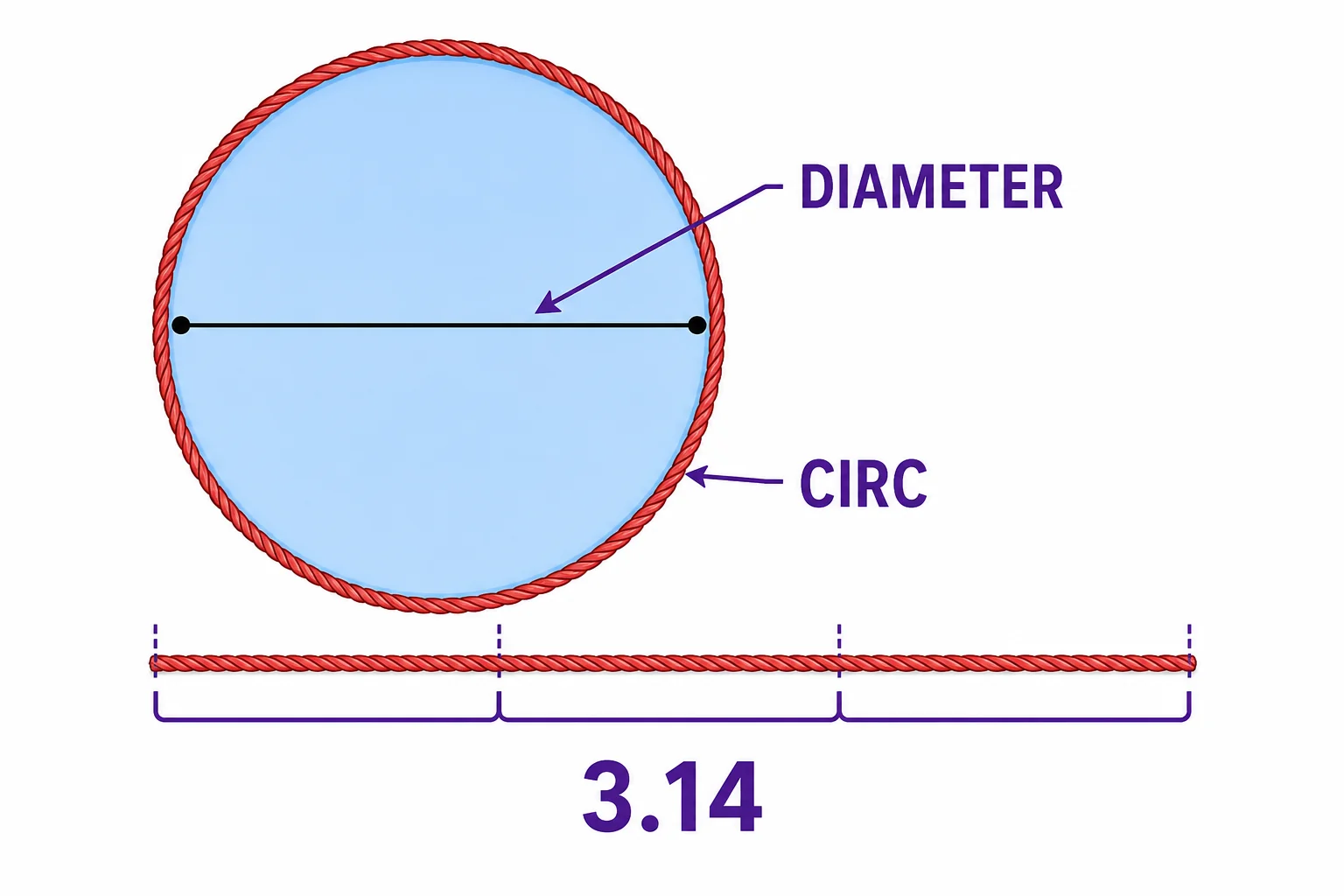
A circle with its diameter and a straightened circumference string shown side by side to compare the two lengths.
Pi compares the distance around with the distance across.
Start with a circle and mark its diameter. The diameter is the straight distance across the center. Now imagine wrapping a string once around the outside edge. When the string is straightened, it shows the circumference. If the diameter is 10 centimeters, the string will be about 31.4 centimeters long. If the diameter is 2 centimeters, the string will be about 6.28 centimeters long. The second circle is smaller, but the comparison stays the same. The circumference is always about 3.14 times the diameter. That comparison is what pi means. In symbols, $\\pi=\\frac{C}{d}$. This works for all circles because every circle has the same shape, only scaled larger or smaller. Scaling stretches every length by the same factor. It does not change the ratio between matching lengths.

Pi is the circumference divided by the diameter.

Different sizes, same ratio
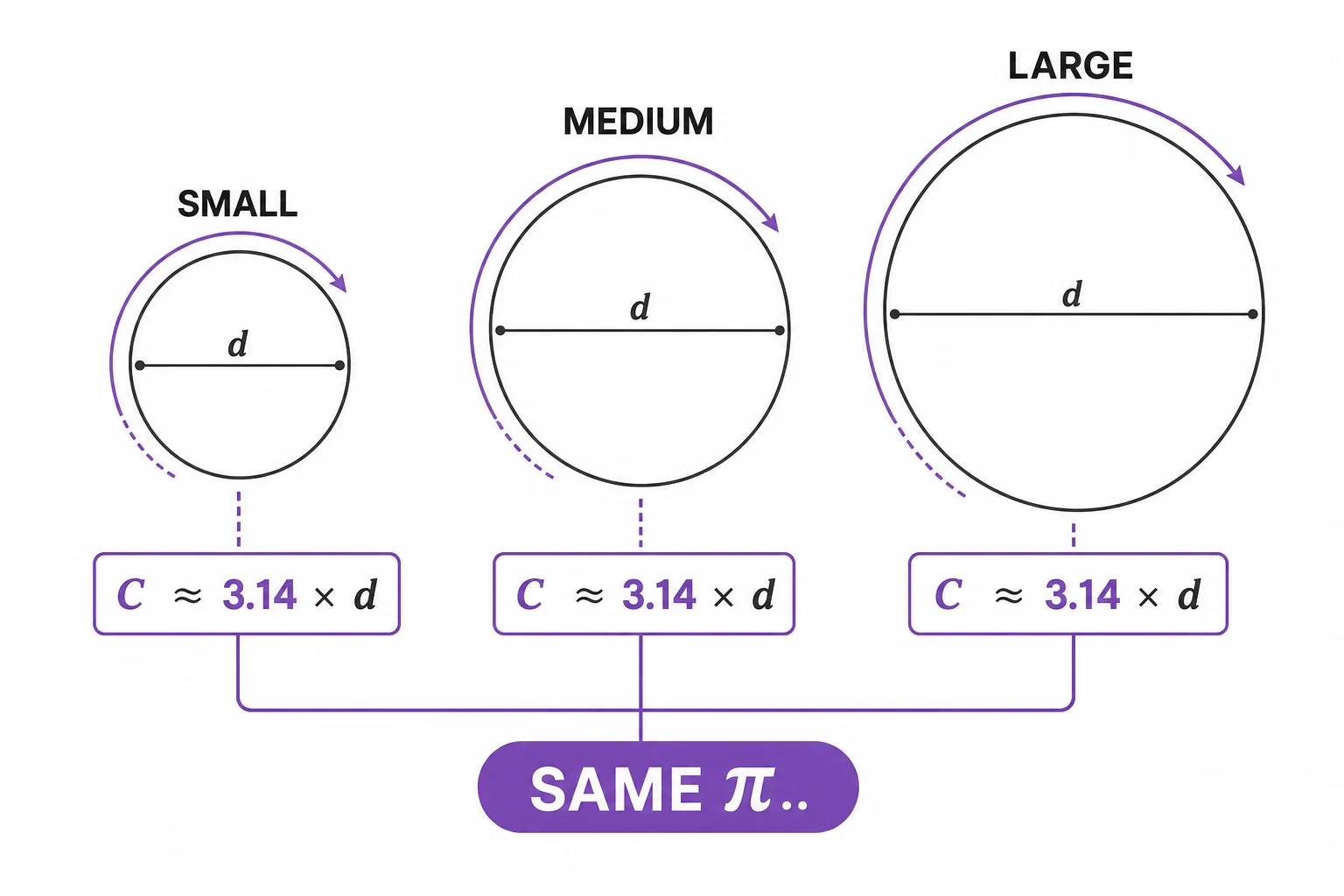
Three circles of different sizes with diameter and circumference values that all give a ratio near 3.14.
Changing size does not change pi.
To test pi, draw several circles with different diameters. A compass works well, but cups, lids, and tape rolls also make good circles. Measure each diameter through the center. Then use string or a flexible measuring tape to measure each circumference. The numbers will not be perfect because real measuring has small errors. Even so, the circumference divided by the diameter should land near 3.14. This is a key idea in proportional reasoning. When a circle doubles in diameter, its circumference also doubles. When the diameter is cut in half, the circumference is cut in half. The ratio stays constant. Pi is not tied to one circle. It is the constant of proportionality between diameter and circumference for all circles. That is why the same formula works for a coin, a pizza, and a planet drawn to scale.

All circles are scaled versions of the same basic shape.

Why area uses pi too
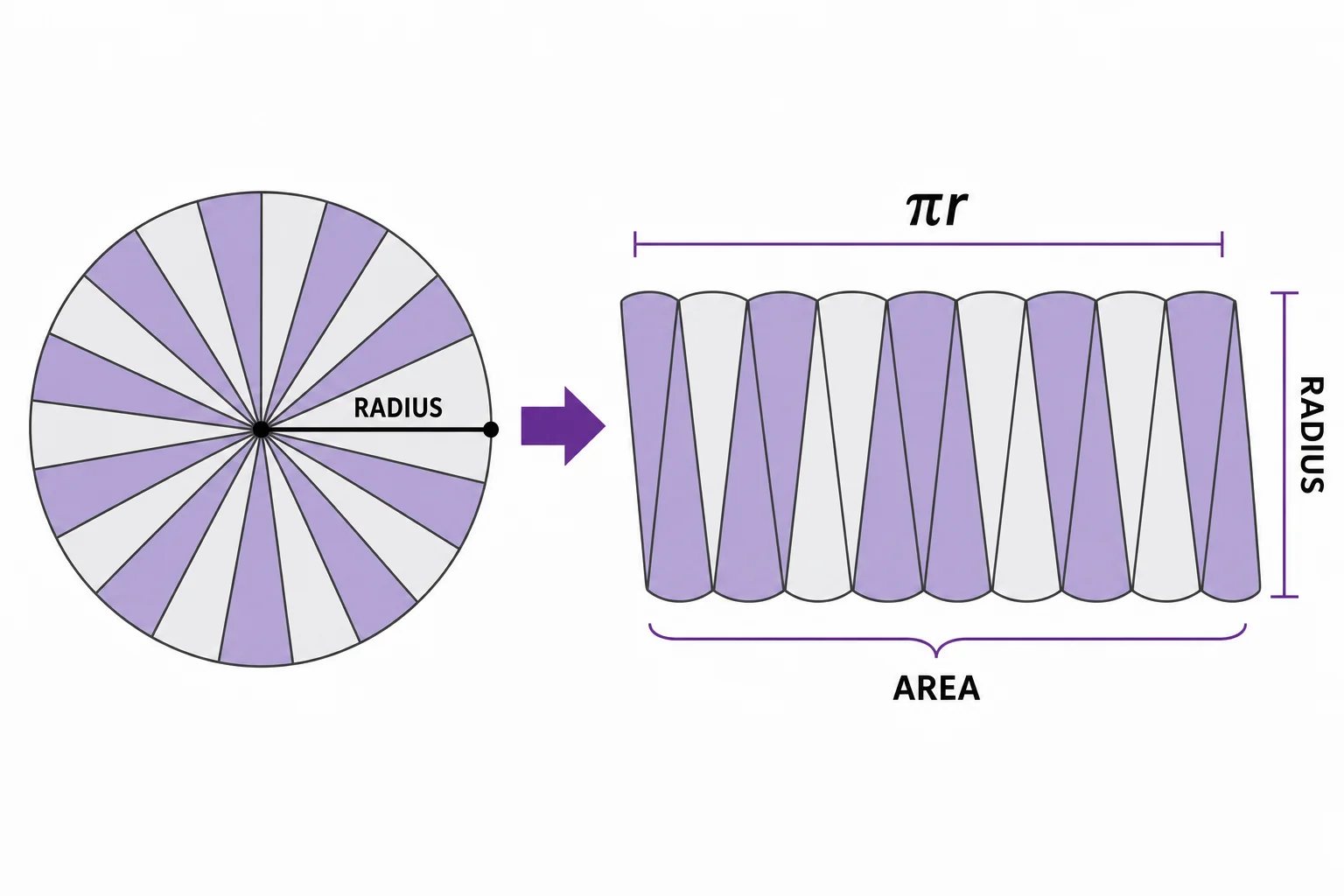
A circle cut into wedges and rearranged into a near rectangle with radius height and half circumference base.
Circle wedges can explain $A=\\pi r^2$.
Pi also appears in the area formula because area depends on the circle's radius. The radius is half the diameter. Picture cutting a circle into many equal wedges, like very thin pizza slices. Arrange the wedges by alternating them up and down. The new shape looks more and more like a rectangle as the wedges get thinner. Its height is the radius. Its long base is about half the circumference, since the curved edges from the top and bottom together make the full outside edge of the circle. Half of $C=2\\pi r$ is $\\pi r$. So the area is close to $\\pi r$ times $r$, which is $\\pi r^2$. With more and thinner wedges, the rearranged shape gets closer to a true rectangle. This gives a geometric reason for the area formula.

The area formula comes from rearranging the circle, not memorizing alone.

Pi never ends neatly
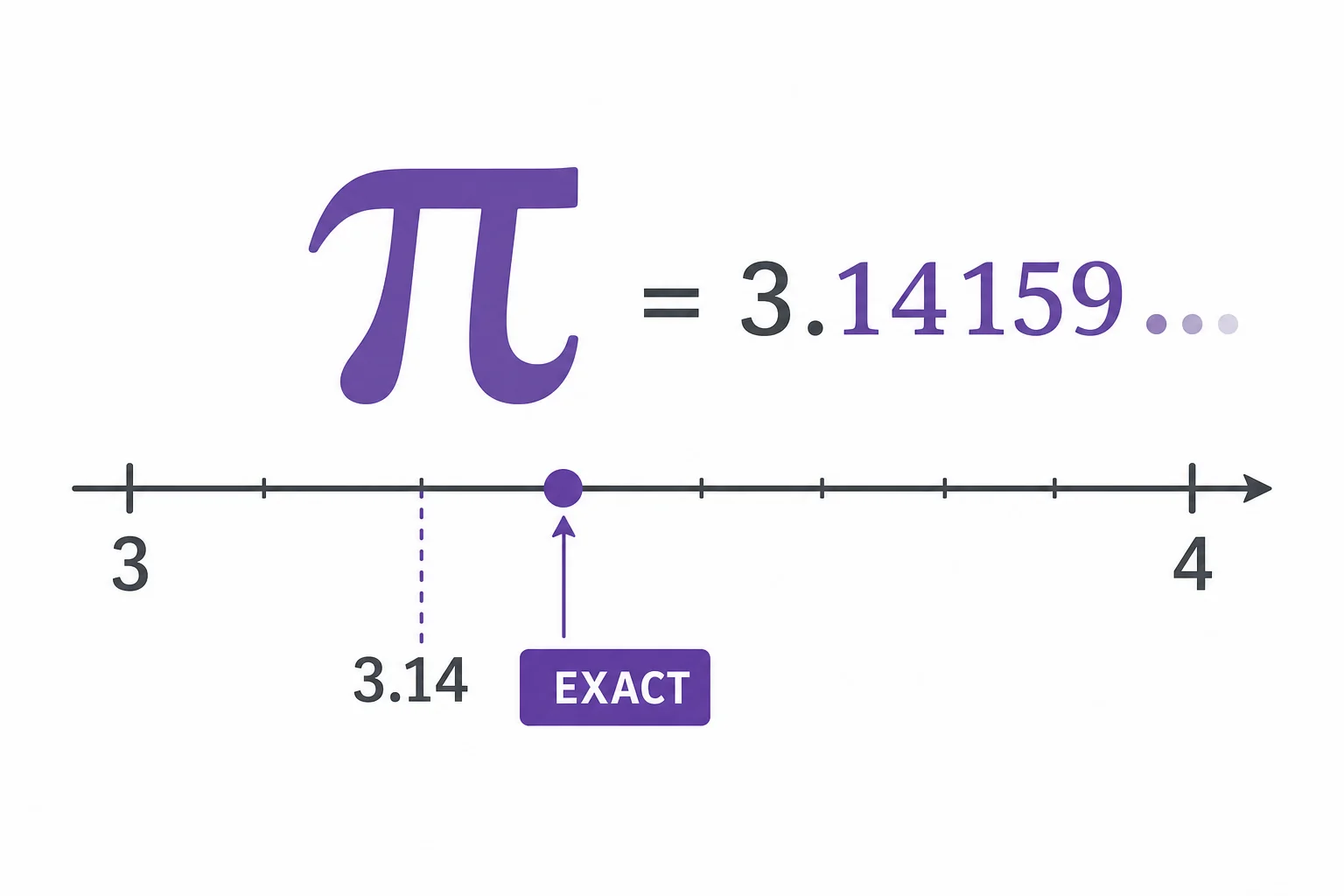
A number line and a stream of pi digits showing that 3.14 is only an approximation of pi.
3.14 is close, but π is exact.
Pi is not exactly 3.14. That is only a useful decimal estimate. Pi is an irrational number, which means it cannot be written exactly as a fraction of two whole numbers. Its decimal digits continue forever without repeating in a pattern. This can feel strange because circle measurements seem so physical. You can hold a lid and measure it with a ruler. The exact ratio hiding in that lid is still not a terminating or repeating decimal. In school problems, we often use 3.14 or $\\frac{22}{7}$ as an estimate. Those values are close enough for many calculations. For exact work, mathematicians keep the symbol π. Using the symbol means the exact value is still there, even if we do not write every digit. Pi connects simple measuring to a deeper idea about numbers.

Approximations are useful, but the symbol π means the exact value.

Using pi in real problems
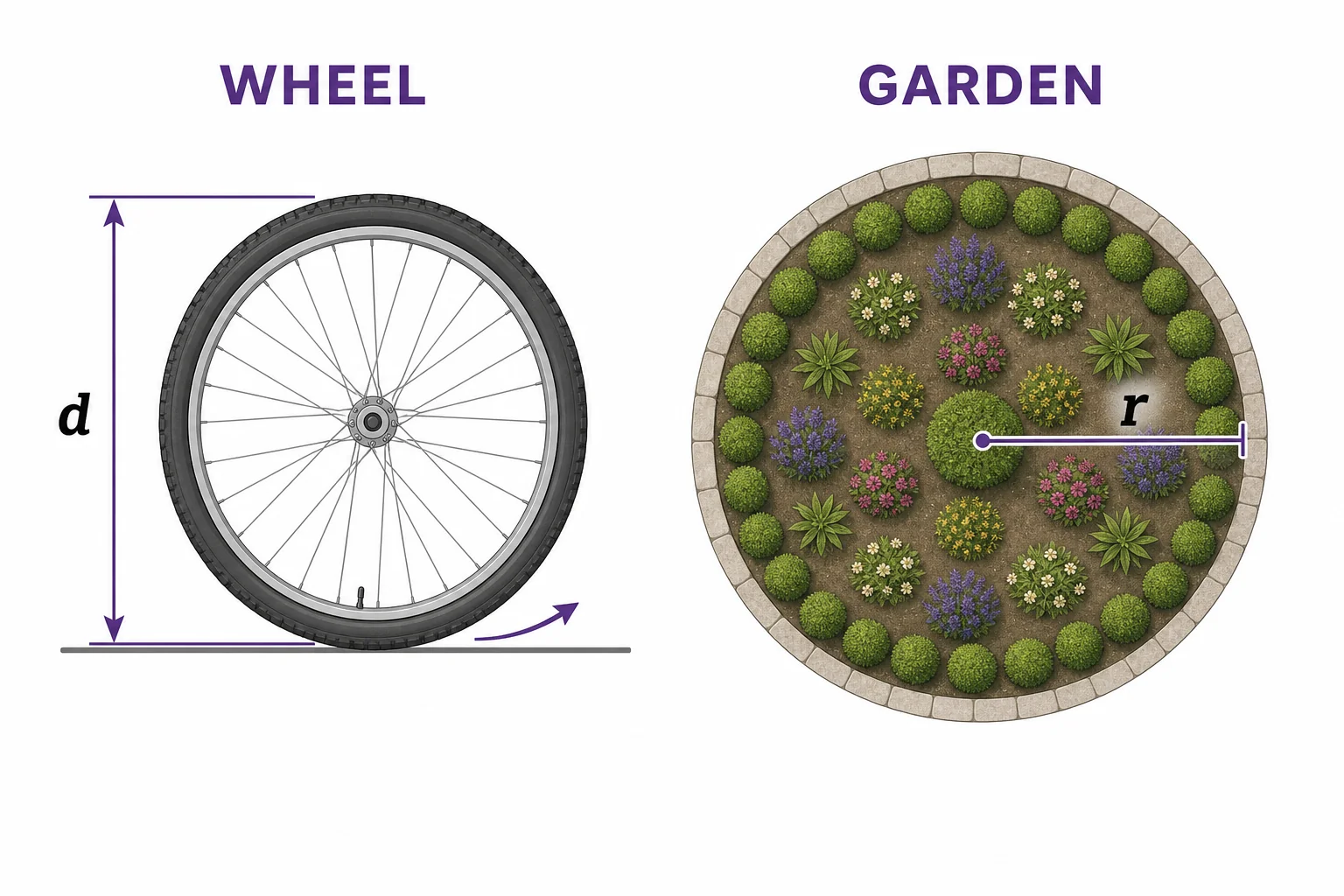
A bicycle wheel and a round garden showing how circumference and area formulas use pi in real settings.
Pi helps solve real circle problems.
Pi becomes useful when circle measurements are missing. If a bike wheel has a diameter of 70 centimeters, one full turn moves the bike about $70\\pi$ centimeters forward. That is about 220 centimeters using 3.14. If a round garden has a radius of 4 meters, its area is $16\\pi$ square meters, or about 50.2 square meters. These are not separate tricks. They both come from the same circle structure. Circumference measures distance around. Area measures space inside. Diameter and radius are linked because the diameter is twice the radius. In Common Core 7.G.B.4, students use these relationships to solve problems with circles. The goal is not only to plug numbers into formulas. It is to understand why the formulas match the shape.

Pi links circle formulas to measurements you can use.

Vocabulary

Pi
The constant ratio of a circle's circumference to its diameter, written as π.
Circumference
The distance around a circle.
Diameter
A straight line distance across a circle through its center.
Radius
The distance from the center of a circle to any point on the circle.
Irrational number
A number that cannot be written exactly as a fraction of two whole numbers.
Area
The amount of flat space inside a two dimensional shape.

In the Classroom

Measure pi around the room

25 minutes | Grades 6-8

Students measure the circumference and diameter of several circular objects, then calculate $C\\div d$. They compare results and discuss why measurement error makes the values close to, but not exactly, 3.14.

Cut and rearrange a circle

30 minutes | Grades 7-8

Students cut a paper circle into 12 or 16 wedges and rearrange them into a near rectangle. They identify the rectangle's height as the radius and its base as about half the circumference.

Circle formula challenge

20 minutes | Grades 6-8

Students solve short problems involving wheels, plates, gardens, or clocks. They must explain whether circumference or area is needed before choosing a formula.

Key Takeaways

  • Pi is the ratio of circumference to diameter for every circle.
  • The circumference formula is $C=\\pi d$ or $C=2\\pi r$.
  • The area formula $A=\\pi r^2$ can be explained by rearranging circle wedges.
  • Pi is irrational, so 3.14 is an approximation, not the exact value.
  • Common Core 7.G.B.4 uses pi to connect circle formulas with real measurements.