Garden Area & Perimeter Lab
Design your own garden plots on a square grid. Count unit squares to find the area, trace the boundary to find the perimeter, and discover how two shapes with the same area can have very different perimeters.
Guided ExperimentExploring Area and Perimeter on a Grid
If two garden shapes have the same area (24 square units), do you think they will always have the same perimeter? Make a prediction before you start designing.
Write your hypothesis in the Lab Report panel, then click Next.
Controls
Click cells to fill or unfill them. Design your garden shape, then record it in the data table.
Data Table
(0 rows)| # | Garden Shape | Length | Width | Area (sq units) | Perimeter (units) | Notes |
|---|
Reference Guide
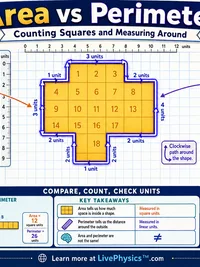
Area - Counting Unit Squares
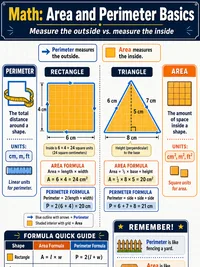
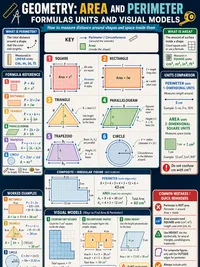
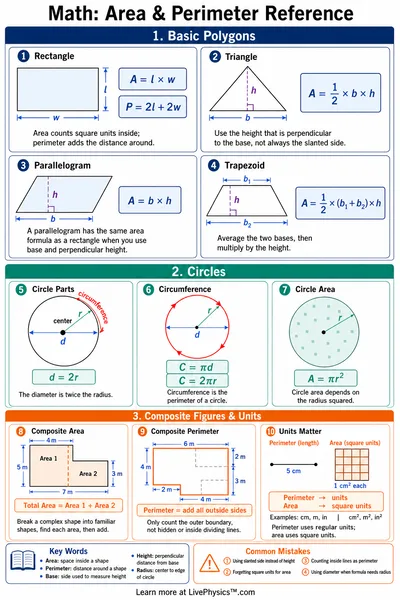
Area is the number of square units that fit inside a shape.
For rectangles, Area = length × width
For irregular shapes, count each filled square on the grid.
Area is measured in square units (sq cm, sq in, sq ft, etc.).
Perimeter - Counting Boundary Edges
Perimeter is the total length around the outside of a shape. For a rectangle
For a 4 × 6 rectangle, P = 2 × (4 + 6) = 2 × 10 = 20 units
For grid shapes, count each exposed outer edge of the filled cells.
Perimeter is measured in units (cm, in, ft, etc.), not square units.
Same Area, Different Perimeter
Two shapes can have the same area but different perimeters. Compare these two rectangles with area = 12
- 3 × 4 rectangle, P = 2 × (3 + 4) = 14 units
- 2 × 6 rectangle, P = 2 × (2 + 6) = 16 units
- 1 × 12 rectangle, P = 2 × (1 + 12) = 26 units
A square has the smallest perimeter for a given area.
Real-World Connection
Understanding area and perimeter matters in real life
- Fencing a garden depends on perimeter - the length of fence you need.
- Planting seeds depends on area - how many seeds fit in the space.
- A square garden uses less fence than a long thin garden of the same planting area.
Farmers and gardeners think about both when designing plots!