Area & Perimeter Design Challenge
Build fenced gardens on a grid and discover the surprising relationship between perimeter and area. Given a fixed fence length, can you find the shape that encloses the most space? Given a fixed garden size, can you use the least fencing?
Guided ExperimentFixed Fence Length
For a fixed perimeter (fence length), which rectangle shape do you think will enclose the most area?
Write your hypothesis in the Lab Report panel, then click Next.
Controls
You have exactly 16 units of fence. Build a garden that encloses the most area.
Hint Try a 4x4 square. Does any other shape do better?
Current area 16 sq units (best 16)
Grid
each cell = 1 unitMeasurements
Area
16
sq units
Perimeter
16
units
Shape Analysis
Constraint
Fixed perimeter 16 units of fence
Goal maximize area
Optimal 4 × 4 = 16 sq units
Data Table
(1 row)| # | Challenge | Width(units) | Height(units) | Area(sq units) | Perimeter(units) | Optimal? | |
|---|---|---|---|---|---|---|---|
| 1 |
Reference Guide
Area vs Perimeter
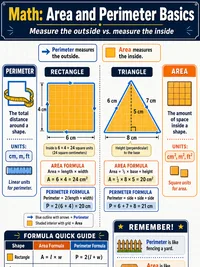
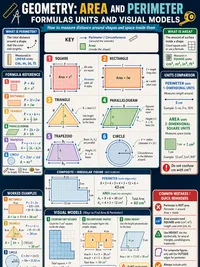
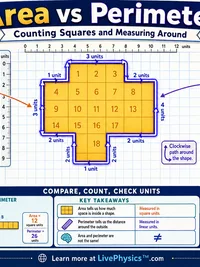
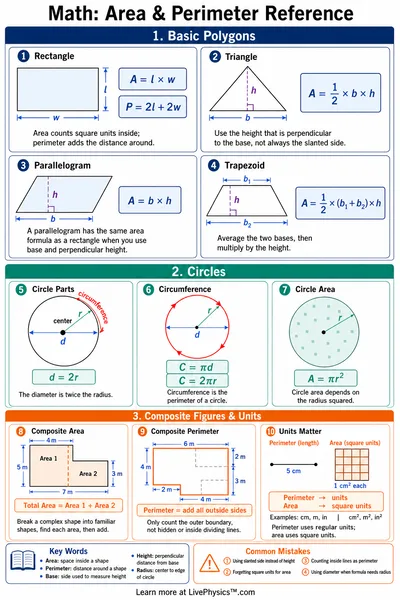
Area measures the space inside a shape (square units). Perimeter measures the total length of the boundary (units).
These two measures are related but independent. You can change one without the other staying the same.
Rectangles and Squares
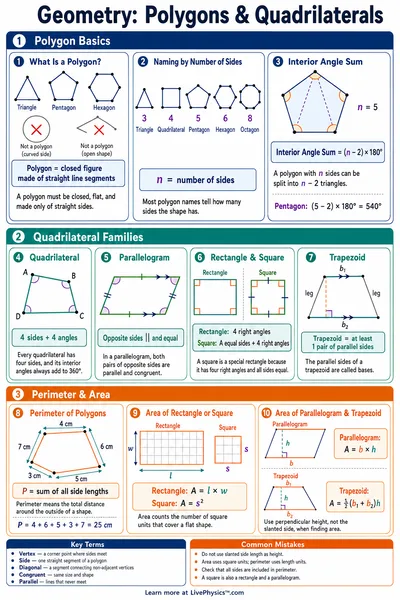
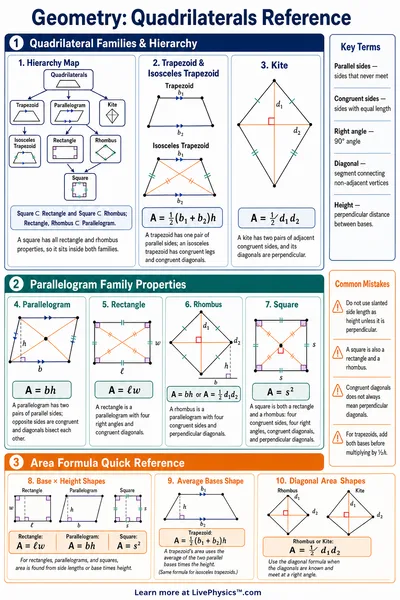
For a rectangle with a fixed perimeter P, the area is maximized when width equals height. This is a square.
Similarly, for a fixed area A, the perimeter is minimized by a square with side length equal to the square root of A.
Real-World Applications
Farmers and gardeners use this principle when deciding how to fence a plot. A square field gives the most growing area for a given length of fencing.
Architects apply the same idea when designing floor plans. Rooms that are close to square use less wall material for the same floor area.
Nature also follows this pattern. Cells, soap bubbles, and honeycombs all tend toward shapes that minimize surface area relative to volume.