Sign in to save

Bookmark this page so you can find it later.

Sign in to save

Bookmark this page so you can find it later.

Physics high-school May 21, 2026

Why Do Skaters Spin Faster When They Pull In Their Arms?

A spin speeds up when mass moves inward
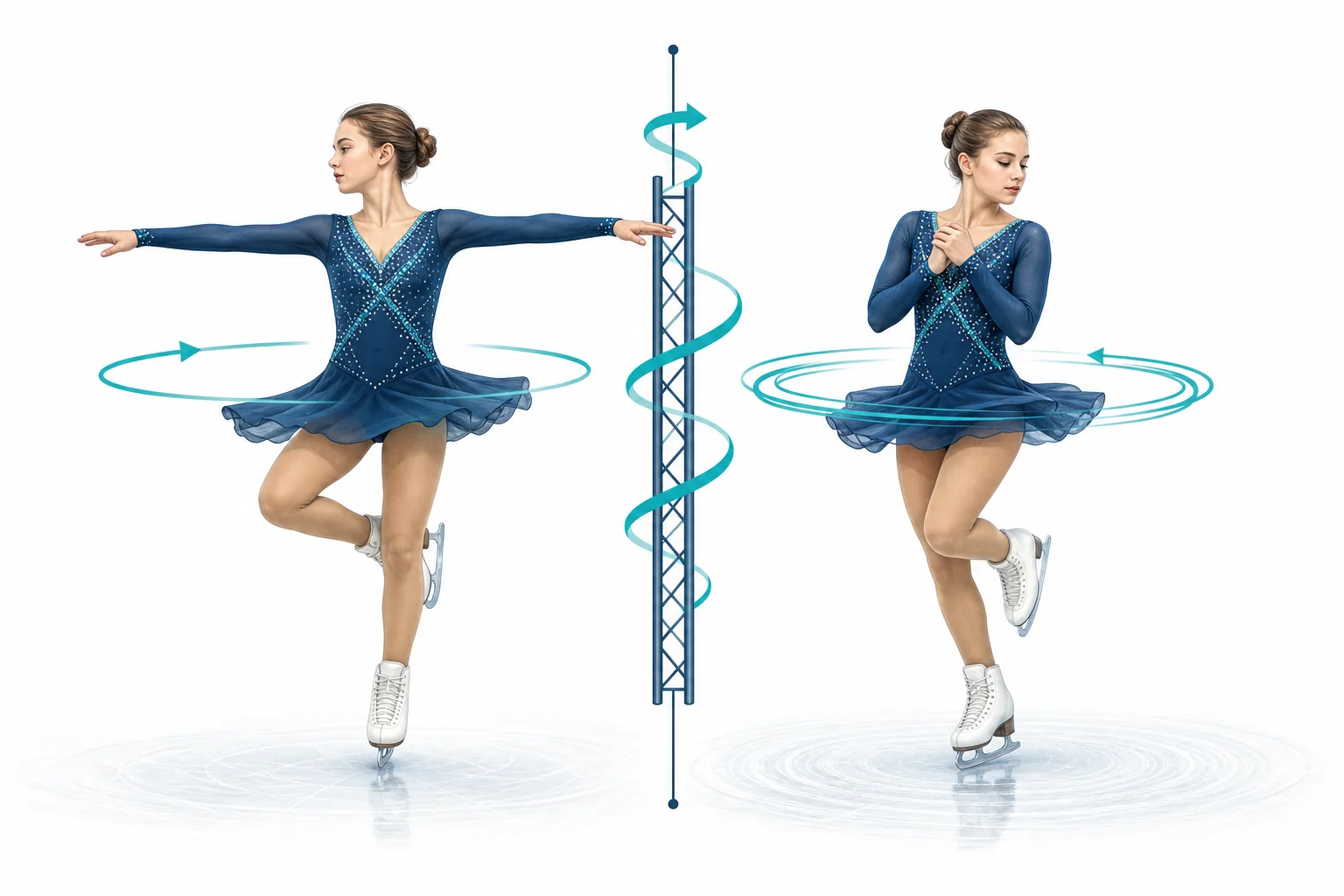
A skater shown in two positions, first spinning with arms extended and then spinning with arms pulled in, to compare rotational motion

A skater spins faster when they pull in their arms because their body becomes easier to turn. The amount of spin they already have stays nearly the same because the ice gives very little twisting push. To keep that spin amount the same, their body turns more times each second.

Big Idea. NGSS HS-PS2-2 connects changes in motion to forces, and a skater's spin shows how rotation changes when mass moves closer to the axis.

A figure skater can begin a spin with arms stretched out, then suddenly pull both arms close to the chest. The motion changes right away. The skater turns faster even though no motor starts pushing them. This is not a trick of balance. It is a clear example of a rule for rotating objects. When very little outside twisting force acts on a spinning skater, the skater keeps nearly the same angular momentum. That amount depends on two things. It depends on how fast the skater spins, and on how far the skater's mass is spread from the spin axis. Pulling the arms inward moves some mass closer to the axis. The body has a smaller moment of inertia, so the spin rate increases. The simple model is $L = I\omega$. If $L$ stays nearly constant and $I$ gets smaller, $\omega$ must get larger.

The skater keeps spin
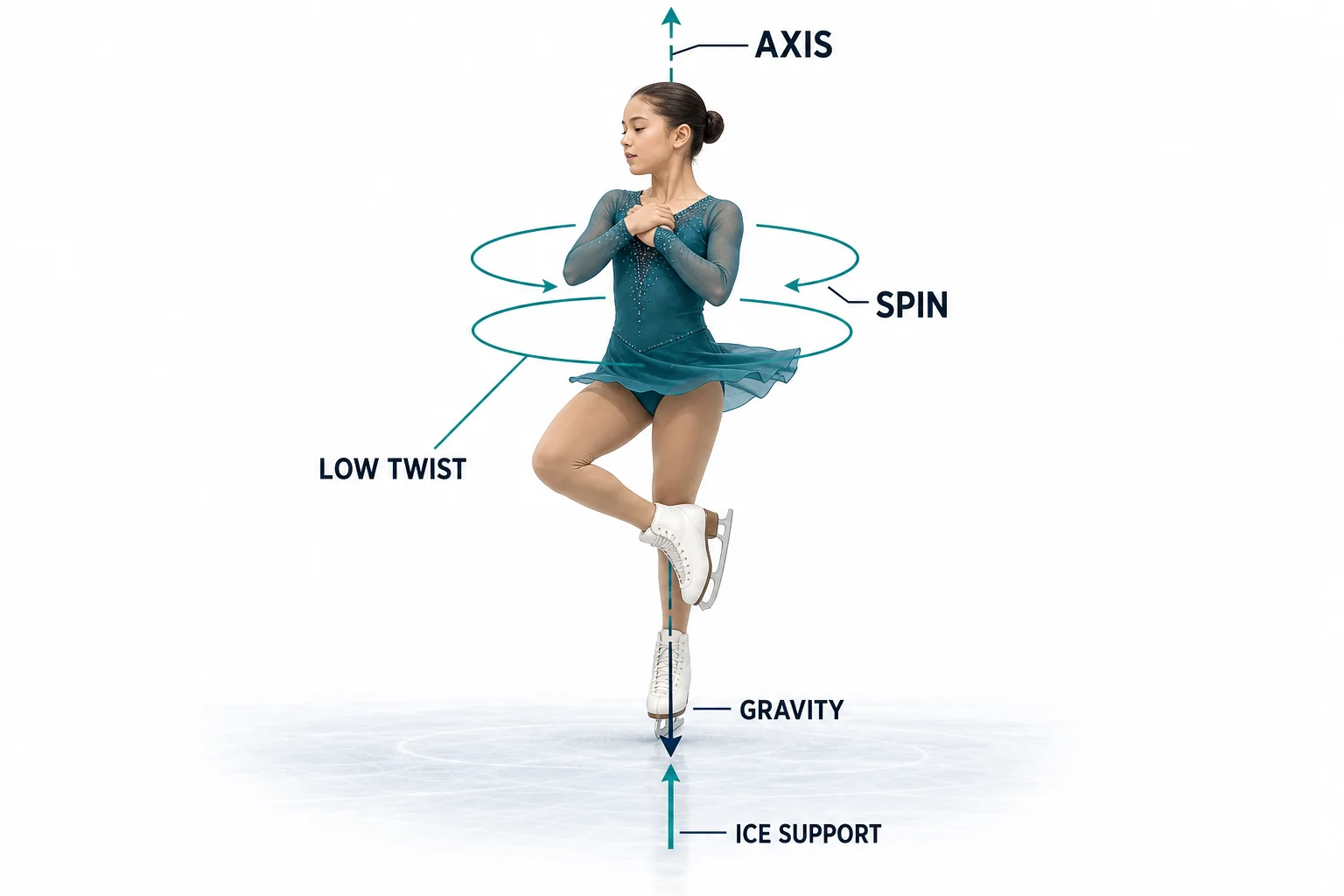
A skater viewed from the side and top with arrows showing rotation around a vertical axis and small outside twisting force
With little outside twist, angular momentum stays nearly constant.
A spinning skater has angular momentum. This is the rotation version of momentum. It describes how much spin an object has. For a skater on smooth ice, outside twisting forces are small. The skate blade touches the ice, but friction is low. Gravity pulls downward, and the ice pushes upward. Those forces mostly balance and do not twist the skater much around the vertical axis. That means the skater's angular momentum stays nearly constant during the quick arm motion. The skater is not creating spin from nothing. They are changing how the same spin is shared between body shape and spin rate. The useful equation is $L = I\omega$. Here $L$ is angular momentum, $I$ is moment of inertia, and $\omega$ is angular speed. During the arm pull, $L$ is almost unchanged.

The skater does not need a new push to spin faster.

Arms change the turn
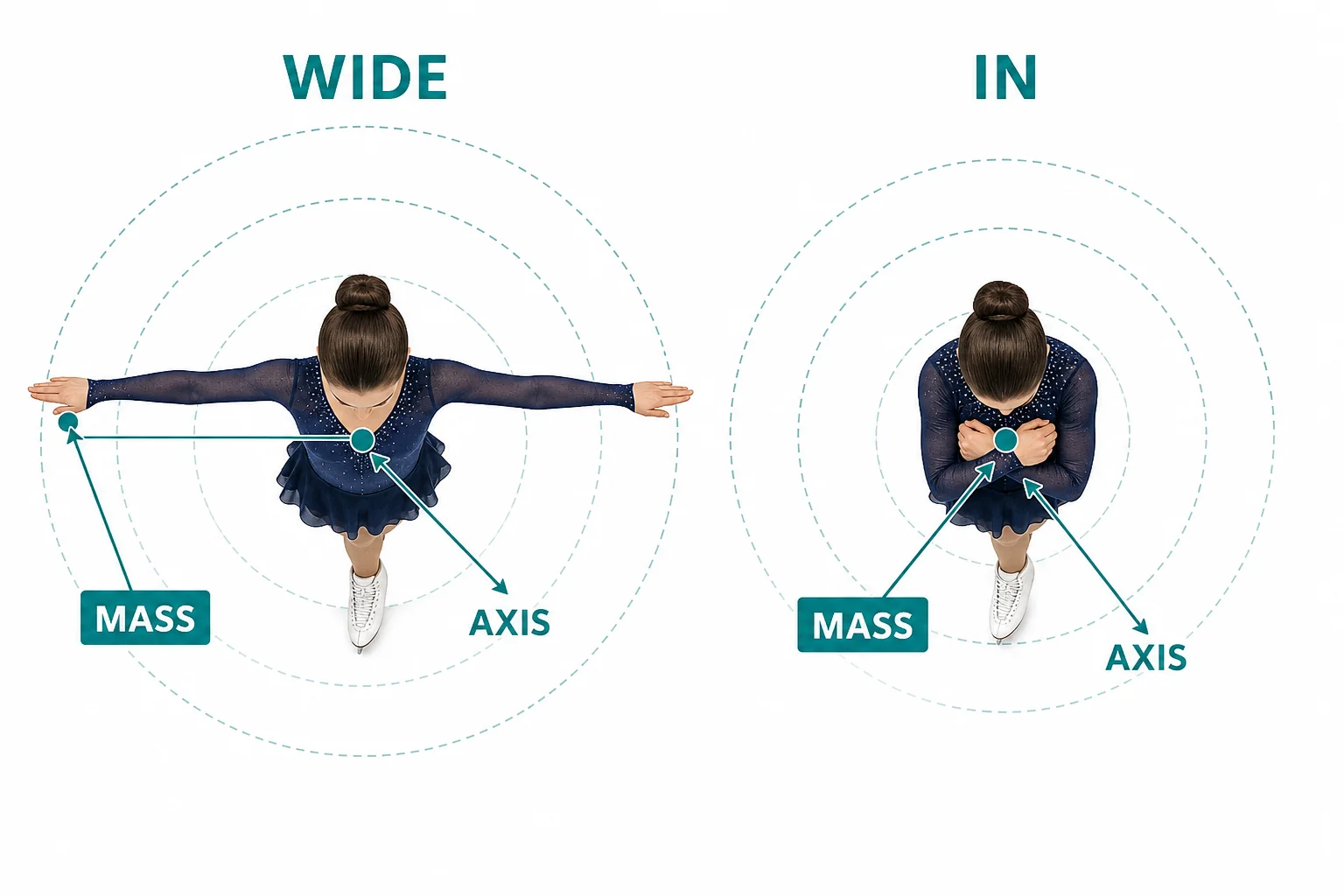
Top view of a skater with arms extended compared with arms pulled in, showing mass farther from and closer to the rotation axis
Mass farther from the axis gives a larger moment of inertia.
Moment of inertia measures how hard it is to change an object's rotation. It depends on mass and where that mass is located. Mass far from the rotation axis matters more than mass near the axis. A skater's arms are not most of the body, but they can be far from the spin axis when extended. That gives them a strong effect on moment of inertia. When the arms move inward, the same arm mass is closer to the axis. The moment of inertia decreases. This is why a long wrench is easier to twist than a short knob, and why a heavy door is harder to swing when more mass is far from the hinge. For a spinning skater, pulling in arms changes the body's mass distribution. The skater becomes easier to rotate, so the same angular momentum produces a faster spin.

Moving mass inward makes the body easier to spin.

The equation balances
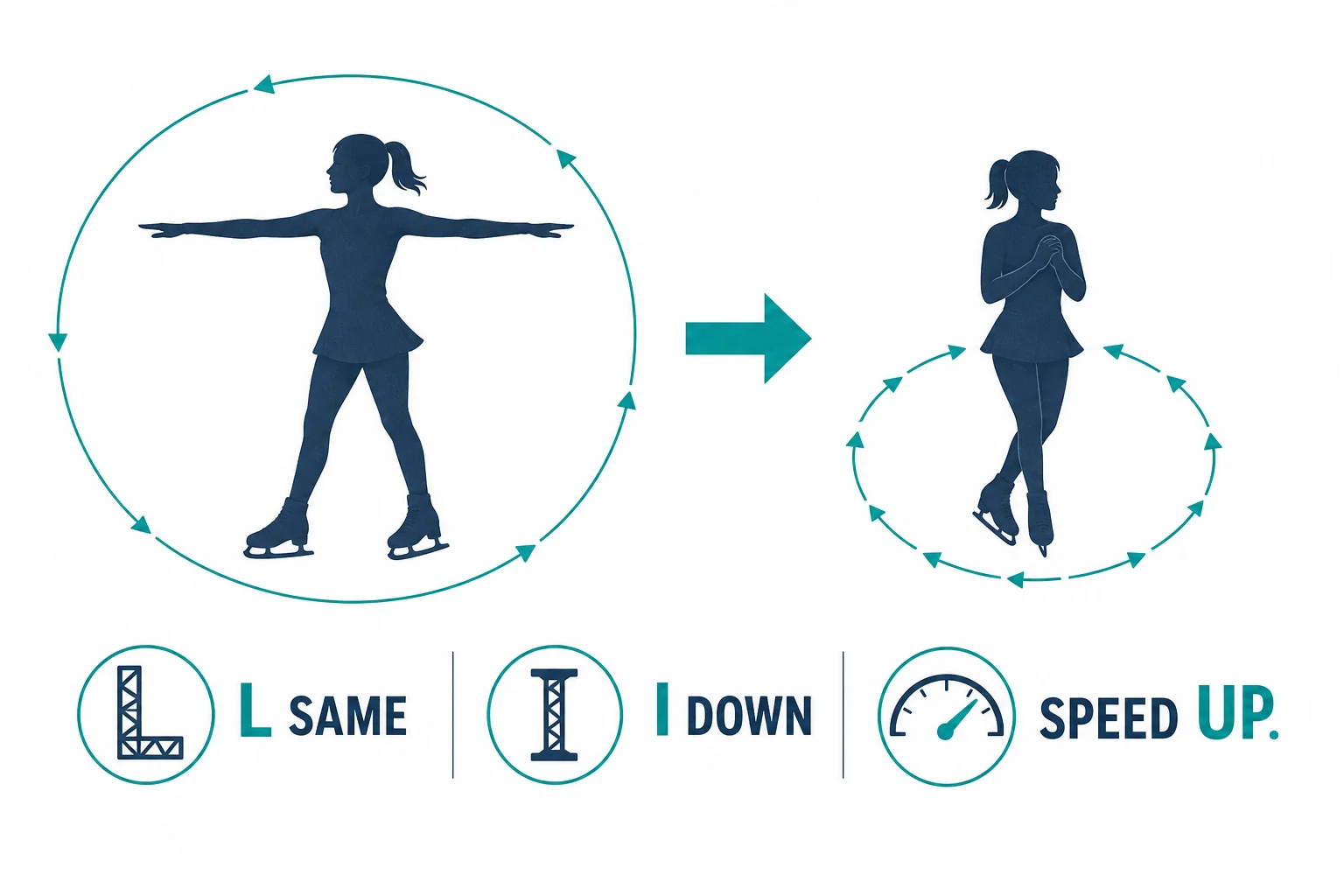
A simple balance diagram showing angular momentum staying the same while moment of inertia decreases and angular speed increases
If $L$ stays constant, smaller $I$ means larger $\omega$.
The relationship $L = I\omega$ helps explain the speed change. If angular momentum $L$ is conserved, then a smaller moment of inertia $I$ must come with a larger angular speed $\omega$. Imagine a skater whose moment of inertia drops to half its original value. If outside twisting forces are small, the spin rate roughly doubles. Real skaters are more complicated than that simple example. Their legs, torso, head, and arms all move in slightly different ways. The ice also gives some friction. Still, the main pattern is reliable. Extended arms mean larger $I$ and slower rotation. Pulled-in arms mean smaller $I$ and faster rotation. This same math applies to many rotating systems. A diver tucks to flip faster. A spinning stool speeds up when a person pulls weights inward.

The faster spin is the equation keeping balance.

Energy also changes
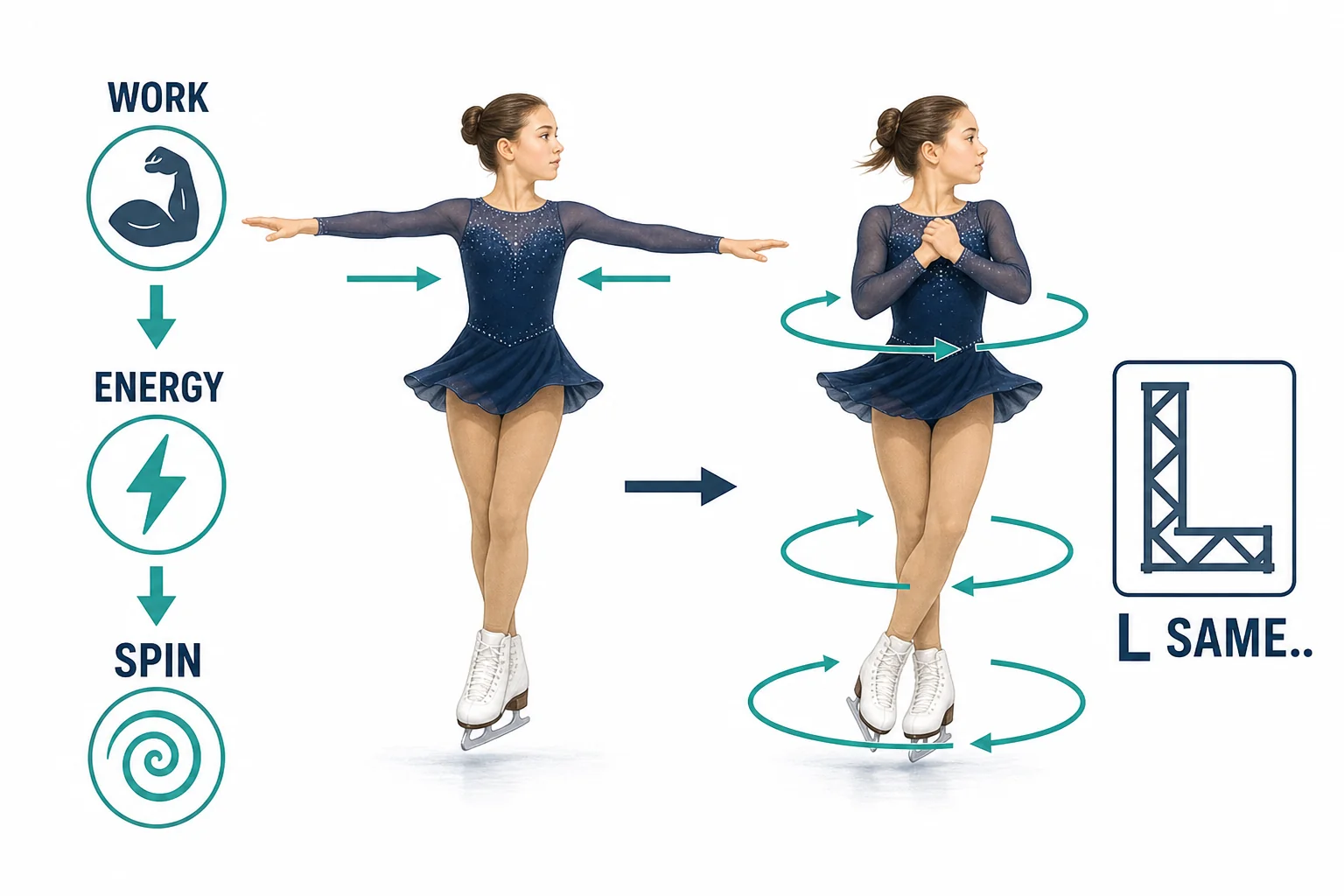
A skater pulling arms inward with arrows showing muscle work adding rotational kinetic energy while angular momentum remains nearly constant
Muscle work can raise rotational kinetic energy.
Angular momentum stays nearly constant, but rotational kinetic energy does not have to stay constant for the skater alone. The skater does work while pulling the arms inward. Muscles use chemical energy to move the arms against the outward feeling caused by rotation. That work increases the skater's rotational kinetic energy. The spin gets faster, so the kinetic energy of rotation rises. This may sound like it breaks conservation of energy, but it does not. Energy changes form. Chemical energy in muscles becomes mechanical energy in the spin, plus some thermal energy in the body and the ice. This is why the arm pull takes effort. A skater cannot keep gaining spin energy forever without doing work. The conserved quantity in the nearly isolated spin is angular momentum, not rotational kinetic energy.

Angular momentum can stay the same while spin energy increases.

Try the pattern
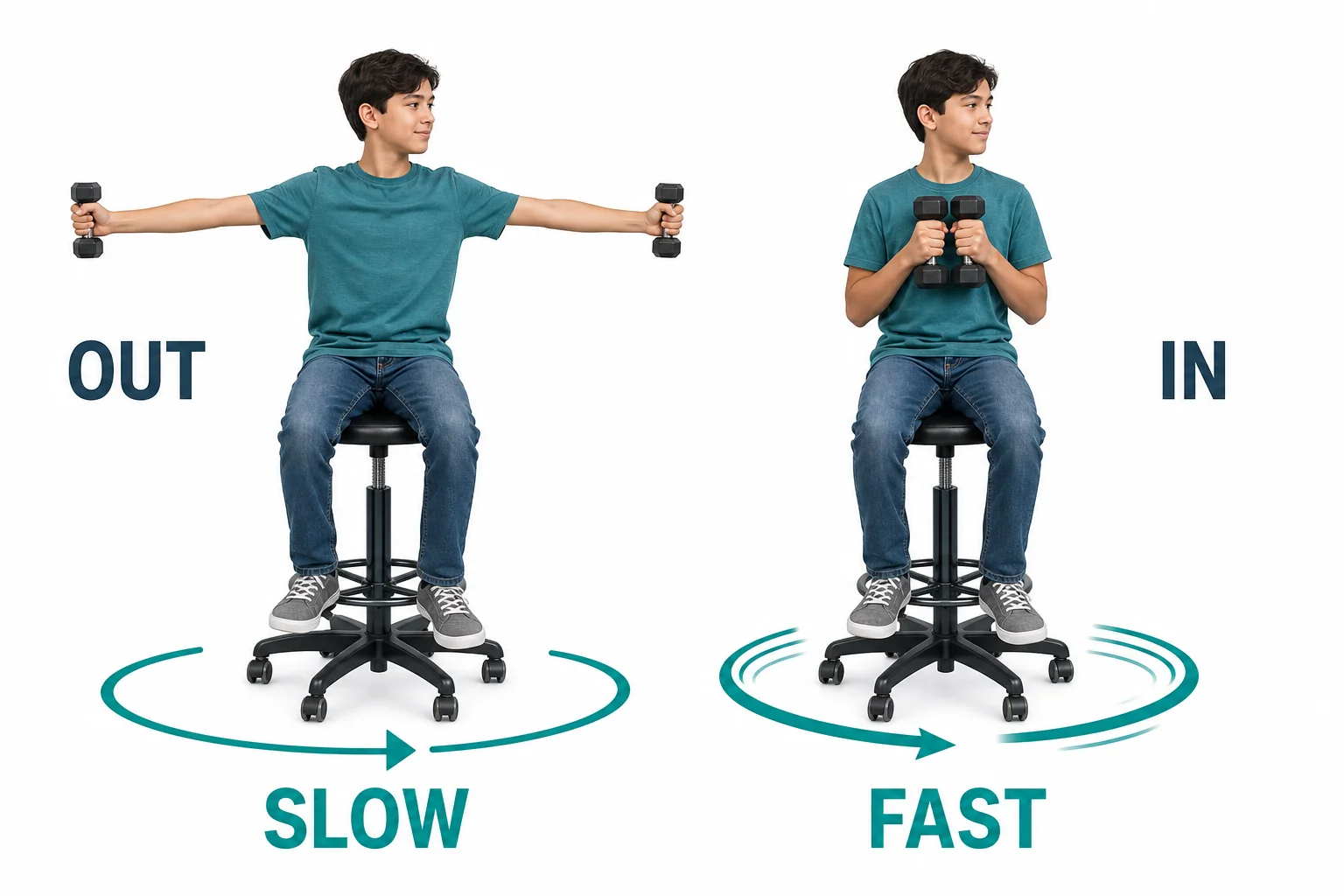
A student on a rotating chair holding weights out and then in, showing a classroom model of a skater's changing spin rate
A chair and hand weights model the same physics.
You can feel this effect with a rotating chair and two small weights. Sit on the chair with arms extended while someone gives a gentle spin. Pull the weights toward your chest and the chair turns faster. Extend them again and the spin slows. The same rule appears in sports and space science. Divers tuck to rotate faster before opening up for entry. Gymnasts change body shape to control flips. A collapsing star can spin faster as its matter moves inward. In each case, mass distribution changes the moment of inertia. If outside twisting forces are small, angular momentum stays nearly constant. The motion may look sudden, but the cause is simple. Pull mass closer to the axis, and the rotation rate must rise to keep the same angular momentum.

The classroom model shows the same mass-inward effect.

Vocabulary

Angular momentum
A measure of how much spin a rotating object has.
Moment of inertia
A measure of how hard it is to change an object's rotation, based on mass and how far that mass is from the axis.
Axis of rotation
The line around which an object spins.
Angular speed
How fast an object turns, often measured in radians per second or rotations per second.
Rotational kinetic energy
The energy an object has because it is spinning.

In the Classroom

Rotating stool investigation

20 minutes | Grades 9-12

Students sit on a rotating stool while holding light weights. They compare spin speed with arms extended and arms pulled inward, then connect the result to $L = I\omega$.

Mass distribution model

30 minutes | Grades 9-12

Students build simple cardboard disks with movable clay masses. They predict which setups are easier to spin, then test how moving mass inward or outward changes rotation.

Energy and momentum discussion

15 minutes | Grades 10-12

Students explain why angular momentum can stay nearly constant while rotational kinetic energy increases. They identify where the added energy comes from when a skater pulls in their arms.

Key Takeaways

  • A skater spins faster when arms move closer to the rotation axis.
  • Angular momentum stays nearly constant when outside twisting forces are small.
  • Moment of inertia decreases when mass moves inward.
  • If $L = I\omega$ and $L$ stays constant, a smaller $I$ means a larger $\omega$.
  • The skater's muscles do work, so rotational kinetic energy can increase.