Practice AP Physics 1 rotational kinematics and dynamics, including angular velocity, angular acceleration, torque, rotational inertia, Newton's second law for rotation, rolling motion, and static equilibrium.
Read each problem carefully. Show equations, substitutions, units, and reasoning in the space provided. Use g = 9.8 m/s^2 unless stated otherwise.
Angular motion, torque, rotational inertia, and equilibrium
Physics - Grade 9-12
- 1
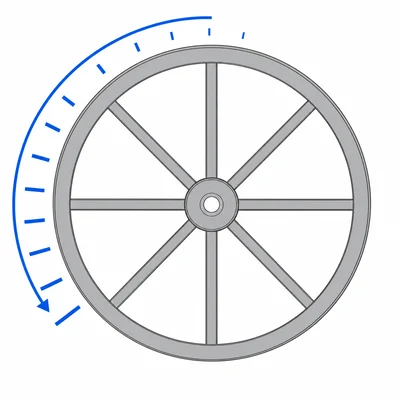
A wheel starts from rest and rotates with a constant angular acceleration of 3.0 rad/s^2 for 4.0 s. Find the wheel's final angular speed and the angular displacement during this time.
- 2
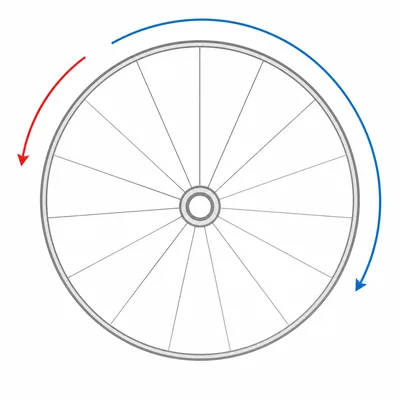
A disk rotates at 18 rad/s and slows uniformly to 6 rad/s in 8.0 s. What is its angular acceleration? How many radians does it rotate through while slowing down?
- 3
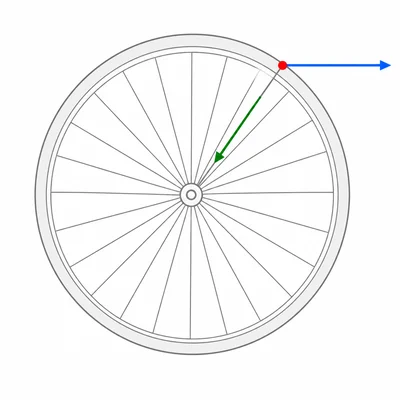
A point on the rim of a rotating wheel has a tangential speed of 5.0 m/s. The wheel has a radius of 0.25 m. Find the angular speed of the wheel and the centripetal acceleration of the point on the rim.
- 4
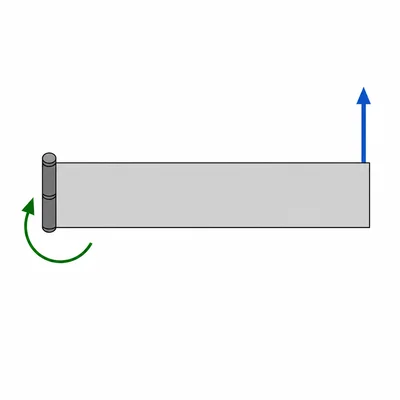
A student pushes perpendicular to the edge of a door with a force of 35 N. The force is applied 0.80 m from the hinge. What torque does the student exert about the hinge?
- 5
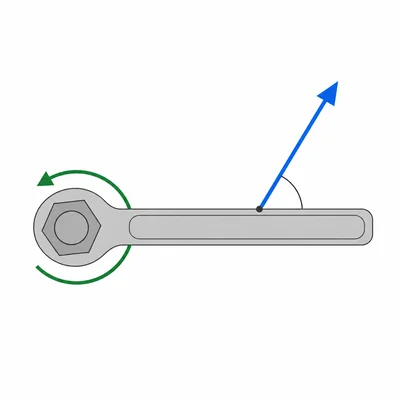
A 12 N force is applied to a wrench at a distance of 0.30 m from the bolt. The force makes a 60 degree angle with the wrench handle. Find the magnitude of the torque about the bolt.
- 6
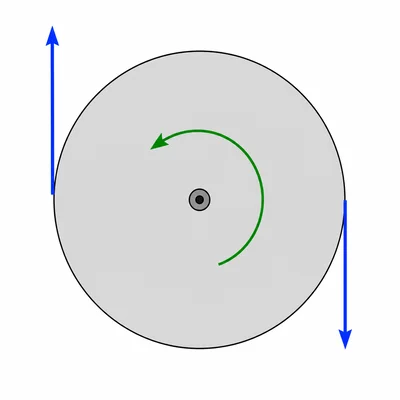
A solid disk has mass 4.0 kg and radius 0.50 m. Its rotational inertia about its central axis is I = one half MR^2. What constant net torque is needed to give it an angular acceleration of 6.0 rad/s^2?
- 7
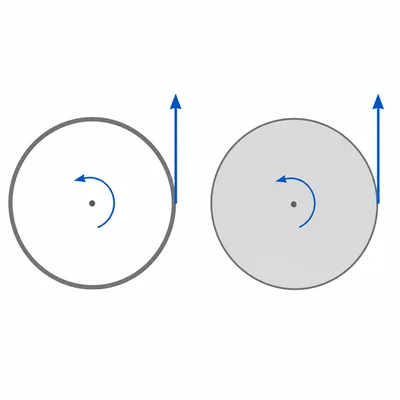
Two objects have the same mass and radius: a hoop with I = MR^2 and a solid disk with I = one half MR^2. The same constant net torque is applied to each. Which object has the greater angular acceleration, and why?
- 8
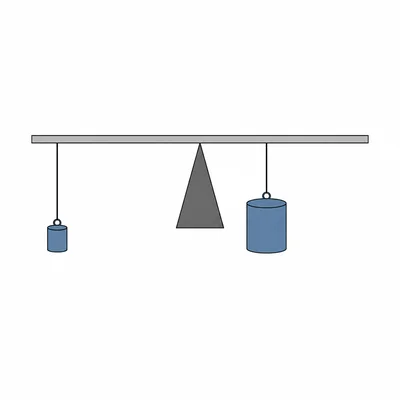
A uniform meterstick is supported at its center. A 2.0 N weight is hung 0.30 m to the left of the center. Where should a 3.0 N weight be hung on the right side so the meterstick remains in rotational equilibrium?
- 9
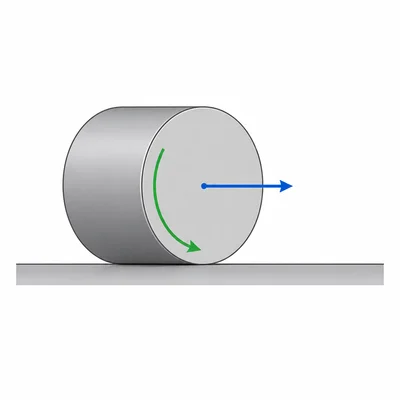
A 1.5 kg solid cylinder rolls without slipping at a speed of 4.0 m/s. For a solid cylinder, I = one half MR^2. Find its total kinetic energy.
- 10
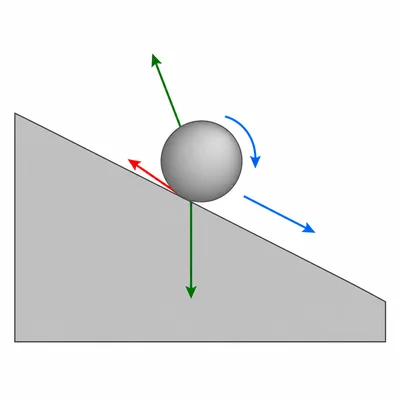
A ball rolls without slipping down a ramp. Explain why static friction can provide a torque on the ball even though it does no mechanical work on the ball.
- 11
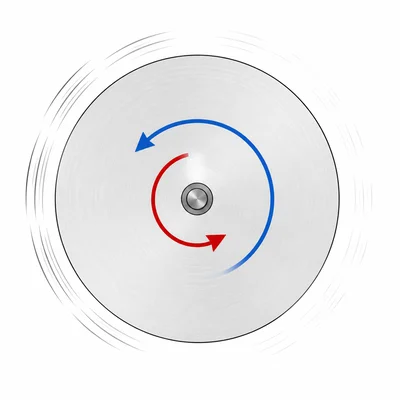
A horizontal disk with rotational inertia 0.80 kg m^2 has an angular speed of 5.0 rad/s. A constant frictional torque of 1.0 N m acts opposite the rotation. How long does it take the disk to stop?
- 12
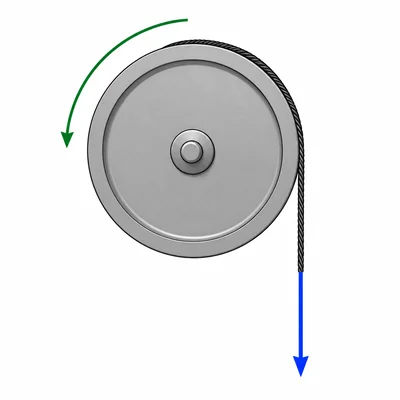
A light string is wrapped around a pulley of radius 0.10 m and rotational inertia 0.020 kg m^2. A student pulls the string with a constant force of 6.0 N, and the string does not slip. Find the pulley's angular acceleration and the tangential acceleration of the string.