Rolling Motion Lab
Release four rolling objects from the same height on an inclined plane and watch them race to the bottom. Explore how the moment of inertia constant k determines finishing order, velocity, and the split between translational and rotational kinetic energy.
Guided ExperimentWhich Object Wins the Race?
If you release a solid ball, a disk, and a hoop from the same height at the same time, which do you predict will reach the bottom first? What property of each object might determine the outcome?
Write your hypothesis in the Lab Report panel, then click Next.
Controls
Race Results
Energy Distribution
Data Table
(0 rows)| # | Trial | Angle(deg) | Height(m) | Ball Time(s) | Disk Time(s) | Hoop Time(s) | Shell Time(s) | Winner |
|---|
Reference Guide
Moment of Inertia
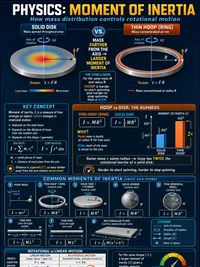
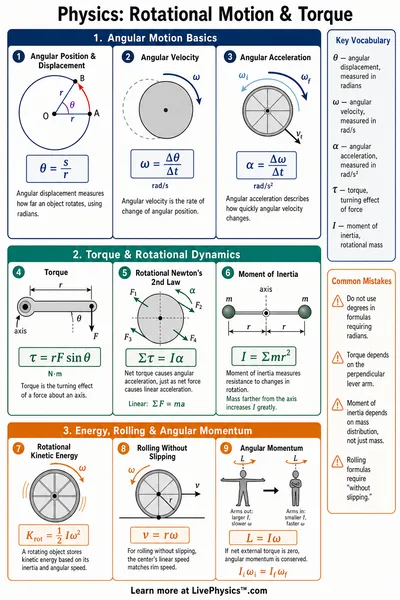
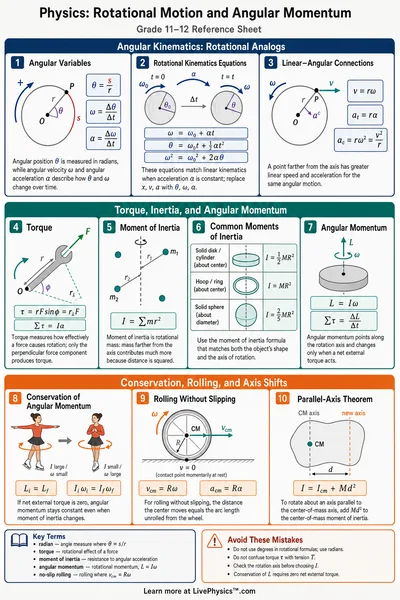
Moment of inertia I measures how mass is distributed around the rotation axis. For a uniform object rolling on its own axis it takes the form I = k m r squared, where k depends only on shape.
- Solid sphere (Ball), k = 2/5 = 0.40
- Solid disk (Disk), k = 1/2 = 0.50
- Hollow sphere (Shell), k = 2/3 = 0.67
- Hollow cylinder (Hoop), k = 1
Rolling Without Slipping
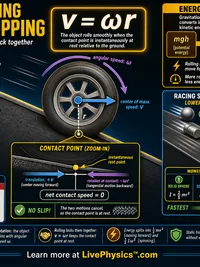
When an object rolls without slipping, the contact point is momentarily at rest. This constrains translational speed v and angular speed omega by v = omega r.
The acceleration down a slope of angle theta is
Smaller k means larger acceleration. The solid sphere always wins the race because k = 2/5 is the smallest value of any uniform rolling body.
Energy Conservation
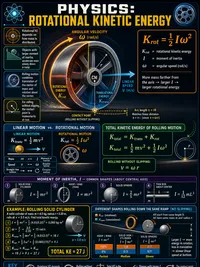
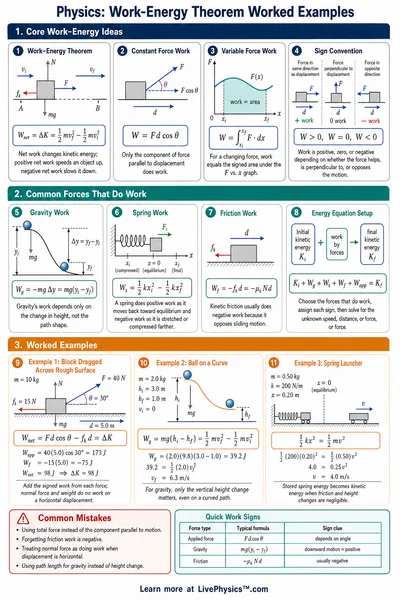
Gravitational potential energy mgh converts entirely into translational and rotational kinetic energy at the bottom (assuming no slip and no rolling friction loss).
Solving for the bottom speed
Rotational Energy Fraction
Of the total kinetic energy at the bottom, the fraction stored in rotation is
- Ball, 2/5 / (7/5) = 29% rotational
- Disk, 1/2 / (3/2) = 33% rotational
- Shell, 2/3 / (5/3) = 40% rotational
- Hoop, 1 / 2 = 50% rotational
The hoop devotes half its energy to spinning, leaving only half for forward motion, which is why it arrives last.