Practice solving and explaining uniform circular motion problems involving centripetal acceleration and centripetal force.
Read each problem carefully. Show your work, include units, and round answers to a reasonable number of significant figures.
Calculating speed, period, force, and inward acceleration
Physics - Grade 9-12
- 1
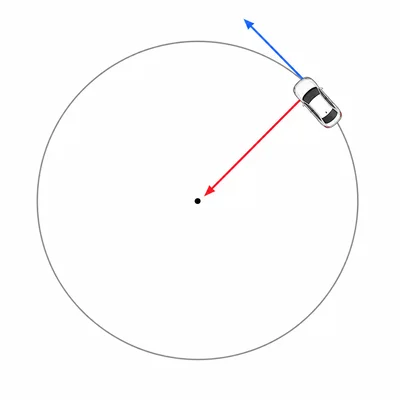
A car travels at a constant speed around a circular track. Explain why the car is accelerating even though its speed is not changing.
- 2
A ball moves in a circle with radius 0.75 m at a speed of 4.0 m/s. Calculate its centripetal acceleration.
- 3
A satellite moves in a nearly circular orbit with radius 6.8 x 10^6 m and period 5.7 x 10^3 s. Calculate the satellite's orbital speed.
- 4
A 900 kg car rounds a flat curve of radius 50 m at 20 m/s. Calculate the centripetal force required to keep the car moving in the curve.
- 5
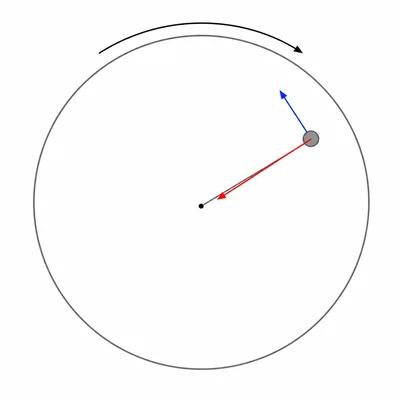
A turntable rotates at 2.0 revolutions per second. A small object sits 0.40 m from the center. Find the period, speed, and centripetal acceleration of the object.
- 6
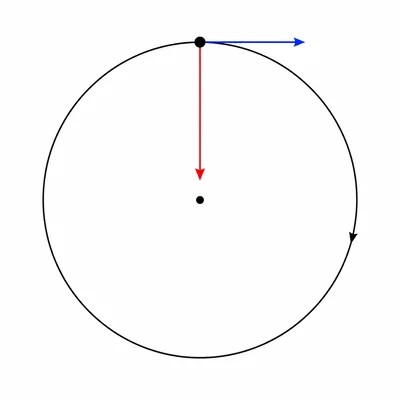
At the top point of a circle, an object is moving clockwise. State the direction of its velocity and the direction of its centripetal acceleration at that instant.
- 7
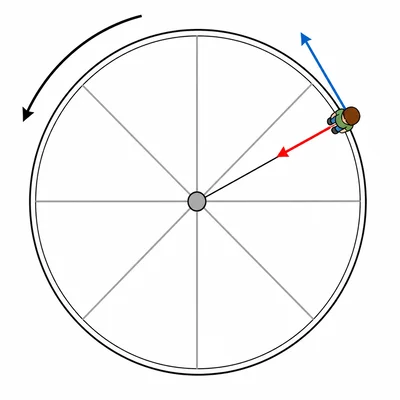
A child rides on a merry-go-round 2.5 m from the center. The merry-go-round completes one rotation every 8.0 s. Calculate the child's speed and centripetal acceleration.
- 8
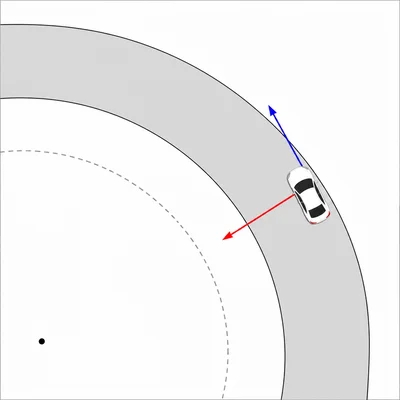
A car rounds a flat curve of radius 80 m at 25 m/s. What minimum coefficient of static friction is needed to prevent skidding? Use g = 9.8 m/s^2.
- 9
An object moves in a circle of fixed radius. If its speed doubles, how does its centripetal acceleration change?
- 10
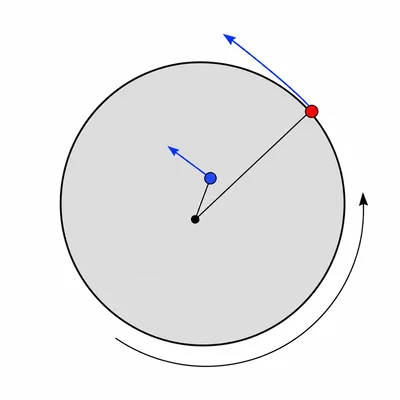
Two riders are on the same rotating platform. Rider A is 1.0 m from the center, and Rider B is 3.0 m from the center. The platform rotates once every 6.0 s. Which rider has the greater speed, and how many times greater is it?
- 11
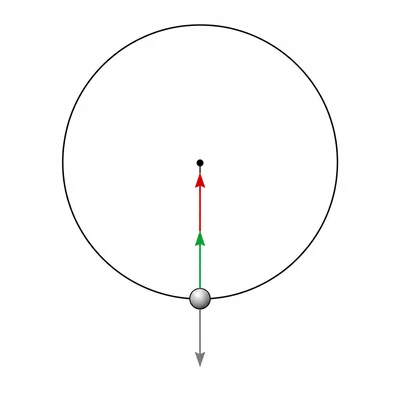
A 0.20 kg ball is swung in a vertical circle. At the bottom of the circle, the ball's speed is 6.0 m/s and the radius is 0.90 m. Find the net centripetal force required at the bottom.
- 12
Show that the formula a = v^2/r gives units of acceleration when v is measured in m/s and r is measured in m.
- 13
A drone flies in a circular path at 12 m/s. Its centripetal acceleration is 3.0 m/s^2. Calculate the radius of the circular path.
- 14
A student measures the speed of a cart moving in circles of different radii. For one trial, the radius is 0.50 m and the speed is 1.5 m/s. Calculate the centripetal acceleration. Then state whether increasing speed or increasing radius would increase the acceleration.
- 15
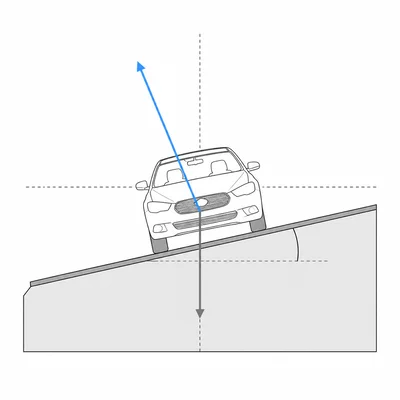
A road curve is banked so that a car can travel around it without friction. The curve radius is 60 m and the design speed is 18 m/s. Calculate the banking angle. Use tan θ = v^2/(rg) and g = 9.8 m/s^2.