Practice analyzing circular motion, centripetal force, centripetal acceleration, and the variables that affect motion in a circle.
Read each problem carefully. Use complete sentences, equations, and units when needed. Show your work in the space provided.
Understanding inward force, speed, radius, and acceleration in circular paths
Physics - Grade 9-12
- 1
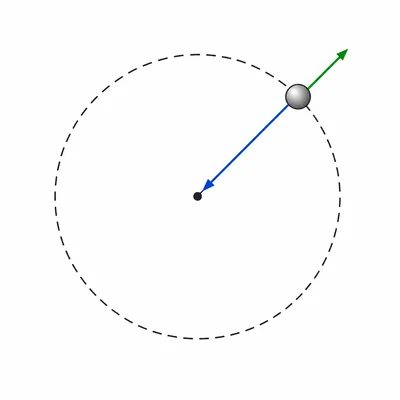
Define centripetal force in your own words and describe the direction it points during circular motion.
- 2
A 2 kg ball moves in a circle of radius 3 m at a speed of 6 m/s. Calculate its centripetal acceleration.
- 3
A 2 kg ball moves in a circle of radius 3 m at a speed of 6 m/s. Calculate the centripetal force acting on it.
- 4
A car travels around a flat circular track of radius 50 m at 10 m/s. If the speed doubles to 20 m/s and the radius stays the same, by what factor does the centripetal force change?
- 5
A student swings a 0.5 kg rubber stopper in a horizontal circle of radius 0.8 m at a speed of 4 m/s. Calculate the centripetal force.
- 6
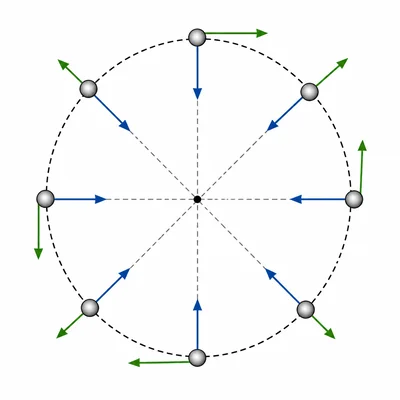
Explain why an object moving in a circle is accelerating even if its speed stays constant.
- 7
A 1200 kg car rounds a curve of radius 40 m with a centripetal acceleration of 5 m/s^2. Find the net centripetal force on the car.
- 8
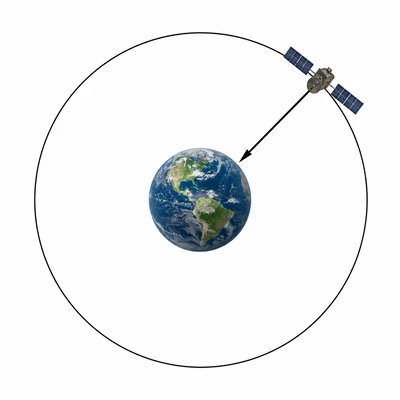
A satellite moves in a circular orbit because of gravity. Identify the force providing the centripetal force and explain its role.
- 9
A 3 kg object moves in a circle with radius 2 m and centripetal acceleration 18 m/s^2. Find its speed.
- 10
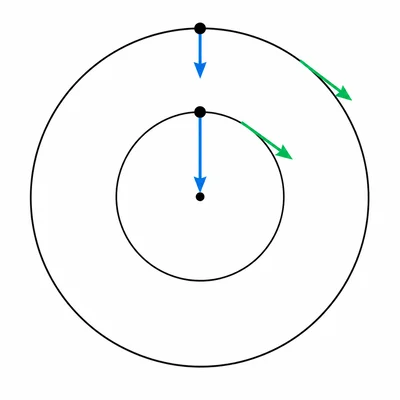
Compare the centripetal force needed for two objects of the same mass moving at the same speed if one travels in a circle of radius 2 m and the other in a circle of radius 4 m.
- 11
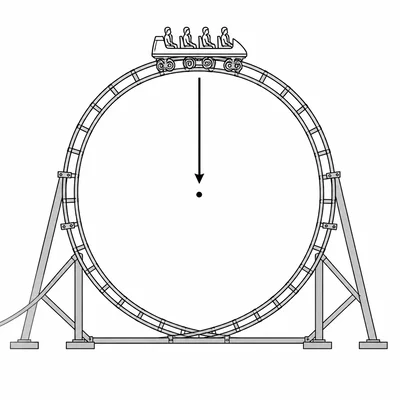
A roller coaster car moves through a vertical loop. At the top of the loop, what direction must the centripetal force point, and why?
- 12
A 1.5 kg mass moves in a circle of radius 0.75 m with a centripetal force of 18 N. Calculate its speed.