Sign in to save

Bookmark this page so you can find it later.

Sign in to save

Bookmark this page so you can find it later.

Physics middle-school May 21, 2026

Why Do Things Fall at the Same Rate?

Gravity gives falling objects the same acceleration
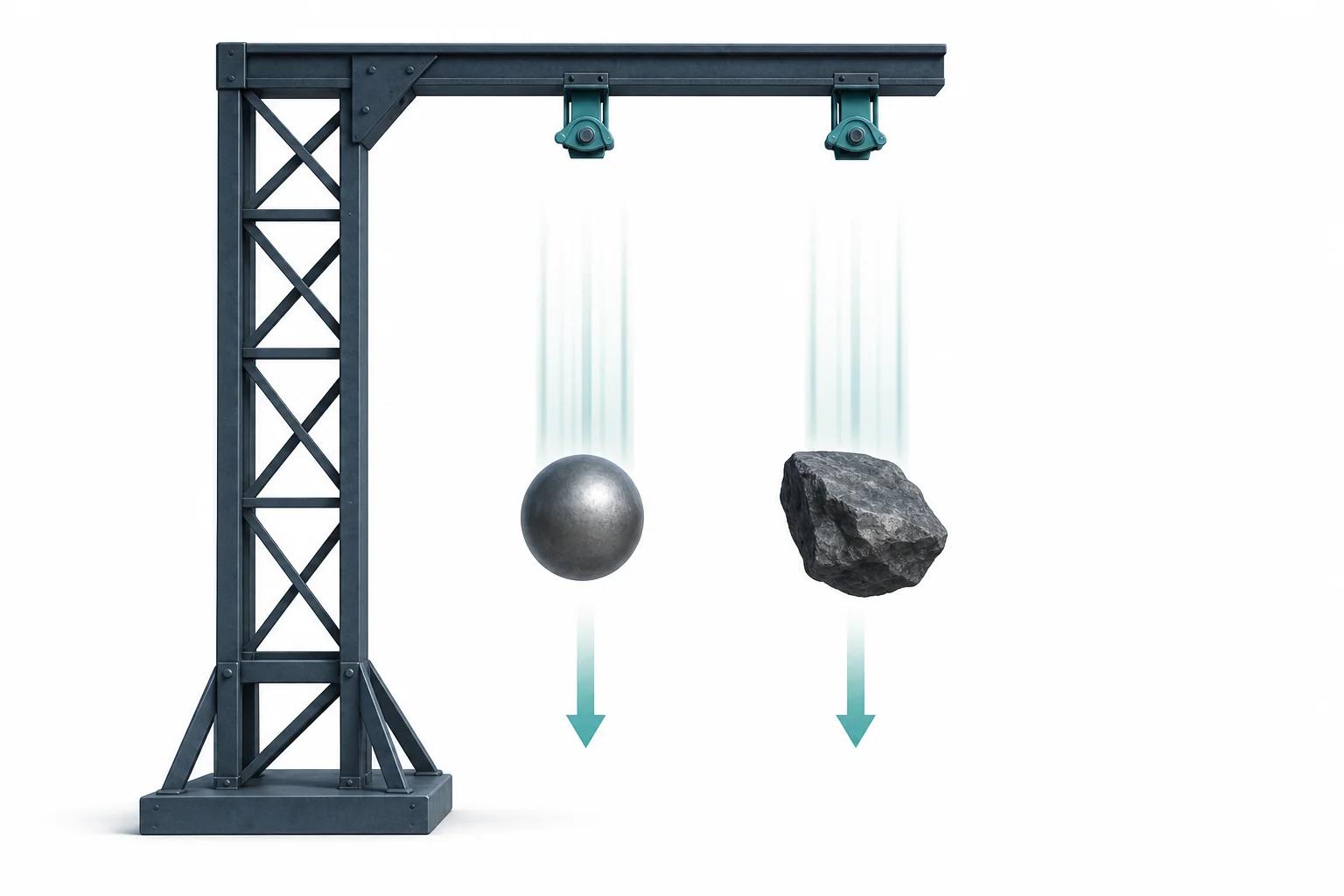
Two balls with different masses falling side by side near Earth to show that gravity gives them the same acceleration when air resistance is small.

Near Earth, gravity makes all objects speed up at the same rate if air does not get in the way. A heavier object feels a stronger pull from gravity, but it also takes more force to speed it up. Those two effects balance, so mass alone does not make one object fall faster.

Big Idea. NGSS MS-PS2-2 connects this idea to investigations of how forces change an object's motion.

A bowling ball and a tennis ball do not feel the same weight in your hands. The bowling ball is pulled down harder by Earth. It seems like it should fall faster. In careful tests, though, objects with different masses fall with the same acceleration when air resistance is small. This is one of the simplest and deepest ideas in physics. Gravity pulls on every bit of matter. A larger mass gets a larger gravitational force, but a larger mass is also harder to speed up. The result is that both objects gain speed at the same rate. Near Earth's surface, that rate is about $9.8\ \text{m/s}^2$. The part that often confuses people is air. A feather and a coin fall differently in a classroom because the feather pushes much more air out of the way for its weight.

Gravity pulls on mass
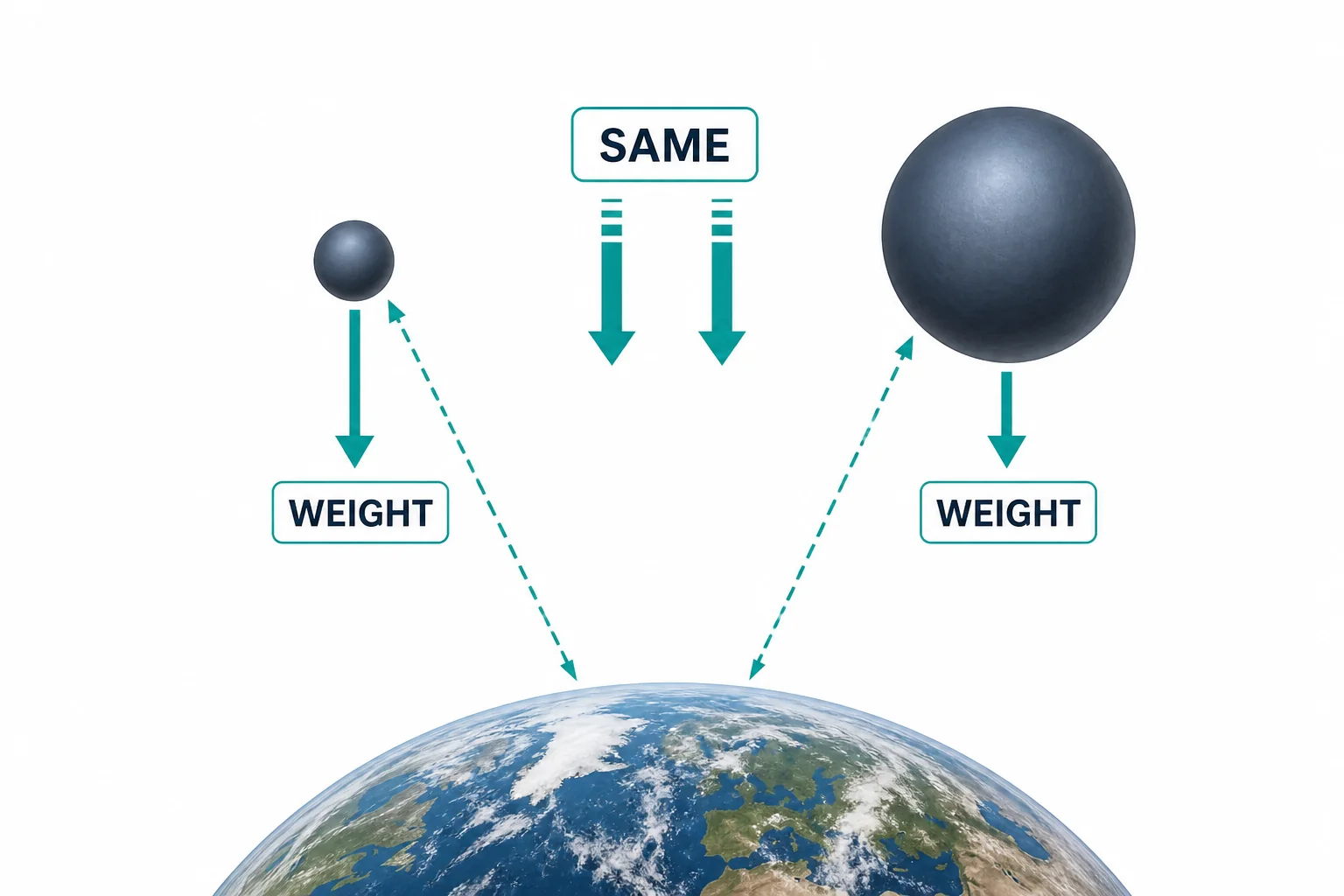
Earth pulling downward on a small ball and a larger ball with different force arrows, while both balls have the same downward acceleration arrow.
More mass means more weight, not more falling acceleration
Earth pulls downward on every object. The pull is called weight. A heavier object has more weight because it has more mass. That part matches everyday experience. A backpack full of books is harder to hold than an empty backpack. If the story stopped there, heavier things would always fall faster. It does not stop there. Motion also depends on how hard it is to change an object's speed. That property is also tied to mass. A bowling ball needs a larger force than a tennis ball to get the same change in motion. During free fall, Earth gives the bowling ball a larger pull, but the bowling ball also needs a larger pull to speed up at the same rate. Those two facts fit together. The falling acceleration does not depend on mass by itself.

A larger gravitational pull is balanced by a larger resistance to speeding up.

Acceleration is the key
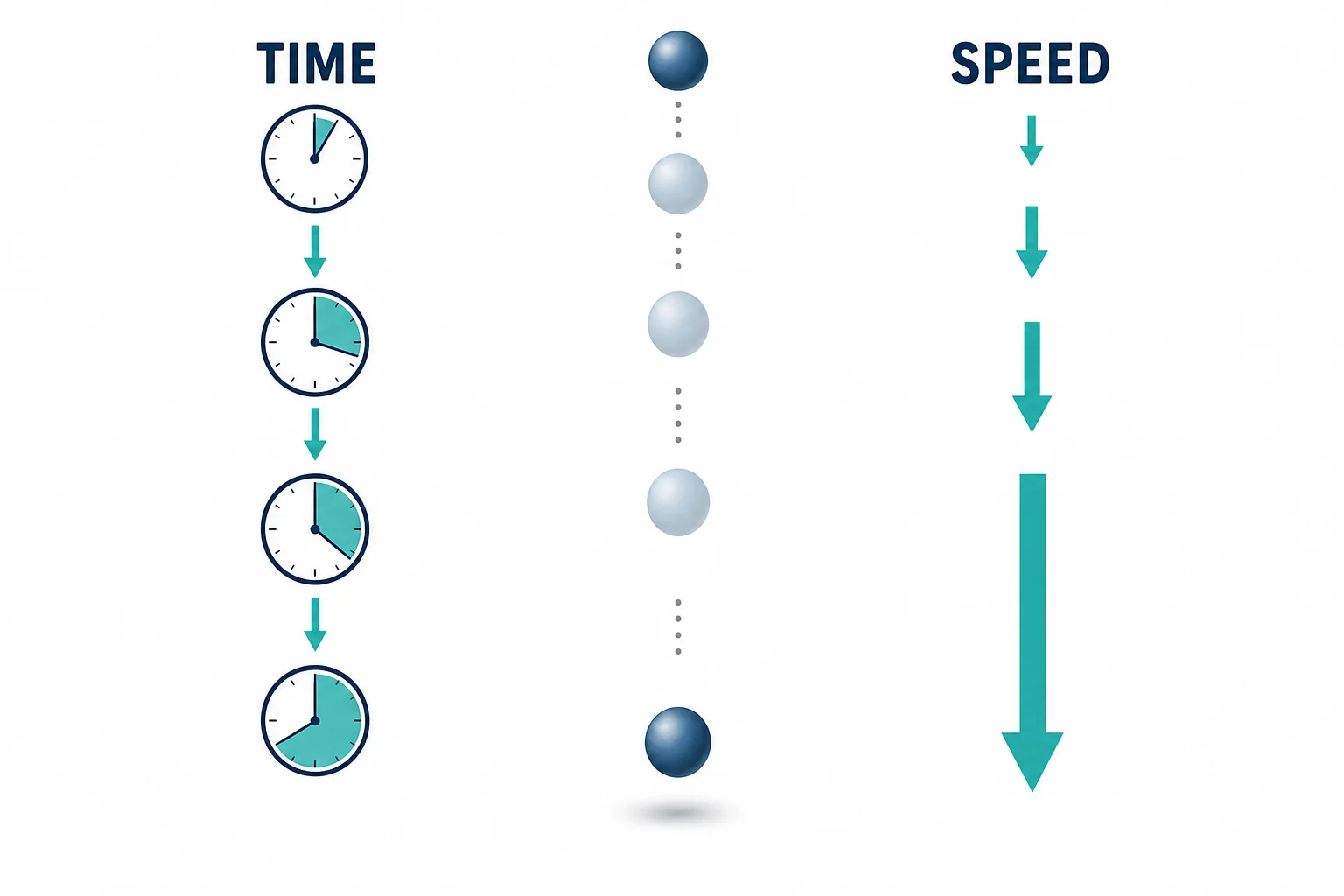
A falling ball shown at equal time intervals with larger spacing between positions to show increasing speed during downward acceleration.
Equal time steps show speed increasing
Falling is not just moving downward. It is speeding up downward. Speed tells how fast an object moves. Acceleration tells how quickly the speed changes. Near Earth's surface, freely falling objects gain about $9.8\ \text{m/s}$ of speed each second. After one second, an object dropped from rest is moving about $9.8\ \text{m/s}$. After two seconds, it is moving about $19.6\ \text{m/s}$, if air resistance is ignored. The number is the same for a marble, a metal ball, and a dropped book. This does not mean all falling objects have the same speed at every moment in every real situation. It means gravity gives them the same acceleration when gravity is the main force. In school labs, this idea is often tested with timers, ramps, video frames, or motion sensors.

Free fall means the speed changes by the same amount each second.

Why mass cancels out
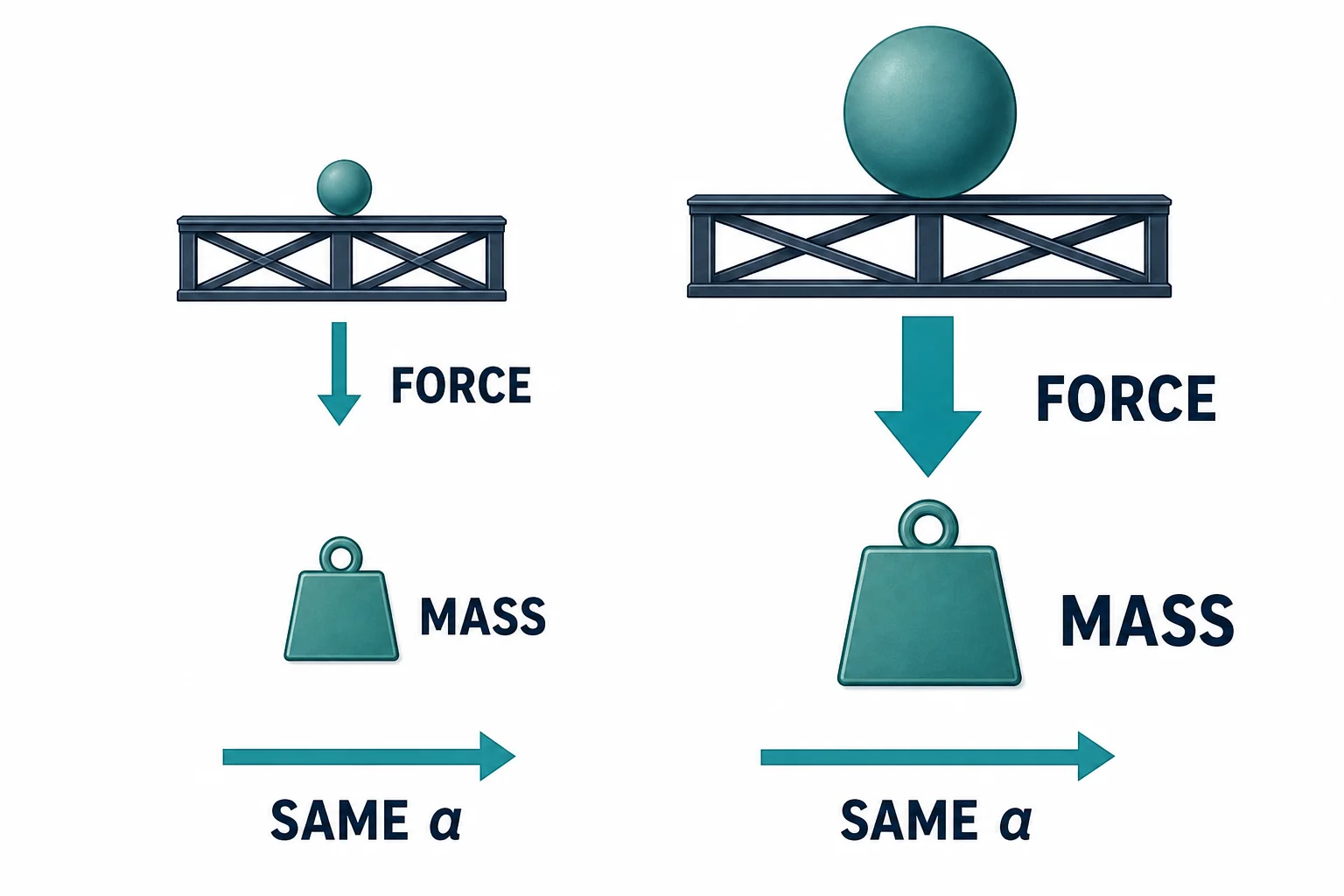
A simple balance-style diagram showing a light object and heavy object with force and mass increasing together, leading to equal acceleration.
Force and mass grow together
Newton's second law says that acceleration depends on force and mass. In symbols, $a = \frac{F}{m}$. For falling objects, the gravitational force is the object's weight. Near Earth, weight can be written as $F = mg$. The letter $g$ stands for the acceleration due to gravity. If you put that force into Newton's second law, you get $a = \frac{mg}{m}$. The mass appears on the top and bottom, so it cancels. What remains is $a = g$. This math explains the experiment. A two kilogram object has twice the weight of a one kilogram object. It also has twice the mass to accelerate. Twice the pull divided by twice the mass gives the same acceleration. The equation is short, but the idea is important.

More weight and more mass increase together, so the acceleration stays the same.

Air changes the result
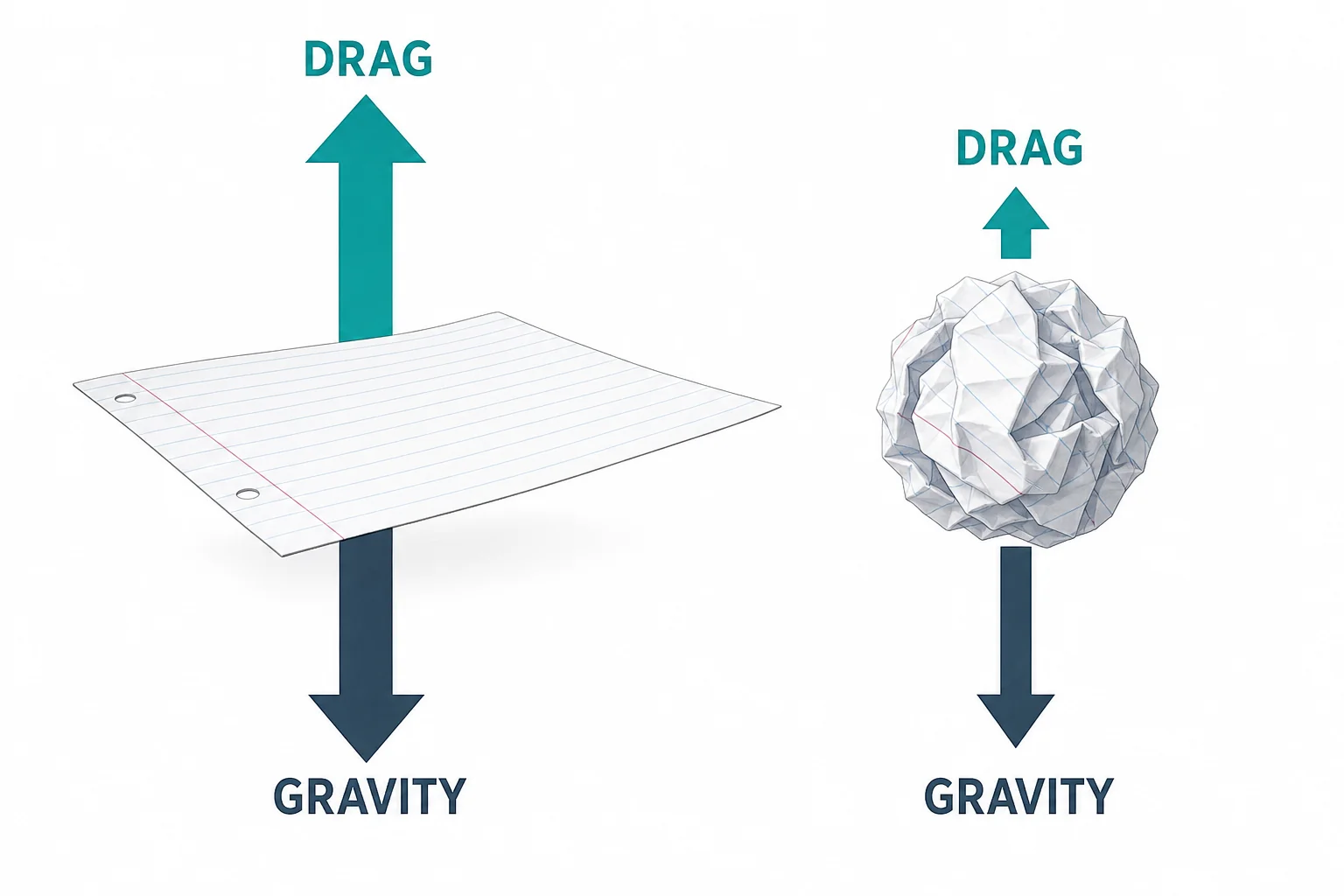
A flat sheet of paper falling slowly with a large upward air resistance arrow and a crumpled paper ball falling faster with a smaller air resistance arrow.
Shape affects air resistance
A sheet of paper and a metal coin do not fall together in a normal classroom. The paper falls more slowly because air pushes up on it. That upward push is air resistance, also called drag. Drag depends on shape, size, speed, and the air around the object. A flat sheet of paper has a large area for its weight, so drag matters a lot. If the same paper is crumpled into a tight ball, it falls more like the coin. The mass did not change much, but the shape changed. This is why parachutes work. They spread out and catch air, which increases drag and reduces acceleration. Free fall in the pure physics sense means gravity is the only important force. Many real falls are not pure free fall because air is also important.

Different fall speeds in air often come from drag, not from mass.

Galileo's lesson
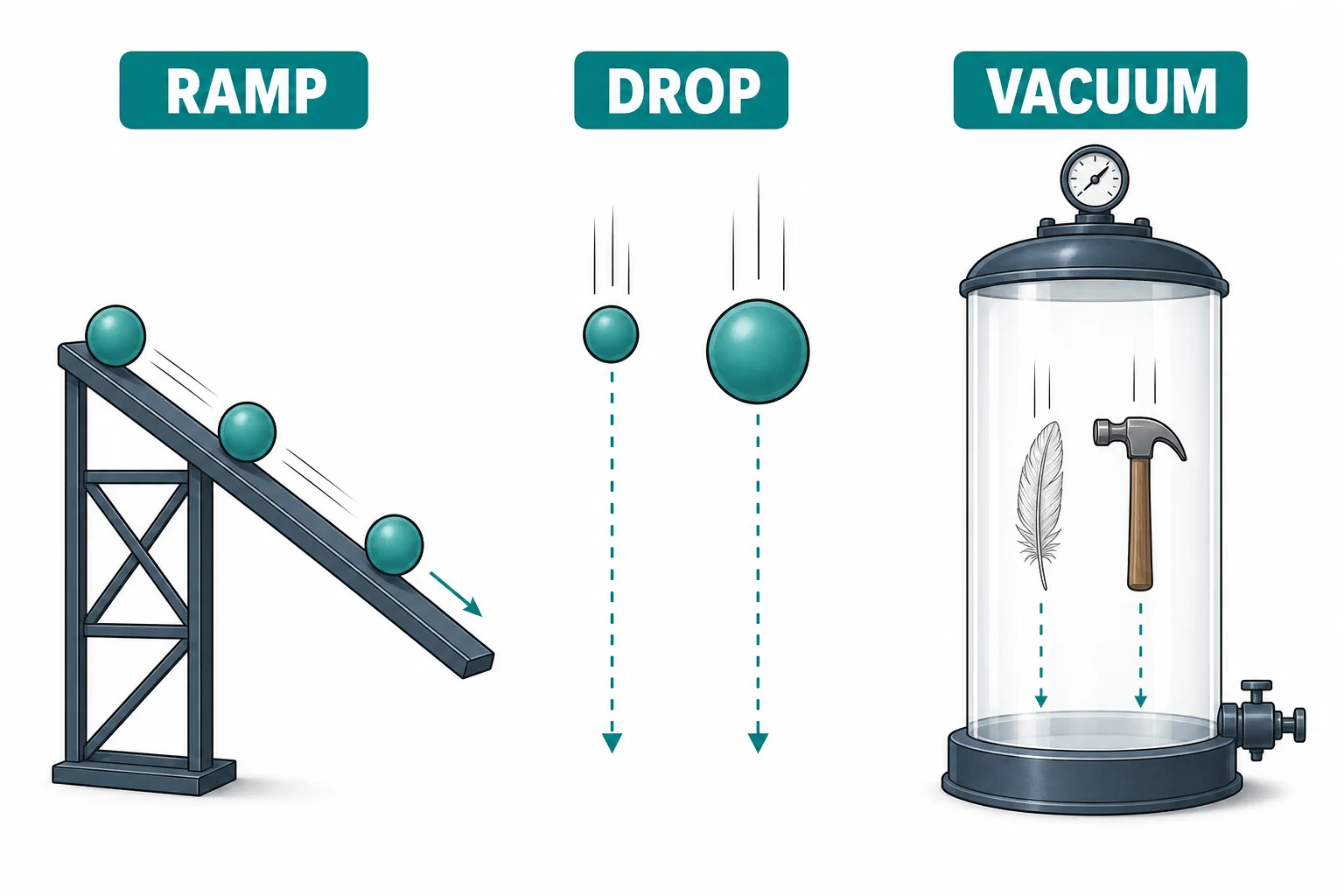
A historical and modern comparison showing a ramp experiment, two falling balls, and a feather and hammer falling together in a vacuum tube.
Evidence replaced the old idea
The idea that heavy objects must fall faster was common for a long time. Galileo helped change that view by focusing on evidence. Stories often place him at the Leaning Tower of Pisa, dropping objects of different masses. Historians debate the details, but the scientific point is clear. Careful observation can test a claim about motion. Galileo also studied rolling balls on ramps, which slowed the motion enough to measure it. Those ramp experiments showed patterns in acceleration. Today, the same idea can be tested with slow motion video or a vacuum tube. In a vacuum, a feather and a hammer fall together because there is no air to push on the feather. The Moon has almost no atmosphere, so Apollo 15 astronaut David Scott showed this directly with a feather and hammer.

Experiments show what intuition can miss.

Vocabulary

Gravity
The attractive force between objects that have mass. Near Earth, it pulls objects downward toward Earth's center.
Free fall
Motion when gravity is the only important force acting on an object.
Acceleration
A change in speed or direction over time. Falling objects near Earth accelerate downward.
Mass
A measure of how much matter an object has and how hard it is to change its motion.
Air resistance
An upward force from air that acts on moving objects and can slow their fall.

In the Classroom

Coin and paper drop

15 minutes | Grades 6-8

Drop a coin and a flat sheet of paper from the same height, then repeat with the paper crumpled into a ball. Students compare how shape changes air resistance while mass changes very little.

Video free fall frames

30 minutes | Grades 6-8

Record a ball dropping next to a meter stick using a phone or tablet. Students mark its position frame by frame and look for increasing spacing over equal time intervals.

Force and mass model

20 minutes | Grades 7-8

Give groups cards showing different masses and matching weights. Students calculate simple ratios to see why doubling both force and mass gives the same acceleration.

Key Takeaways

  • Objects in free fall have the same acceleration near Earth, no matter their mass.
  • A heavier object feels a stronger gravitational force, but it is also harder to accelerate.
  • Near Earth's surface, free fall acceleration is about $9.8\ \text{m/s}^2$.
  • Air resistance can make objects with different shapes fall at different rates.
  • Experiments with drops, ramps, video, and vacuums help separate gravity from air resistance.