Escape Velocity Launcher
Launch a rocket from a planet's surface and watch whether it orbits, escapes into space, or crashes back down. Explore how velocity and angle determine the fate of any launch.
7.90 km/s
0Orbital 7.91 km/sEscape 11.19 km/s15
0°
0° (horizontal)90° (vertical)
Orbital Mechanics Explained
Orbital Velocity
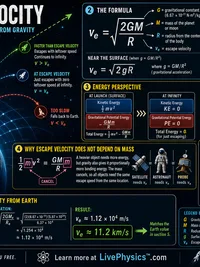
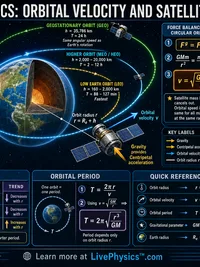
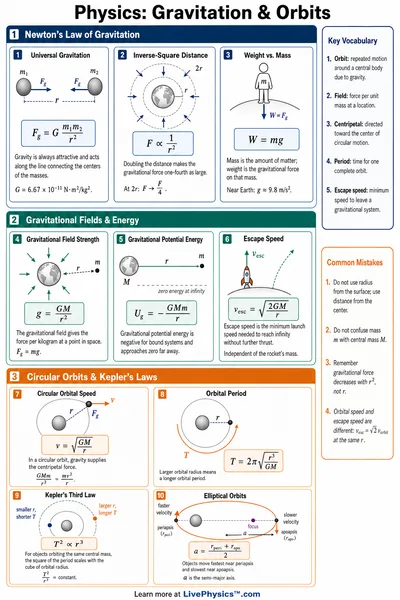
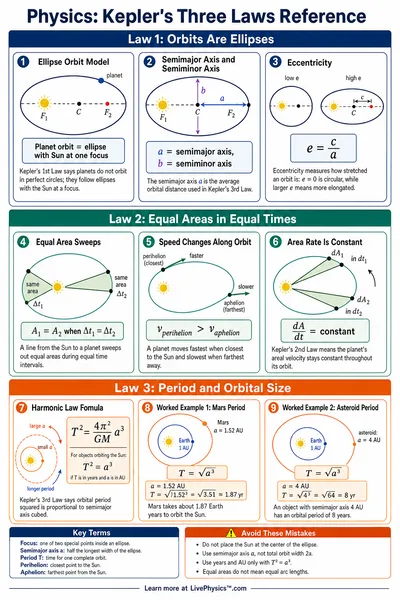
At 7.91 km/s horizontally, a projectile falls toward Earth at exactly the same rate Earth curves away. This creates a stable circular orbit. The ISS orbits at 7.66 km/s at 400 km altitude.
Escape Velocity
At 11.19 km/s, a projectile has enough kinetic energy to overcome Earth's gravity entirely. The formula is v = sqrt(2GM/R), where M is Earth's mass and R its radius.
Newton's Cannonball
Isaac Newton imagined a cannonball fired from a mountain so fast it kept missing Earth. Below orbital speed it lands. At orbital speed it orbits. Above escape speed it flies away forever.
Related Content
Related Tools
Projectile Motion Calculator
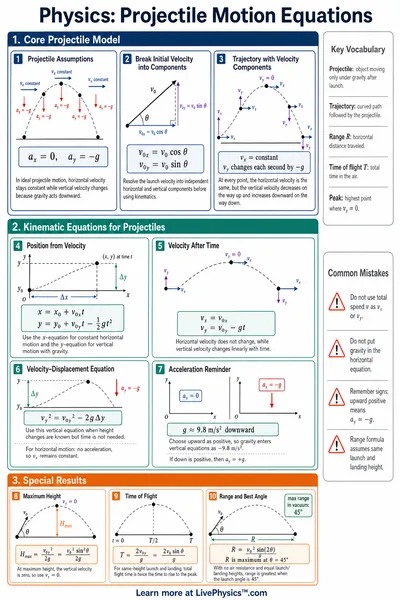
Calculate trajectory, range, max height, and time of flight for projectile motion. Visualize the parabolic path with an interactive time slider and velocity vectors.
Circuit Calculator
Calculate voltage, current, resistance, and power with Ohm's law. Build series and parallel resistor networks with step-by-step equivalent resistance.
Lens & Mirror Calculator
Visualize image formation with interactive ray diagrams for lenses and mirrors.
Kinematics Solver
Solve constant-acceleration problems with step-by-step solutions and motion graphs.
Related Labs
Gravity & Orbits Lab
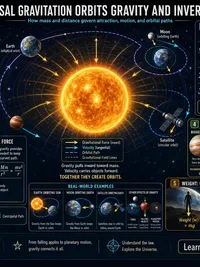
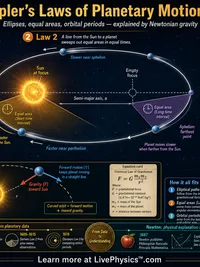
Set central mass, semi-major axis, and eccentricity to animate elliptical orbits. Verify Kepler's Third Law, measure orbital velocity with the vis-viva equation, and compare circular and highly eccentric trajectories
Full Projectile Motion Experimental Lab
Run a full projectile motion investigation. Three modes test optimal launch angle, R vs v² to derive g, and the effect of launch height. Replicated trials, regression, residuals, and percent-error analysis
Pendulum Lab
Measure pendulum period at different lengths to derive gravitational acceleration. Plot T² vs L, compare small and large angle behavior, and explore planetary gravity presets