Understanding Forces & Free-Body Diagram Tool
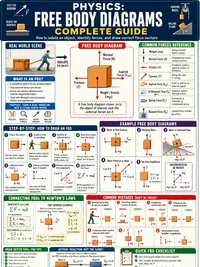
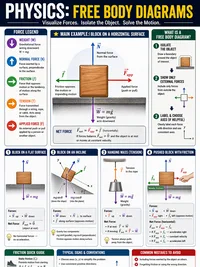
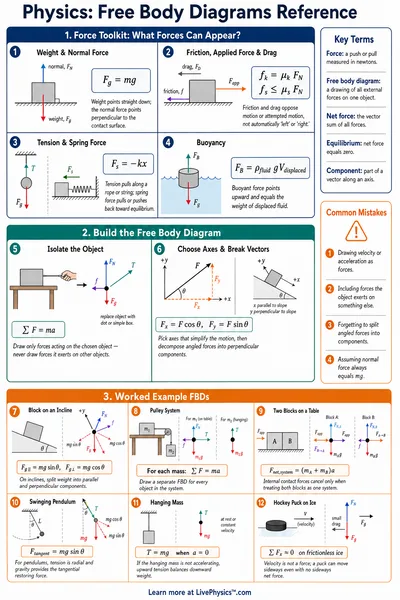
A free-body diagram begins by choosing one object and ignoring everything else except its interactions. A book on a table has a weight force from Earth, a support force from the table, and perhaps a push from a hand. Drawing forces on the object rather than on the surrounding scene prevents a common error, which is mixing up forces that act on different objects.
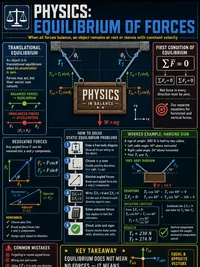
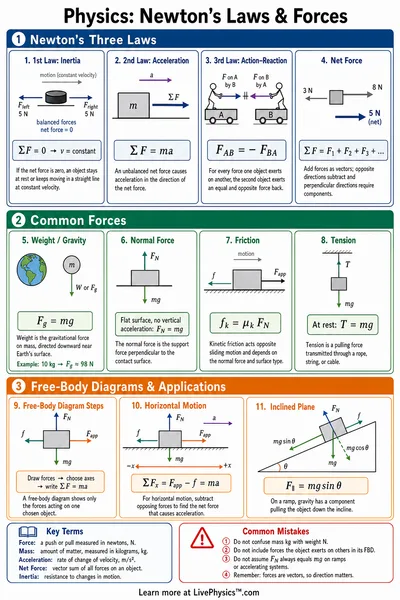
Each arrow represents a force with both size and direction. Forces pointing in opposite directions must be combined carefully, because the result is the net force. Newton's second law says force equals mass times acceleration, so a nonzero net force changes motion in the net-force direction.
Zero net force does not mean no motion. It can mean an object moves at a steady speed in a straight line.
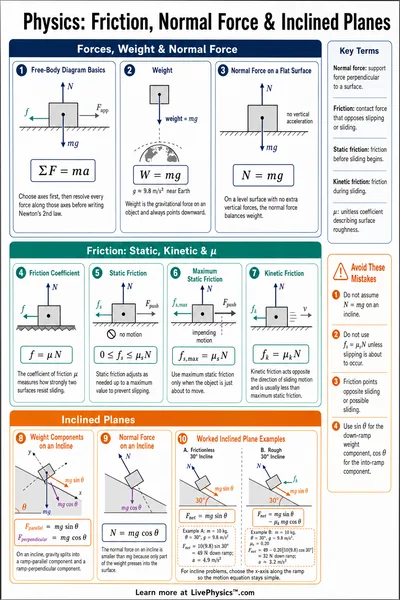
The normal force is often misunderstood because it is not always equal to weight. It is the push from a surface, directed perpendicular to that surface.
On a level floor with no other vertical forces, normal force and weight balance. On a slope, the surface pushes at an angle, while weight still points straight down toward Earth.
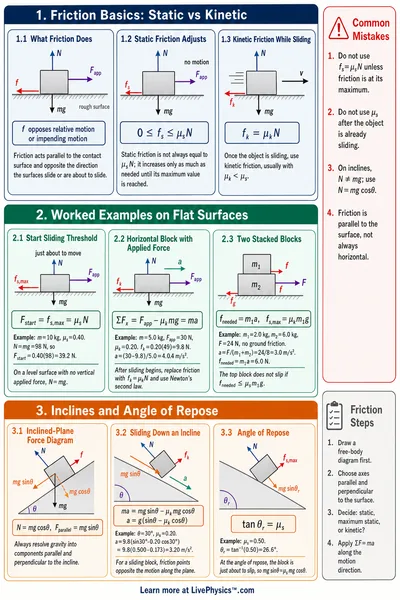
Inclined planes become easier when weight is separated into two directional parts. One part points into the surface and affects the normal force. The other part points down the slope and tends to make the object slide.
Students should choose axes parallel and perpendicular to the slope before comparing forces. This choice keeps the diagram clear and makes it easier to decide which forces can balance.
Friction is a contact force that opposes relative motion or the tendency to move. Static friction can adjust from zero up to a maximum value, so a box can remain still even when someone pushes it gently.
Kinetic friction applies after sliding begins and is often smaller than the maximum static friction. In daily life, friction explains why shoes grip the ground, bicycle brakes work, and heavy furniture needs a stronger push to start moving than to keep moving.
A reliable method is to list every interaction before drawing arrows. Include gravity whenever the object is near Earth, include contact forces only when objects touch, and include tension only when a rope or cable pulls.
Do not invent a force in the direction of motion. Motion is the result of forces, not a separate force.
It helps to check whether every arrow has a clear source. A wall can exert a normal force, a rope can exert tension, and air can exert drag.
If an object pushes on a surface, the surface pushes back on the object with an equal force in the opposite direction. Those two forces belong on separate diagrams because they act on different objects.
Real problems often involve a cart being pulled, an elevator rising, a sled on snow, or a car turning. The key skill is not memorising a picture.
It is deciding which forces act, choosing useful directions, and checking whether the net force matches the stated motion. A correct diagram makes the later calculations much less confusing.