Sign in to save

Bookmark this page so you can find it later.

Sign in to save

Bookmark this page so you can find it later.

Universal Gravitation Calculator

Enter two masses and the distance between them to calculate gravitational force, field strength, orbital velocity, and escape velocity. Every result includes a step-by-step breakdown of the formula with your values substituted in.

Force Diagram

m₁5.972 × 10^24 kgm₂7.342 × 10^22 kgr = 3.844 × 10^8 mF = 1.98 × 10^20 N

Parameters

kg
kg
m

Results

Gravitational Force (F)
1.98 × 10^20 N
Field strength (g) at m₁
2.697 × 10^-3 m/s²
Field strength (g) at m₂
3.316 × 10^-5 m/s²
Orbital velocity around m₁
1018 m/s
Orbital velocity around m₂
112.9 m/s
Escape velocity from m₁
1440 m/s
Escape velocity from m₂
159.7 m/s

Step-by-Step Calculation

1. Gravitational Force

F=Gm1m2r2F = \frac{G \cdot m_1 \cdot m_2}{r^2}
F=(6.674×10¹¹)(5.972×1024)(7.342×10²²)(3.844×10⁸)2F = \frac{(6.674 \times 10^{-11})(5.972 \times 10^{24})(7.342 \times 10^{22})}{(3.844 \times 10^{8})^2}
F=1.98×10²⁰ NF = 1.98 \times 10^{20} \text{ N}

2. Field Strength due to m₁

g1=Gm1r2g_1 = \frac{G \cdot m_1}{r^2}
g1=(6.674×10¹¹)(5.972×1024)(3.844×10⁸)2g_1 = \frac{(6.674 \times 10^{-11})(5.972 \times 10^{24})}{(3.844 \times 10^{8})^2}
g1=2.697×10³ m/s2g_1 = 2.697 \times 10^{-3} \text{ m/s}^2

3. Orbital Velocity around m₁

vorb=Gm1rv_{\text{orb}} = \sqrt{\frac{G \cdot m_1}{r}}
vorb=(6.674×10¹¹)(5.972×1024)3.844×10⁸v_{\text{orb}} = \sqrt{\frac{(6.674 \times 10^{-11})(5.972 \times 10^{24})}{3.844 \times 10^{8}}}
vorb=1018 m/sv_{\text{orb}} = 1018 \text{ m/s}

4. Escape Velocity from m₁

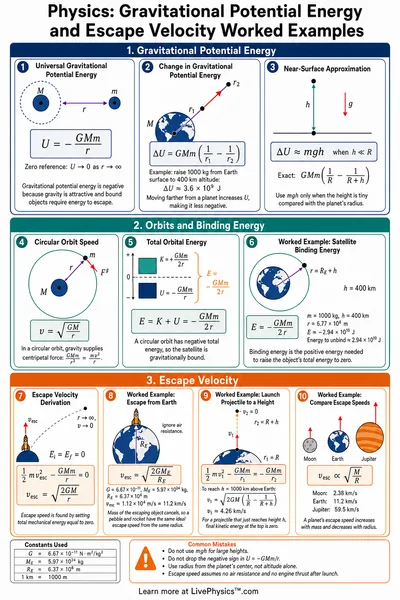
vesc=2Gm1rv_{\text{esc}} = \sqrt{\frac{2G \cdot m_1}{r}}
vesc=2(6.674×10¹¹)(5.972×1024)3.844×10⁸v_{\text{esc}} = \sqrt{\frac{2(6.674 \times 10^{-11})(5.972 \times 10^{24})}{3.844 \times 10^{8}}}
vesc=1440 m/sv_{\text{esc}} = 1440 \text{ m/s}

Reference Guide

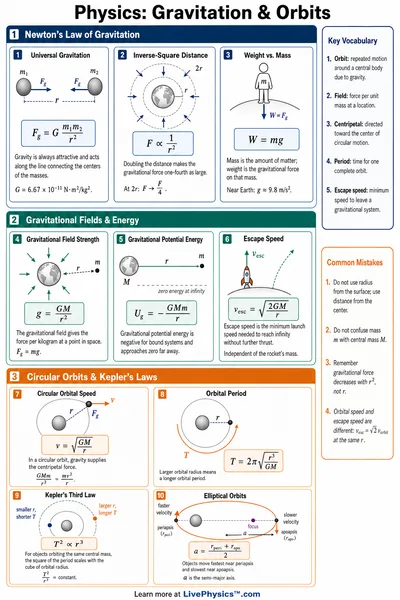
Newton's Law of Gravitation

Every object with mass attracts every other object with mass. The force depends on both masses and the square of the distance between them.

F=Gm1m2r2F = \frac{G \cdot m_1 \cdot m_2}{r^2}

where G=6.674×10¹¹  Nm2/kg2G = 6.674 \times 10^{-11}\;\text{N}\cdot\text{m}^2/\text{kg}^2 is the gravitational constant. The force is always attractive and acts along the line connecting the two centers of mass.

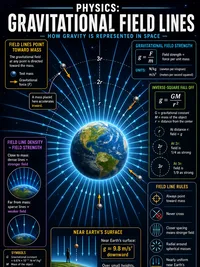
Gravitational Field Strength

The gravitational field strength at a distance rr from a mass MM tells you the acceleration any object would experience at that point.

g=GMr2g = \frac{GM}{r^2}

On Earth's surface, g9.81  m/s2g \approx 9.81\;\text{m/s}^2. On the Moon it is about 1.62  m/s21.62\;\text{m/s}^2, roughly one sixth of Earth's value.

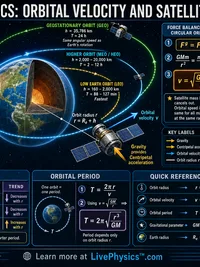
Orbital Velocity

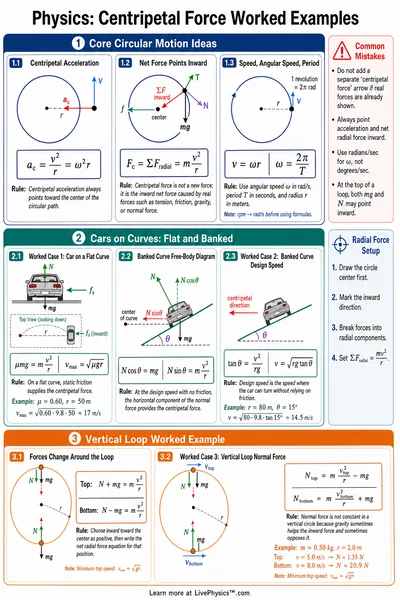
For a circular orbit, gravitational force provides the centripetal acceleration. Setting them equal gives the speed needed to maintain the orbit.

vorb=GMrv_{\text{orb}} = \sqrt{\frac{GM}{r}}

A satellite in low Earth orbit (about 400 km altitude) needs roughly 7,670 m/s. Higher orbits require less speed but take longer to complete one revolution.

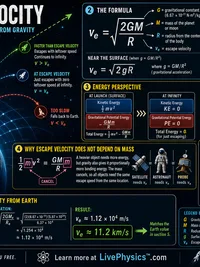
Escape Velocity

Escape velocity is the minimum speed needed to leave a gravitational field without further propulsion. It comes from setting kinetic energy equal to gravitational potential energy.

vesc=2GMrv_{\text{esc}} = \sqrt{\frac{2GM}{r}}

Notice that escape velocity is exactly 2\sqrt{2} times the orbital velocity at the same distance. For Earth's surface, it is about 11,200 m/s.
Related Content