Newton's First Law Lab
Give a hockey puck a brief push, then watch it slide. Try different surfaces and see how friction changes the motion. This lab brings Newton's First Law to life with a quick, hands-on simulation built for middle school physics.
Guided Experiment How does surface affect how far the puck slides?
If you keep mass, force, and push duration the same but change the surface, how will the total sliding distance change?
Write your hypothesis in the Lab Report panel, then click Next.
Hockey Puck Slide
Controls
Results
- Surface Wood (μ = 0.20)
- Mass 2.0 kg
- Push 30 N for 1.0 s
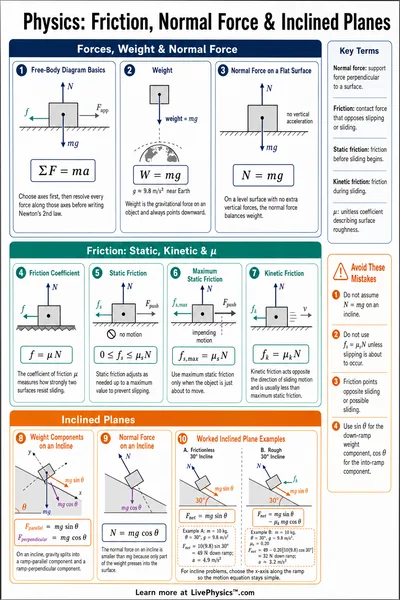
- Friction force on puck 3.92 N
Data Table
(0 rows)| # | Trial | Surface | Mass(kg) | Force(N) | Duration(s) | Peak v(m/s) | Total distance(m) | Time to stop(s) |
|---|
Reference Guide
Newton's First Law
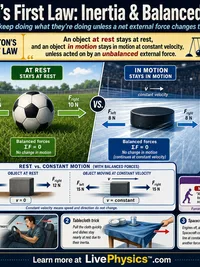
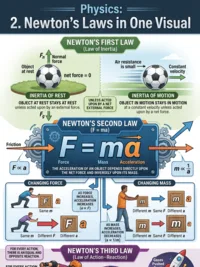
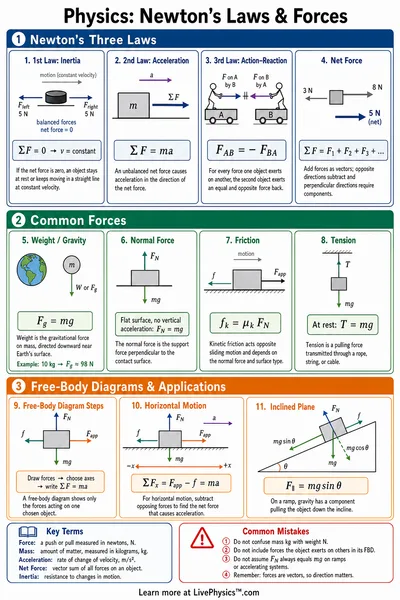
Newton's First Law says an object at rest stays at rest, and an object in motion stays in motion at constant velocity, unless an unbalanced force acts on it.
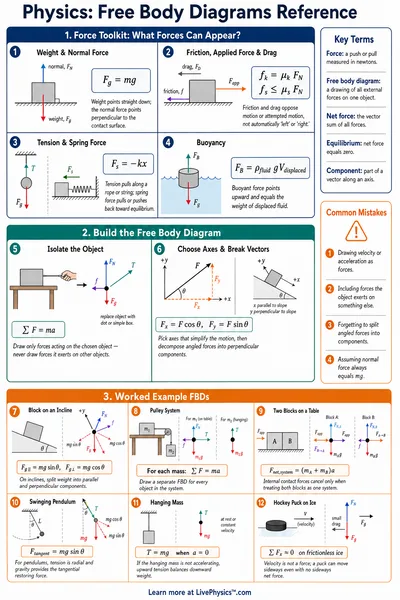
The applied push and the friction force on the puck are the forces in this experiment. When friction is the only force acting, it slows the puck and brings it to rest.
What is inertia?
Inertia is the tendency of an object to keep doing what it is already doing. A heavy hockey puck has more inertia than a light tennis ball, so the same push starts it moving more slowly.
Mass is the measure of inertia. Bigger mass means more inertia and a smaller acceleration for the same applied force.
Friction in everyday life
Surfaces feel slippery or rough because of friction. Ice has a tiny friction coefficient (about 0.05), while sand has a large one (about 0.60).
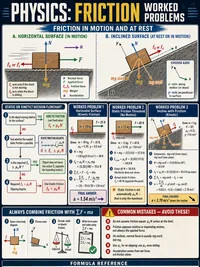
The friction force points opposite to the direction of motion. It slows a sliding object until the object stops. Without friction, the puck would slide forever.
Balanced vs unbalanced forces
When forces on an object cancel out, they are balanced and the motion does not change. When one force is bigger than the others, the forces are unbalanced and the object accelerates.
During the push, the applied force is greater than friction, so the puck speeds up. After the push, only friction acts, so the puck slows down until it stops.