Sign in to save

Bookmark this page so you can find it later.

Sign in to save

Bookmark this page so you can find it later.

Physics high-school May 20, 2026

Why GPS Knows Where You Are

Tiny time differences become a map position
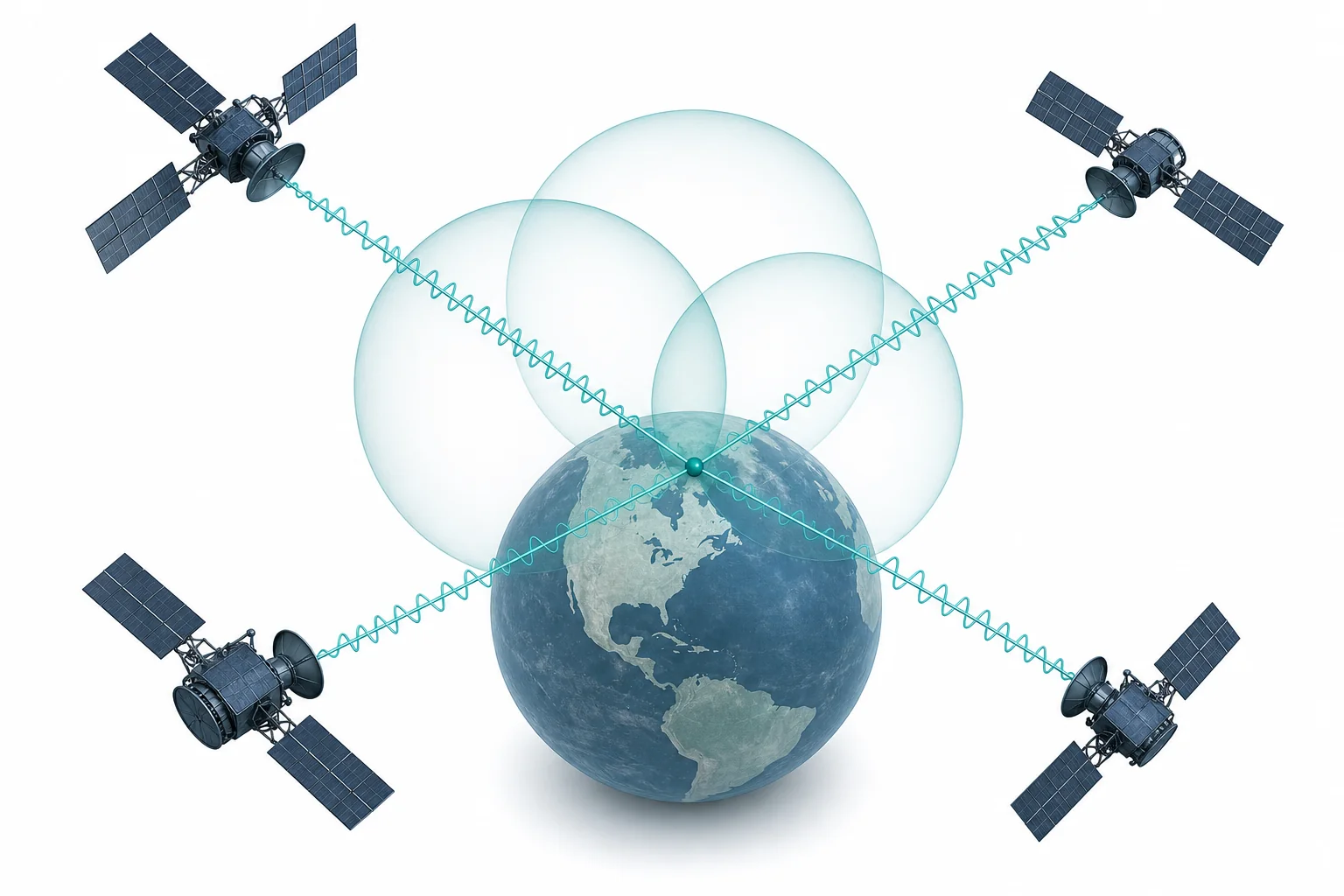
A phone on Earth receiving timing signals from several GPS satellites to determine its position.

GPS works by timing radio signals from satellites. Each time measurement tells your receiver how far it is from one satellite. With signals from several satellites, the receiver finds the one place where all those distances fit.

Big Idea. NGSS HS-PS4-1 connects GPS to waves, timing, and mathematical models of how information travels.

A phone does not know where it is by looking at a map first. It starts with timing. GPS satellites carry very accurate clocks and send radio signals that include the time the signal left the satellite. Your receiver compares that time with the time the signal arrives. Since radio waves travel at the speed of light, the time gap can be turned into a distance using $d = c\Delta t$. One signal gives a huge sphere of possible places. Two signals narrow the options. Three and four signals pin the answer down and correct the receiver clock. This is why GPS is really a physics system, not just a map app. It depends on wave speed, measurement uncertainty, and geometry. If you want to connect this idea to graphs and motion, try a related graphing calculator or a LivePhysics lab after the lesson.

Satellites send time
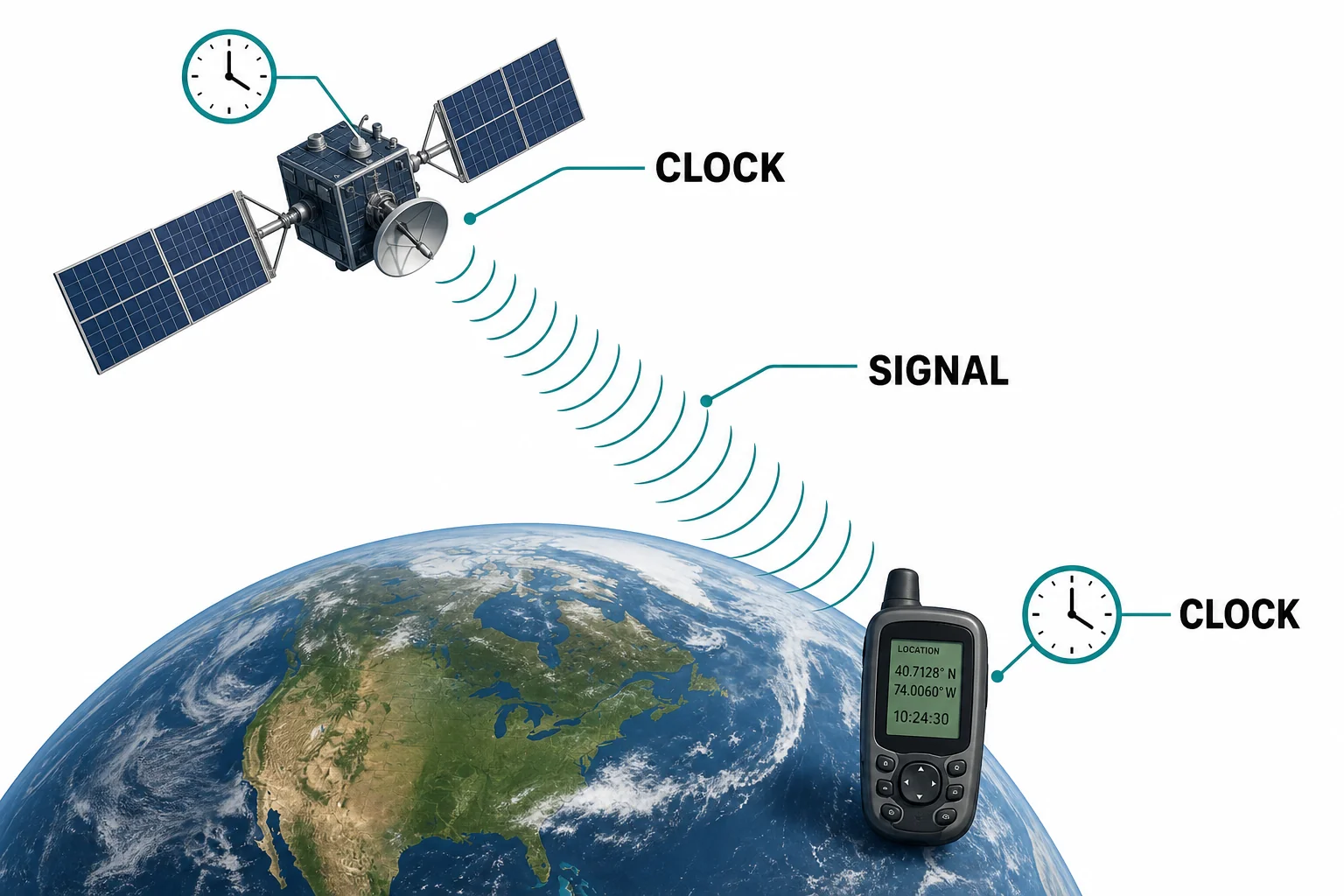
A GPS satellite sending a radio signal with a timestamp toward a receiver on Earth.
GPS begins with a timed radio signal.
Each GPS satellite broadcasts a radio signal over and over. The signal includes the satellite position and the exact time the message was sent. Your phone or GPS receiver does not send a question back to the satellite. It only listens. The important measurement is the travel time of the signal. Radio waves move at about 300,000,000 meters per second in a vacuum, so even a tiny timing error makes a large distance error. A clock error of one millionth of a second means about 300 meters. This is why GPS satellites carry atomic clocks. Your phone clock is not that good, so the receiver solves for its own clock error while it solves for position. The system turns time into distance, then distance into location.

GPS distance starts as a time measurement.

Time becomes distance
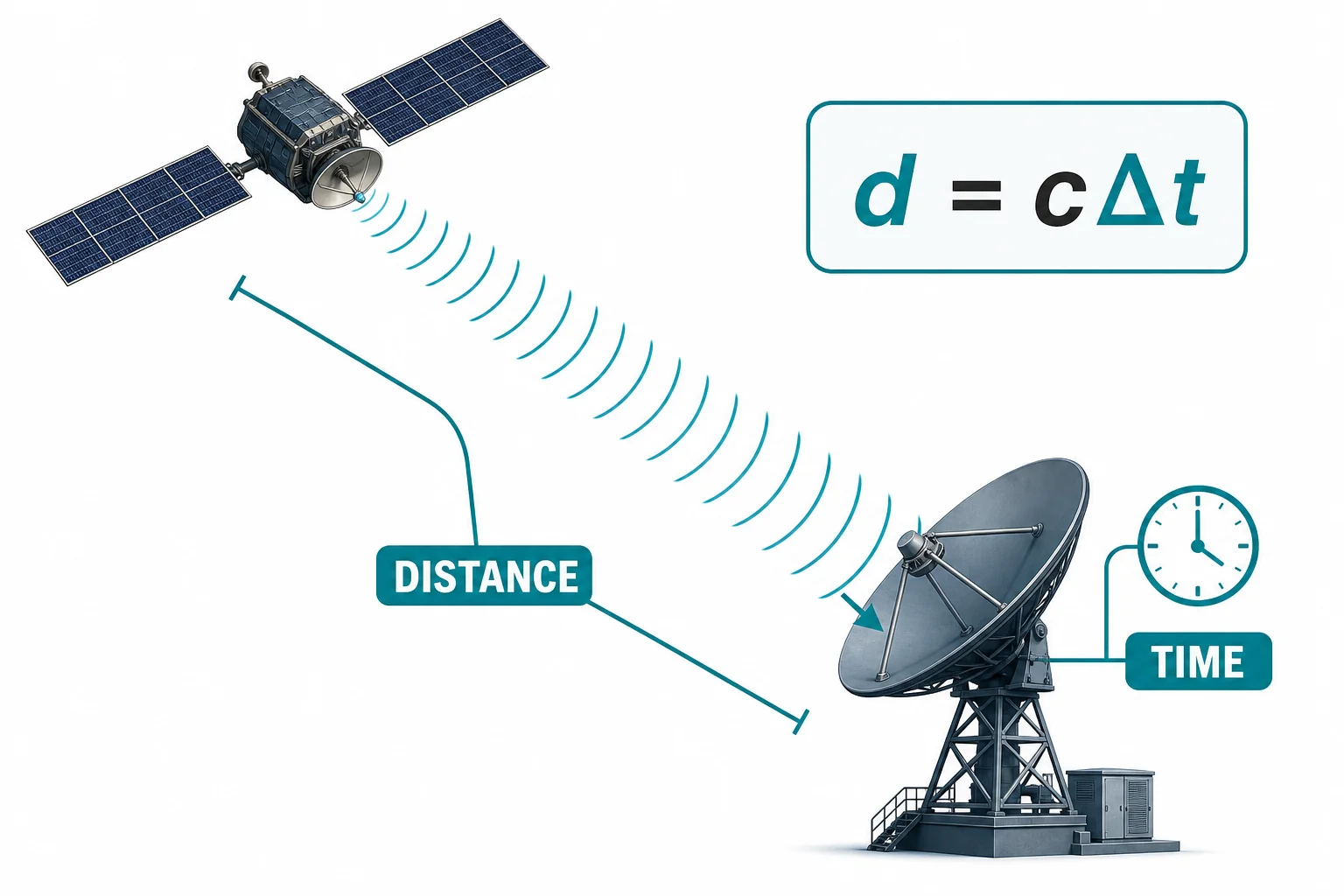
A diagram showing a radio wave path from a satellite to a receiver and the equation distance equals speed times time.
Known speed plus measured time gives distance.
A receiver finds distance by multiplying signal travel time by wave speed. The basic model is $d = c\Delta t$, where $c$ is the speed of light and $\Delta t$ is the time difference. If a signal takes 0.070 seconds to arrive, the path length is about 21,000 kilometers. That number is reasonable because GPS satellites orbit far above Earth. The receiver does not measure the satellite with a ruler. It measures a delay. This is a common physics move. When a wave speed is known, a travel time gives a distance. Sonar uses sound waves in water. Radar uses radio waves in air. GPS uses radio waves from space. The same idea appears in many wave technologies, which makes GPS a strong example for NGSS HS-PS4.

A few nanoseconds matter when signals move at light speed.

One distance is not enough
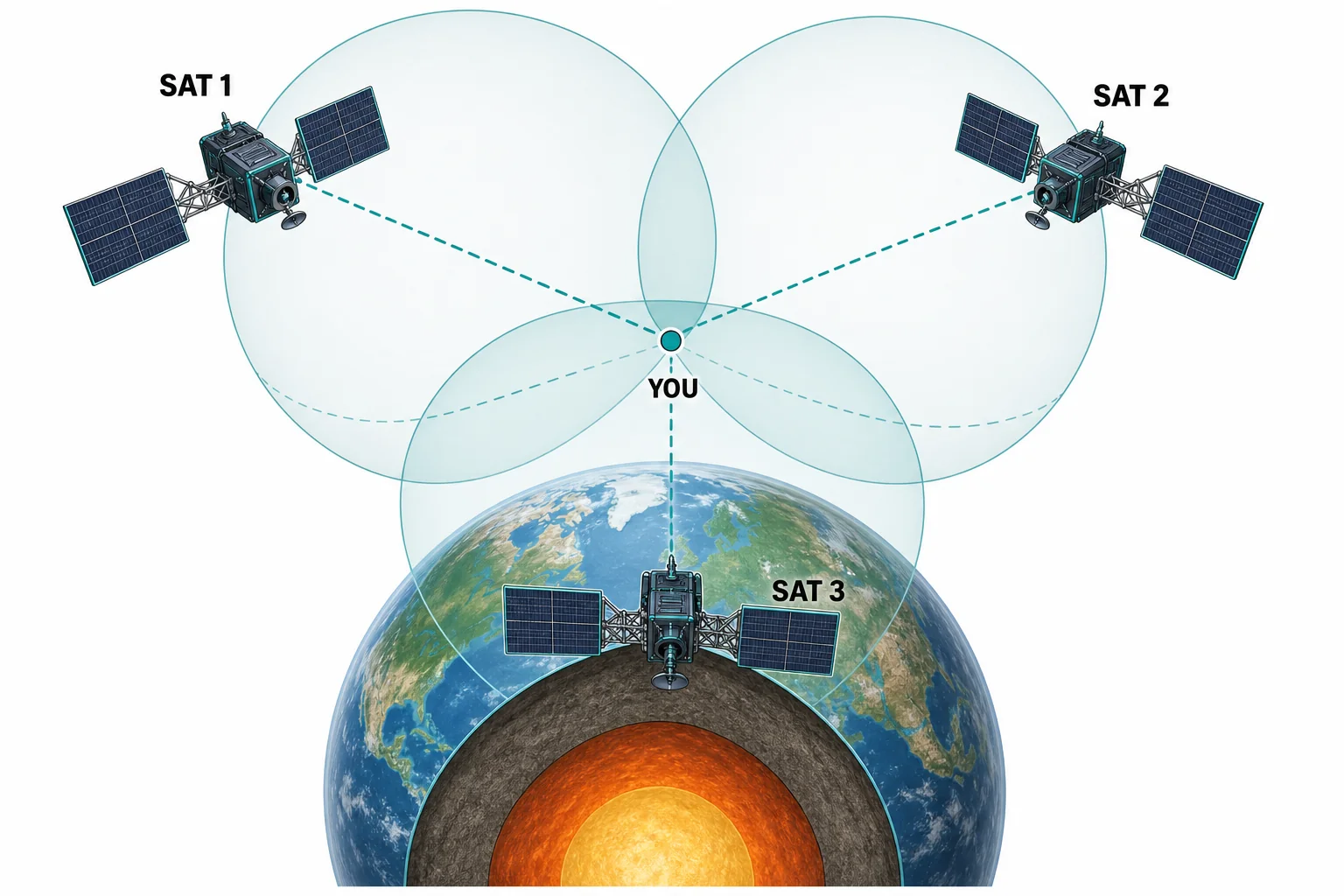
Three distance spheres from satellites intersecting near one receiver location on Earth.
Overlapping distance spheres narrow the location.
A single satellite distance does not give one location. It gives every point that is the same distance from that satellite. In three dimensions, those points form a sphere around the satellite. If the receiver is 20,000 kilometers from a satellite, it could be anywhere on that sphere. Earth cuts through the sphere, which removes many impossible points, but there are still many possible places. A second satellite creates a second sphere. The overlap is a circle. A third satellite narrows the overlap to a small number of points. A fourth satellite helps choose the correct point and fixes the receiver clock. This method is called trilateration, but the central idea is simple. Distances from known points can locate an unknown point.

GPS finds the overlap of several distance clues.

Four signals fix the clock
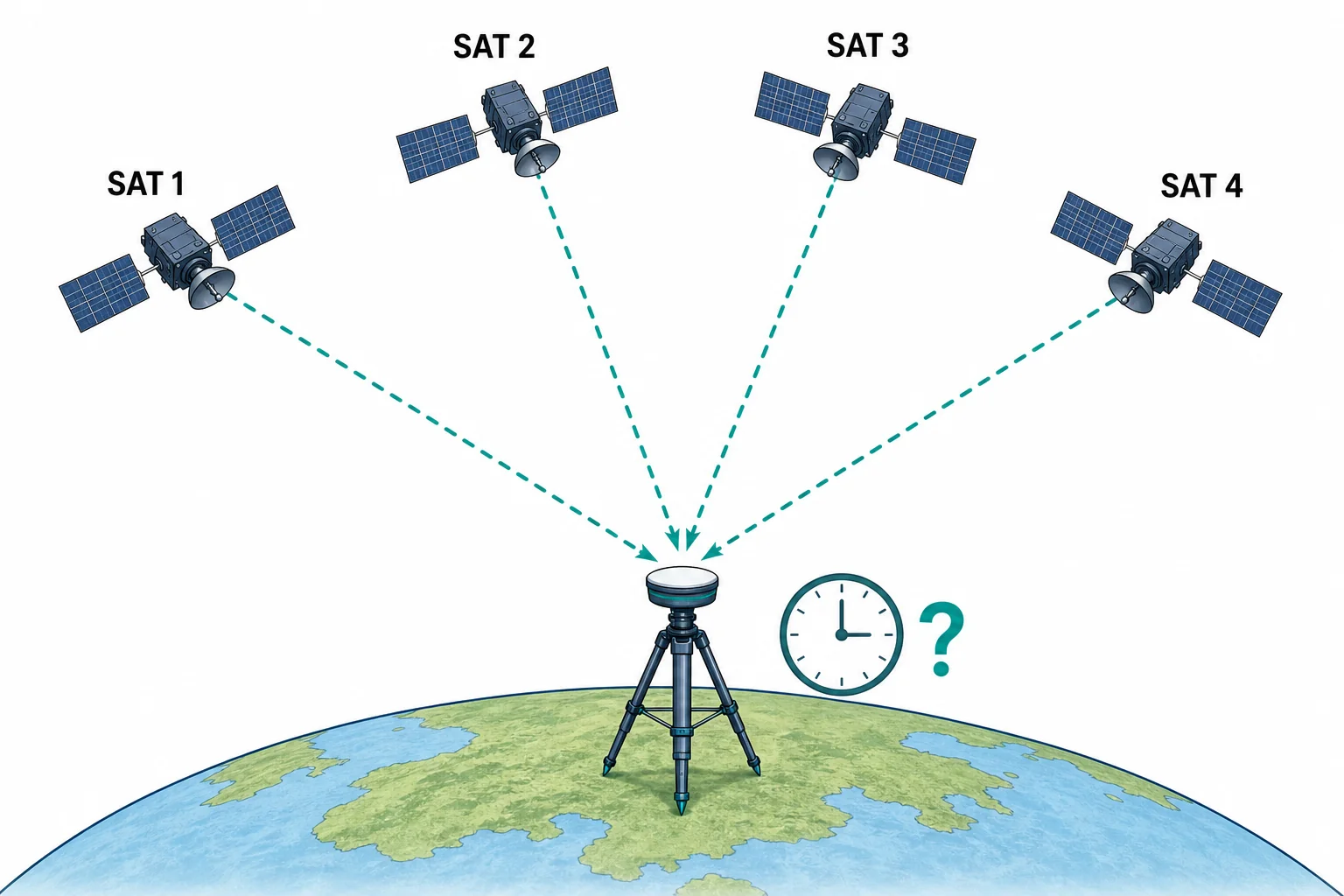
Four satellites sending signals to one receiver, with the receiver clock shown as an unknown being solved.
The fourth signal helps correct the receiver clock.
Many drawings say three satellites are enough. That is partly true if the receiver clock is perfect. A phone clock is not perfect enough for GPS. Since light travels so fast, a small clock offset looks like a large distance offset. GPS receivers solve for four unknowns. They need position in three directions and the receiver clock error. That is why four satellite signals are usually needed for a full fix. Extra satellites improve the result because the receiver can compare more measurements and reduce uncertainty. Buildings, mountains, trees, and the atmosphere can delay or reflect signals. The receiver uses math to find the most likely position from imperfect data. GPS is not magic. It is a fast calculation based on physics measurements.

Position and clock error are solved together.

Errors shape the blue dot
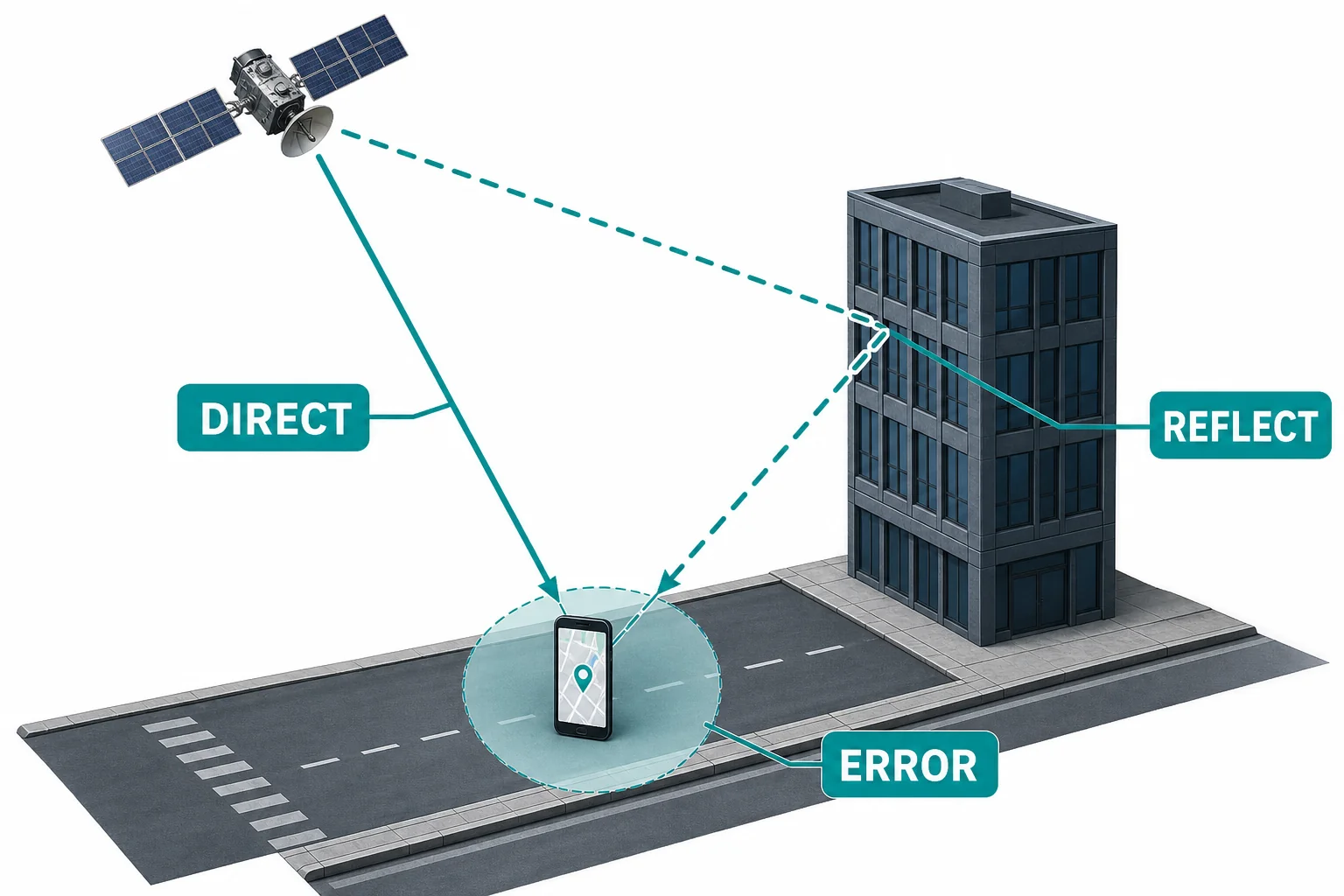
A receiver in a city where one GPS signal travels directly and another reflects off a building before arrival.
Reflections and delays can move the estimated position.
The blue dot on a phone is an estimate, not a perfect fact. Several effects can shift it. Signals slow slightly while passing through the ionosphere and atmosphere. They can bounce off buildings before reaching a receiver, which makes the path seem longer. Satellites also move quickly, so their positions must be predicted and updated. Even relativity matters. Satellite clocks run at a different rate because they are moving fast and because gravity is weaker in orbit. The GPS system corrects for those effects. Without those corrections, positions would drift by kilometers over time. This makes GPS a rich example of high school physics. Waves, speed, geometry, uncertainty, and modern technology all meet in one familiar blue dot.

GPS accuracy depends on both physics and signal conditions.

Vocabulary

GPS
A satellite navigation system that lets receivers estimate position from timed radio signals.
Trilateration
A method for finding a location by using distances from known points.
Radio wave
An electromagnetic wave used to carry information through space and the atmosphere.
Atomic clock
A clock that keeps very accurate time by using regular changes in atoms.
Signal delay
The time between when a signal is sent and when it is received.
Uncertainty
The range of possible error in a measurement or calculation.

In the Classroom

String trilateration map

25 minutes | Grades 9-12

Place three fixed points on a paper map and give students three distances to an unknown point. Students use string or compasses to draw circles and find the overlap. Connect the model to GPS by discussing why real receivers use spheres instead of flat circles.

Timing error calculation

20 minutes | Grades 9-12

Students calculate how far light travels in 1 microsecond, 100 nanoseconds, and 10 nanoseconds. They compare those distances with the size of a classroom, a city block, and a football field. This shows why GPS clocks must be extremely accurate.

Multipath signal model

30 minutes | Grades 9-12

Use a flashlight, a mirror, and a target to model direct and reflected paths. Students compare the lengths of the two paths and explain why a reflected signal can make a receiver overestimate distance. The activity links ray diagrams to real GPS errors.

Key Takeaways

  • GPS satellites send timed radio signals to receivers on Earth.
  • A receiver turns signal travel time into distance using the speed of light.
  • One satellite gives many possible locations, while several satellites narrow the answer.
  • A fourth satellite helps correct the receiver clock error.
  • Atmosphere, reflections, satellite motion, and relativity all affect GPS accuracy.
Content generated with AI assistance and reviewed by the LivePhysics editorial team. See sources below for original references.