Diffraction & Slits Lab
Observe how light bends around edges and interferes through slits. Switch between single-slit diffraction, double-slit interference, and multi-slit grating patterns. Tune wavelength, slit width, spacing, and screen distance to see how each parameter shapes the intensity pattern.
Guided Experiment Double-Slit Fringe Spacing
If you decrease the slit spacing d while keeping wavelength and screen distance constant, what do you predict will happen to the fringe spacing?
Write your hypothesis in the Lab Report panel, then click Next.
Diffraction Pattern- Double Slit
Controls
Results
| Order m | y_m (mm) | Angle (°) |
|---|---|---|
| 0 | 0.000 | 0.000 |
| 1 | 5.500 | 0.315 |
| 2 | 11.000 | 0.630 |
| 3 | 16.500 | 0.945 |
| 4 | 22.000 | 1.261 |
| 5 | 27.500 | 1.576 |
Double-Slit Intensity vs Screen Position
Data Table
(0 rows)| # | Trial | Order (m) | Wavelength(nm) | Slit Spacing(μm) | Screen Dist(m) | Fringe y_m(mm) | Fringe Spacing(mm) |
|---|
Reference Guide
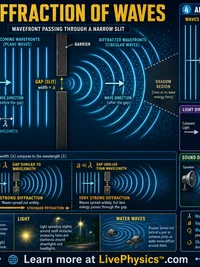
Diffraction
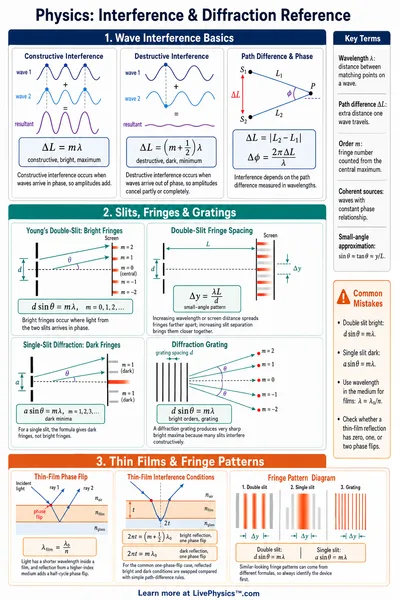
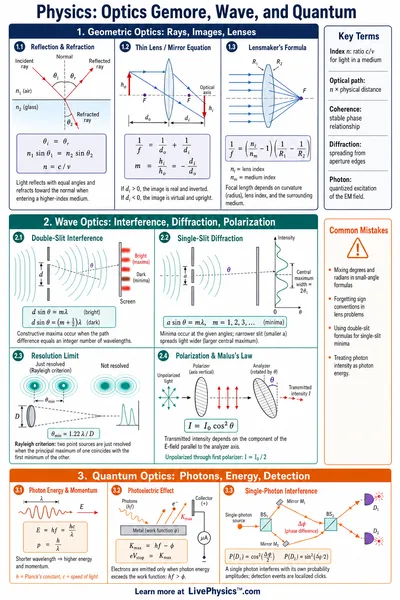
Diffraction occurs when a wave encounters an obstacle or opening comparable in size to its wavelength. Light spreads beyond the geometric shadow and creates an intensity pattern of bright and dark bands.
The amount of spreading grows when the slit width shrinks relative to the wavelength. Wide slits produce narrow central maxima; narrow slits spread light into broad patterns.
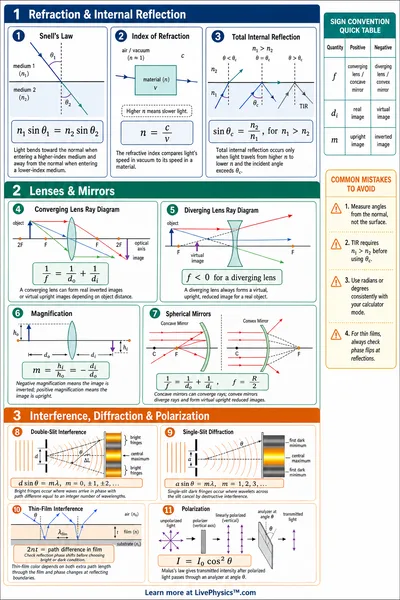
Minima of the single-slit pattern occur where , with integer .
Single-Slit Pattern
A single slit of width produces a central bright maximum flanked by progressively weaker secondary maxima. The first dark fringe appears at angle .
The width of the central maximum (from the first dark fringe on each side) on a screen at distance is approximately . Narrowing the slit broadens the central maximum.
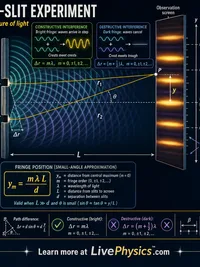
Double-Slit Interference
Two slits separated by distance produce bright fringes wherever light from each slit arrives in phase. Constructive interference occurs at angles satisfying .
The fringe spacing on the screen increases when the wavelength is longer or the screen is further away, and decreases when the slit spacing grows. The single-slit diffraction envelope modulates the overall pattern, suppressing fringes near the single-slit minima.
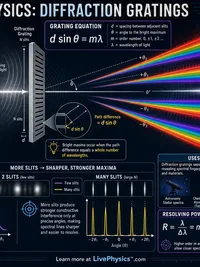
Diffraction Gratings
A diffraction grating has many slits spaced equally at distance . The principal maxima obey the same formula as double-slit maxima, but the peaks become extremely sharp because destructive interference from all the other slits fills the gaps.
With slits, the peak intensity scales as and the peak width narrows as . Gratings are used in spectroscopy to separate wavelengths by diffracting them to different angles.