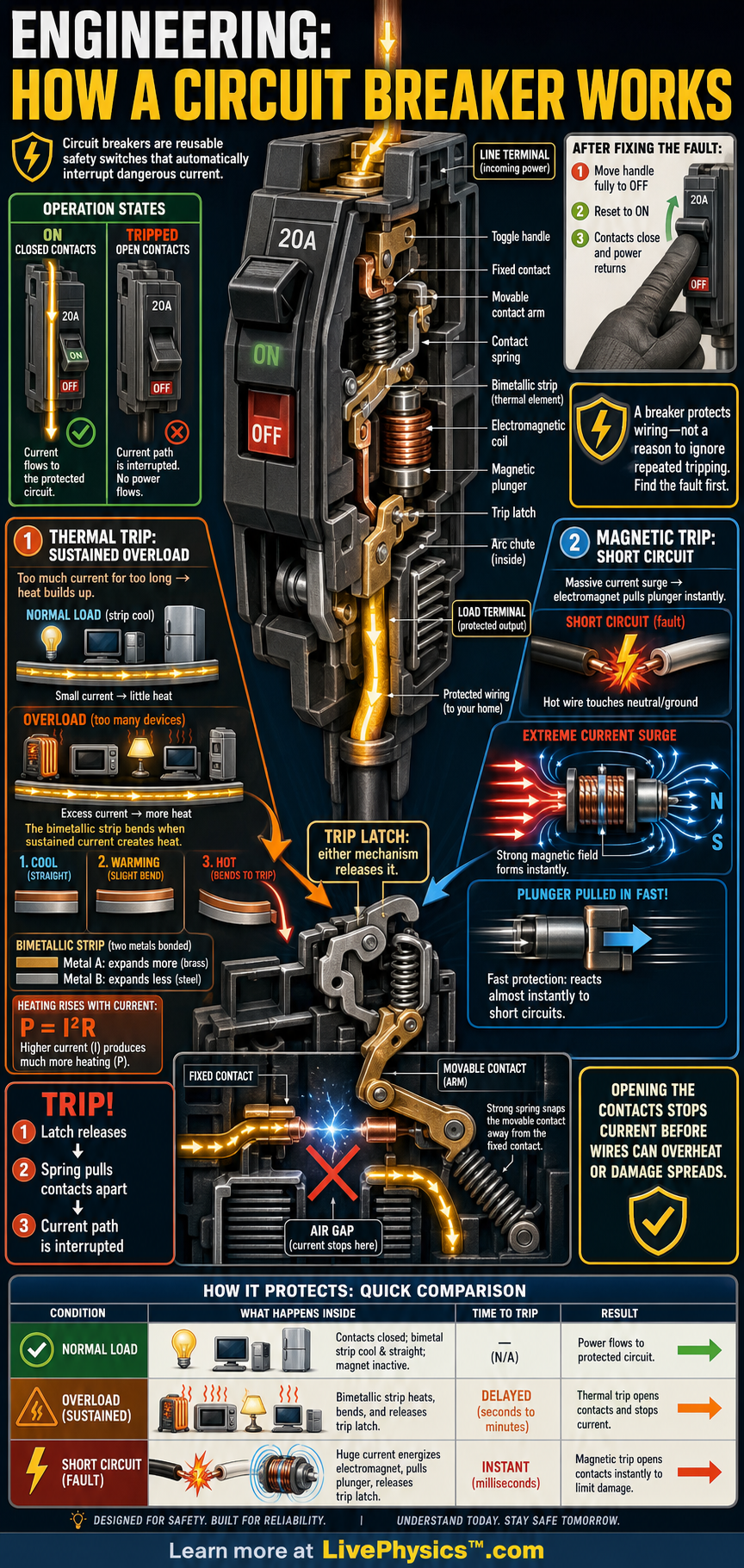
A circuit breaker is a safety switch that automatically opens a circuit when the current becomes dangerous. It protects building wires from overheating, which can damage insulation and start fires. Unlike a fuse, a breaker can usually be reset after the fault is fixed.
Household breakers are designed to carry normal current while responding quickly to overloads and short circuits.
Inside the breaker, current passes through contacts, a bimetallic strip, and often an electromagnetic coil. During a sustained overload, heating makes the two-metal strip bend until it releases a latch. During a short circuit, a very large current creates a strong magnetic field that pulls a trip mechanism almost instantly.
The released latch separates the contacts, interrupting the current path, and the toggle moves to the tripped position until the breaker is reset.
Understanding Engineering, How a Circuit Breaker Works
Breaking a large current is harder than simply pulling two metal pieces apart. As the contacts separate, the electric field across the tiny gap can ionize the air. This creates an electric arc that carries current briefly through the gap.
The arc is extremely hot and can damage the contacts. Many breakers contain an arc chute made of metal plates. It stretches, cools, and splits the arc into smaller sections until it stops.
Springs give the moving contact enough speed to separate firmly. The latch and spring system must work consistently over many trips, so a breaker is a carefully designed mechanical device as well as an electrical one.
A breaker rating must match the wire it protects, not just the appliance connected to that wire. Thick wire can safely carry more current than thin wire because it has lower resistance and can release heat more easily. A circuit may run normally near its rated current for a limited time, yet a smaller extra load can eventually cause a trip.
This delayed response is useful. Motors, refrigerators, and power tools often draw a high starting current for a short moment. A breaker should allow that normal surge while stopping a current that remains too high.
Manufacturers describe this behavior with time current curves. These curves show that larger overloads cause faster trips.
Students meet breakers in the electrical panel of a home, school, or workshop. Individual breakers usually serve groups of outlets, lights, or fixed equipment. If one trips, the handle often rests between the on and off positions.
It should first be moved fully to off before being reset to on. Repeated tripping is evidence of a problem, such as too many devices on one circuit, damaged wiring, or a faulty appliance. Resetting a breaker again and again does not solve the cause.
It can allow damaged equipment to keep creating heat. Electrical panels contain dangerous live parts, so diagnosis inside a panel belongs to a qualified adult or electrician.
Not every electrical danger is an overcurrent. A person can receive a serious shock from a relatively small current leaking through an unintended path. Ground fault circuit interrupters are designed to detect an imbalance between the outgoing and returning current.
Arc fault interrupters look for electrical patterns linked to damaged connections or broken cords. These devices may be built into special breakers or outlets. When learning this topic, keep the different jobs separate.
Overcurrent protection mainly protects wires from excessive heating. Ground fault protection mainly reduces shock risk.
Arc fault protection helps detect sparking faults. All depend on interrupting the circuit quickly enough for the specific hazard.
Key Facts
- A circuit breaker is connected in series with the circuit it protects.
- Normal operation requires I_load <= I_rated.
- Electrical heating in a conductor follows P = I^2R.
- A bimetallic strip bends because its two bonded metals expand by different amounts when heated.
- An electromagnet produces a magnetic field whose strength increases as current increases.
- Opening the contacts breaks the current path, I = 0 A in the protected branch after interruption.
Vocabulary
- Circuit breaker
- A resettable protective switch that opens a circuit when current becomes unsafe.
- Overload
- A condition in which a circuit carries more current than its wires or devices are designed to handle for an extended time.
- Short circuit
- An unintended low-resistance path that allows a very large current to flow.
- Bimetallic strip
- A bonded strip of two different metals that bends when heated because the metals expand by different amounts.
- Electromagnet
- A coil that creates a magnetic field when electric current flows through it.
Common Mistakes to Avoid
- Thinking a breaker limits current to its rating, which is wrong because it allows normal current and only opens after its trip mechanism responds to excess current.
- Treating an overload and a short circuit as the same event, which is wrong because overloads commonly trip through heating over time while short circuits cause a rapid magnetic trip.
- Assuming a tripped breaker can safely be reset repeatedly, which is wrong because the underlying faulty appliance, damaged wire, or overloaded circuit must be found first.
- Believing the breaker protects every device from all damage, which is wrong because its main purpose is protecting circuit wiring from overcurrent rather than regulating voltage or preventing every appliance failure.
Practice Questions
- 1 A 120 V heater has a resistance of 12 ohms. Calculate the current it draws and decide whether it can run alone on a 15 A breaker.
- 2 A wire section has resistance 0.20 ohms and carries 18 A during an overload. Calculate the heating power using P = I^2R.
- 3 A breaker trips immediately when a lamp is switched on, but it does not trip after many minutes of normal use. Explain whether the electromagnetic trip or the bimetallic-strip trip is more likely responsible, and why.