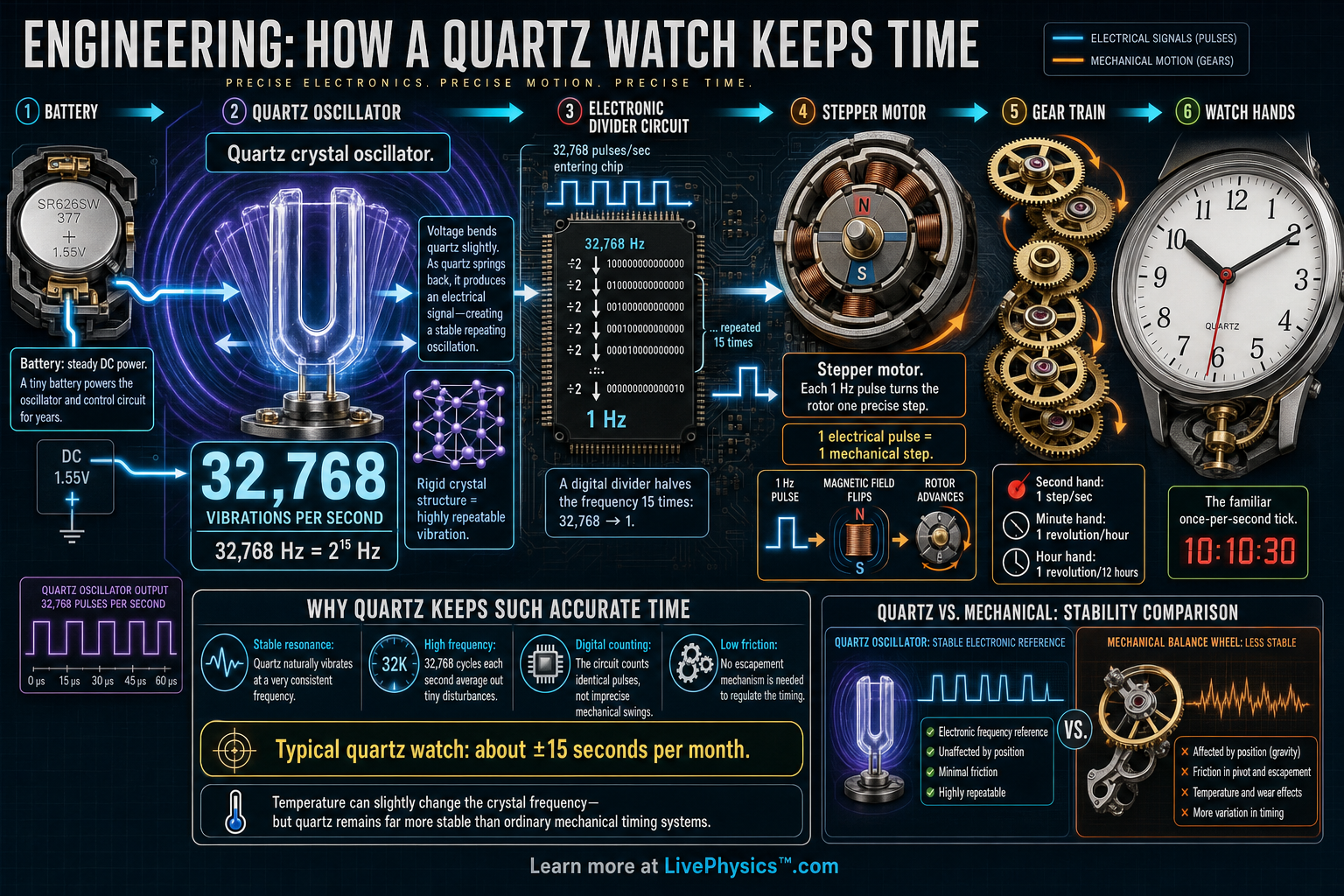
The battery energizes an electronic oscillator circuit, which uses the piezoelectric properties of quartz to keep the crystal vibrating at its natural frequency. A divider circuit repeatedly halves 32,768 Hz until it produces one electrical pulse each second, 32,768 / 2^15 = 1 Hz. Each pulse drives a stepper motor, turning its rotor by a small fixed angle.
A gear train reduces and transfers this motion so the second, minute, and hour hands move at their required rates.
Understanding Engineering, How a Quartz Watch Keeps Time
A watch crystal is not just a random piece of quartz. It is cut into a precise shape, often like a tiny tuning fork, so one vibration pattern is especially stable. Metal electrodes are placed on its surface.
The electronic circuit sends a small changing voltage to these electrodes. The crystal bends back and forth, producing its own electrical signal as it moves. Part of that signal is fed back into the circuit.
This feedback keeps the motion going and rejects many unwanted frequencies. The result is a very regular electronic rhythm made from the crystal’s physical motion.
The crystal behaves like a tuning fork because it has resonance. A playground swing has a natural rhythm, and small pushes at the right time make its motion grow. Pushes at the wrong time do little.
In a watch, the oscillator circuit provides tiny timed pushes. It must match the phase of the crystal’s motion. If the feedback arrives too early or too late, the vibration becomes weaker or unstable.
Engineers design the circuit so the crystal controls the timing rather than the battery or the rest of the electronics. This is why a quartz watch can keep running as its battery slowly loses charge, until the voltage becomes too low for the circuit or motor.
The electronic timing signal is extremely fast compared with visible hand motion. Digital circuits are useful here because they can count using on and off states. A chain of memory elements changes state in sequence, making a signal that is half as fast at each stage.
This is efficient because the chosen crystal rate fits binary counting exactly. The final timing pulse contains very little energy. A separate driver circuit briefly sends a stronger current through a coil near the stepper motor.
The coil creates a magnetic field that pulls or pushes the rotor into its next position. Tiny gears then trade fast, small motor movements for slow, useful motion at the hands. Gear teeth must be made accurately so the hands do not slip or bind.
Quartz timing is good, though it is not perfect. Temperature changes slightly alter the crystal’s dimensions and stiffness, which changes its vibration rate. Aging, mechanical shock, moisture damage, and manufacturing differences can create small errors too.
A basic watch may gain or lose several seconds in a month. Better watches use carefully chosen crystal cuts, factory calibration, or temperature compensation. When learning this system, keep the stages separate.
The crystal creates a stable reference. The electronics count that reference. The motor turns an electrical pulse into motion.
The gears set the rates of the hands. Each stage solves a different engineering problem, and a fault in any one stage can make the watch lose time or stop.
Key Facts
- Quartz is piezoelectric, mechanical stress produces voltage, and an applied voltage can produce mechanical vibration.
- A common watch crystal frequency is f = 32,768 Hz.
- 32,768 = 2^15, so binary divider circuits can reduce the signal exactly to 1 Hz.
- Frequency division follows f_out = f_in / 2^n.
- For a 15-stage divider, 32,768 Hz / 2^15 = 1 pulse/s.
- The stepper motor converts each 1 Hz electrical pulse into a small, controlled mechanical step.
Vocabulary
- Quartz crystal
- A precisely shaped piece of quartz that vibrates at a stable natural frequency when driven electrically.
- Piezoelectric effect
- The ability of certain materials, including quartz, to convert mechanical deformation and electrical voltage into each other.
- Oscillator
- An electronic system that produces a repeating electrical signal at a controlled frequency.
- Frequency divider
- A digital circuit that lowers an input frequency by producing an output pulse after a fixed number of input cycles.
- Stepper motor
- A motor that rotates through small fixed angles in response to individual electrical pulses.
Common Mistakes to Avoid
- Thinking the battery determines the watch's timing. The battery provides energy, while the quartz crystal's resonant vibration provides the timing reference.
- Saying that 32,768 Hz means the second hand moves 32,768 times per second. The divider circuit reduces this frequency to one pulse per second before the motor is driven.
- Dividing 32,768 by 15 to find the one-second signal. The circuit halves the frequency 15 times, so the correct calculation is 32,768 / 2^15.
- Assuming quartz watches are perfectly accurate forever. Temperature changes, crystal aging, and electronic tolerances can cause small timing errors.
Practice Questions
- 1 A quartz crystal vibrates at 32,768 Hz. How many complete vibrations does it make in 5.0 s?
- 2 A divider circuit halves a 32,768 Hz signal 15 times. Calculate the output frequency in hertz.
- 3 Explain why a quartz watch uses both a high-frequency crystal oscillator and a gear train instead of connecting the crystal directly to the watch hands.