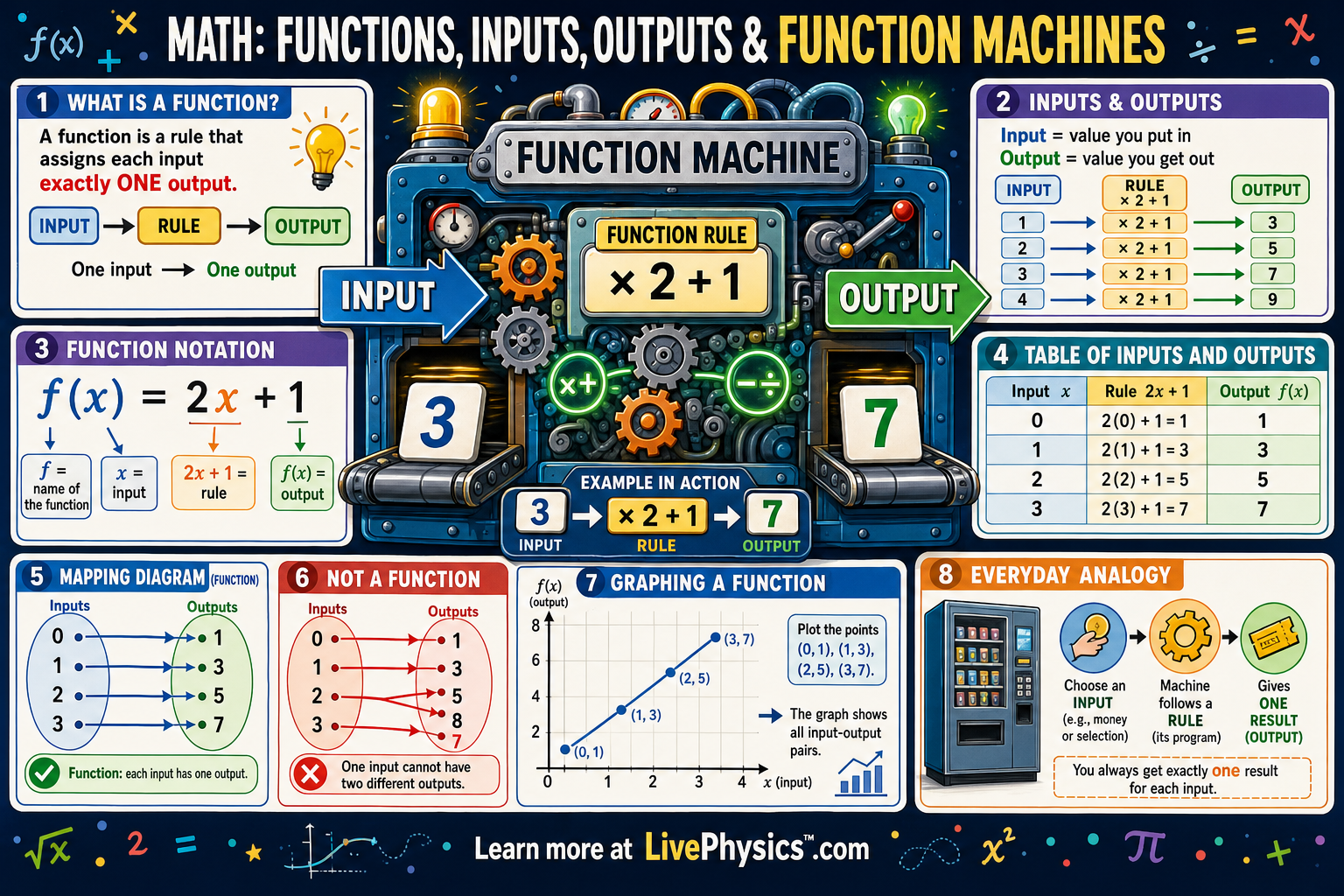
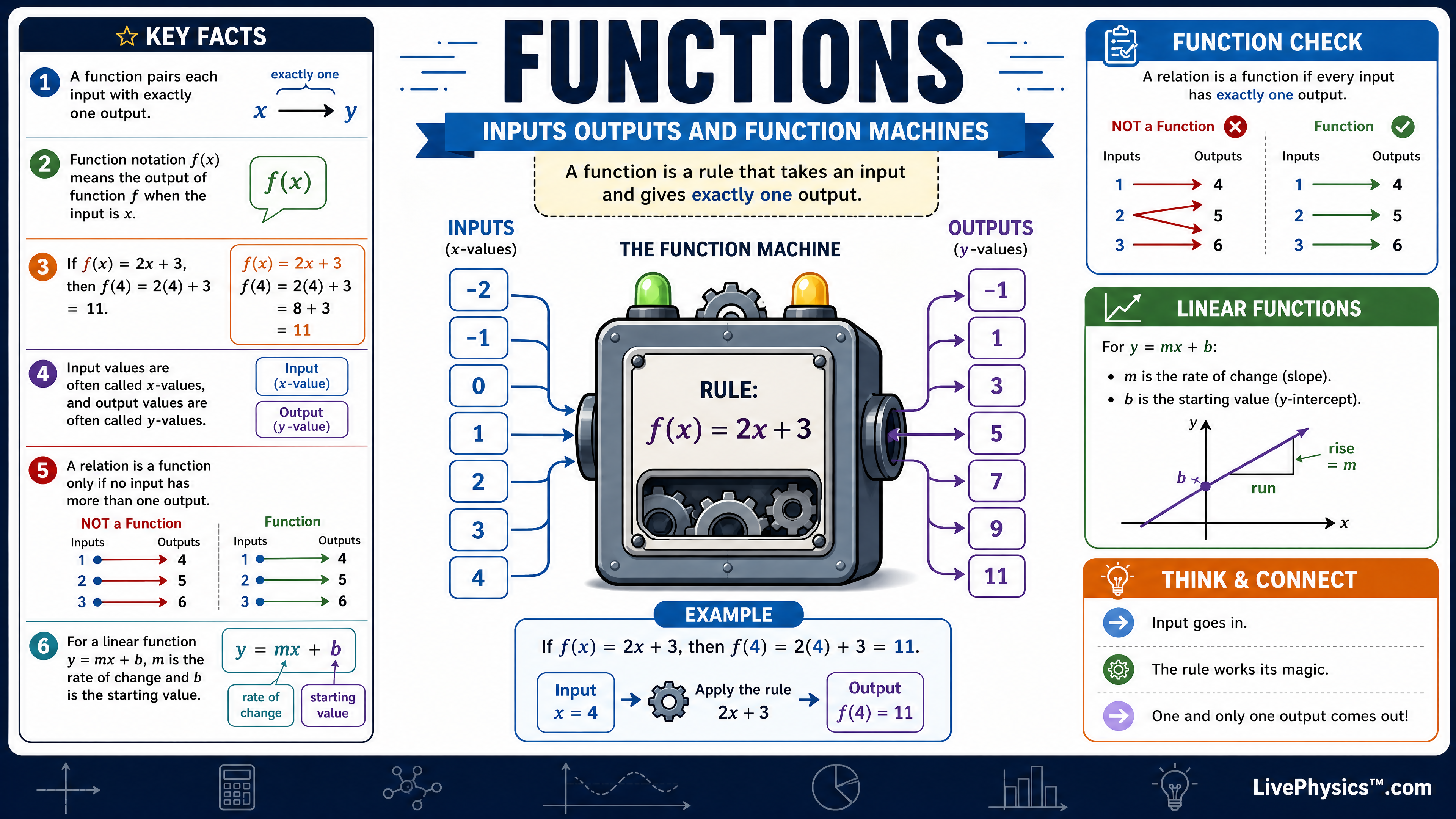
A function is a rule that takes an input and gives exactly one output. You can imagine a function as a machine: a number goes in, the machine follows a rule, and a result comes out. Functions matter because they help describe patterns, relationships, and changes in math and science.
They are used in tables, graphs, equations, and real-world models like cost, distance, and temperature.
Understanding Functions
A function has a domain, which is the set of inputs that make sense for the rule. It has a range, which is the set of outputs it can produce. These sets are important because a rule is not always useful for every number.
A rule involving division cannot use zero as a divisor. A rule that finds the square root of a number usually uses zero or positive inputs in basic school math. Real situations create limits too.
The number of tickets sold cannot be negative, and a time measured after a race begins usually starts at zero. Always notice what values are possible before using a rule.
Function notation is a compact way to name a process. The letter f is just a label, like the name of a machine. Reading f of five means put five into the rule named f.
The parentheses do not mean multiplication. This is a common mistake. When an input includes a negative number or an expression, parentheses help keep the substitution clear.
For example, if a rule says multiply the input by three, then subtract two, f of negative four means multiply negative four by three first, then subtract two. Following the order of operations matters because a small substitution error changes every later answer.
Graphs show how outputs change as inputs move across a set of values. The horizontal axis usually represents the input. The vertical axis usually represents the output.
A graph can be checked with the vertical line test. If a vertical line would cross the graph in more than one place, the graph does not represent a function. This test works because one horizontal position would be linked to different vertical positions.
On a straight line graph, the slope describes how much the output changes when the input increases by one. A positive slope rises from left to right, while a negative slope falls. A zero slope means the output stays constant.
Functions help students make predictions from patterns, but predictions are only reliable within a sensible range. A taxi fare may have a starting charge followed by a cost for each kilometre. A phone plan may include a fixed monthly fee followed by a charge for extra data.
In both cases, the starting amount and the rate of change have meanings beyond the graph. Pay attention to units. A rate of three dollars per kilometre is different from three kilometres per dollar.
Check tables for repeated inputs, read graph scales carefully, and describe what each number means in the situation. These habits make function work more accurate in algebra, science experiments, and everyday planning.
Key Facts
- A function pairs each input with exactly one output.
- Function notation f(x) means the output of function f when the input is x.
- If f(x) = 2x + 3, then f(4) = 2(4) + 3 = 11.
- Input values are often called x-values, and output values are often called y-values.
- A relation is a function only if no input has more than one output.
- For a linear function y = mx + b, m is the rate of change and b is the starting value.
Vocabulary
- Function
- A function is a rule that assigns each input exactly one output.
- Input
- An input is the value put into a function, often represented by x.
- Output
- An output is the value produced by a function, often represented by y or f(x).
- Function notation
- Function notation, such as f(x), names a function and shows which input value is being used.
- Rate of change
- Rate of change describes how much the output changes when the input increases by 1.
Common Mistakes to Avoid
- Treating f(x) as f times x is wrong because f(x) means the output of a function named f for the input x.
- Allowing one input to have two different outputs is wrong because a function must give exactly one output for each input.
- Forgetting to follow the order of operations is wrong because a function rule like 3x + 2 must multiply before adding.
- Confusing input and output is wrong because the input goes into the rule and the output is the result after the rule is applied.
Practice Questions
- 1 A function machine uses the rule f(x) = 4x - 1. Find f(2), f(5), and f(10).
- 2 Complete the table for the rule y = 3x + 2 when x = 0, 1, 2, 3, and 4.
- 3 A relation includes the pairs (1, 4), (2, 5), (3, 6), and (2, 8). Explain whether this relation is a function and why.