
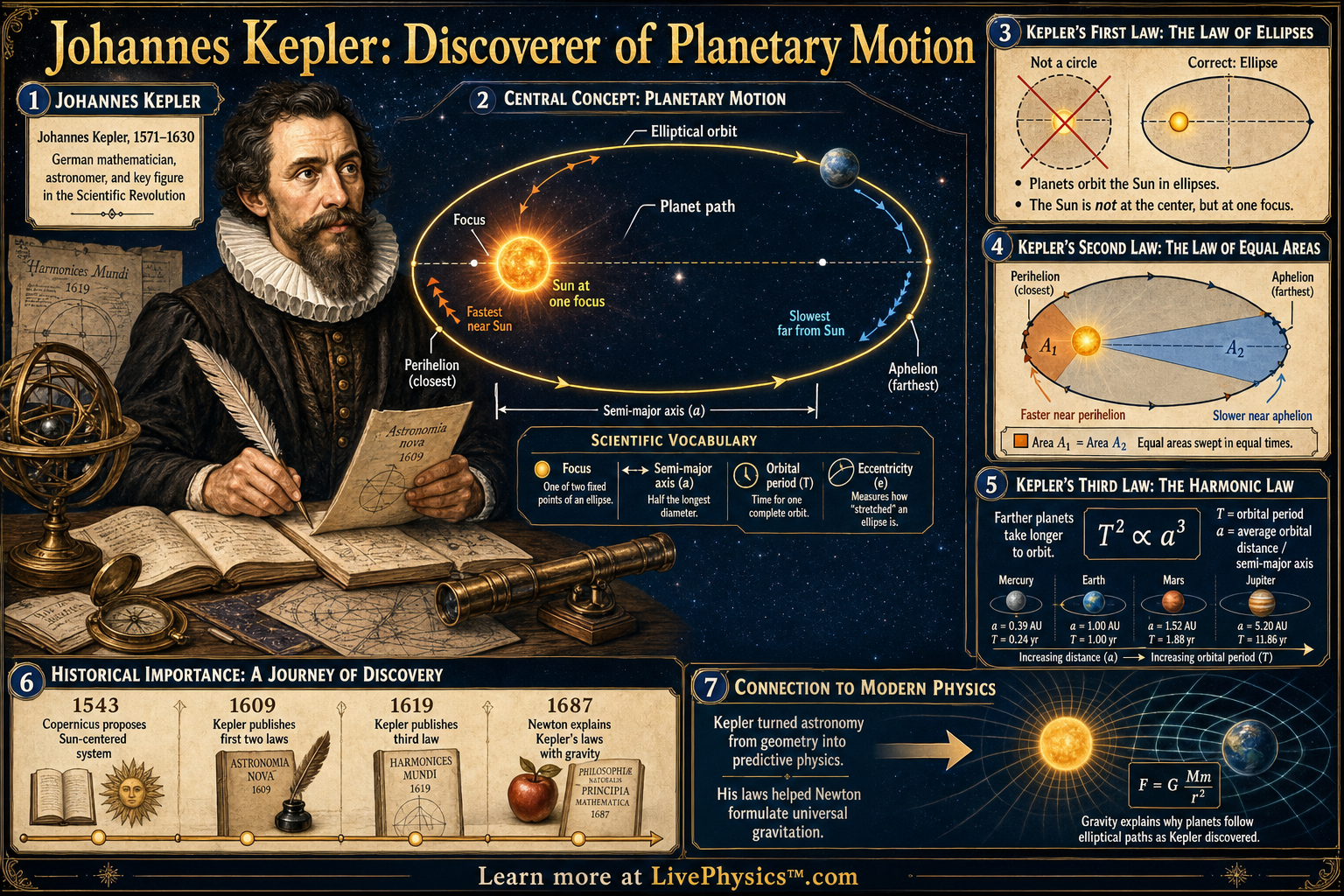
Johannes Kepler was a German mathematician and astronomer who transformed astronomy by finding the mathematical rules behind planetary motion. Using careful observations collected by Tycho Brahe, Kepler showed that planets do not move in perfect circles. His three laws helped replace older Earth-centered and circular-orbit models with a more accurate heliocentric picture.
These laws became a foundation for Newton's law of universal gravitation and modern orbital mechanics.
Kepler's first law says each planet travels in an ellipse with the Sun at one focus, not at the center. His second law says a line from the Sun to a planet sweeps out equal areas in equal times, so planets move faster when closer to the Sun and slower when farther away. His third law connects a planet's orbital period to the size of its orbit using T^2 proportional to a^3.
Together, these laws explain planetary speeds, predict orbits, and connect observation with mathematical physics.
Understanding Johannes Kepler, Discoverer of Planetary Motion Laws
An ellipse is not simply a squashed circle. Its shape can range from nearly circular to very stretched. The amount of stretching is called eccentricity.
Earth has a low eccentricity, so its path looks almost like a circle in many diagrams. Mercury has a more noticeable ellipse. This matters because the distance between a planet and the Sun changes during an orbit.
The closest point is called perihelion. The farthest point is called aphelion.
Students should remember that an ellipse has a center, but the Sun is displaced from that center. Placing the Sun at the center is a common diagram error.
The equal-area rule gives a precise way to understand changing speed. Imagine drawing a line from the Sun to a planet at two moments. In a short time near perihelion, the planet travels a longer curved section of its path.
The narrow wedge-shaped area still matches the area swept during the same time near aphelion, where the planet moves through a shorter section. This pattern is connected to gravity. A planet is pulled more strongly when it is closer to the Sun.
Newton later explained the deeper reason using gravitational force and conservation of angular momentum. Kepler described the motion accurately before the physical cause was known.
The third law is especially useful for comparing different orbits. A planet farther from the Sun has a much longer year, not merely a slightly longer one. If the average orbital distance becomes larger, the period increases rapidly.
For planets orbiting the Sun, when distance is measured in astronomical units and time is measured in years, period squared equals average distance cubed. Earth provides the simple reference case because its period is one year and its average distance is one astronomical unit.
This relationship applies to objects orbiting the same central body. Moons around Jupiter follow a similar pattern, though the numerical constant is different because Jupiter has a different mass.
Kepler's work shows why accurate measurements matter in science. Earlier models could use circles plus extra smaller circles to match much of what observers saw. They failed when tested against the most precise measurements.
Mars was particularly important because its orbit is noticeably noncircular. Small differences between prediction and observation forced Kepler to reject an appealing old idea. He spent years testing possible paths and calculations.
This is a useful lesson for physics students. A model is not accepted because it looks neat. It must agree with evidence, including the awkward results that do not fit expectations.
Kepler's laws are used far beyond the planets. Engineers use related ideas when planning satellite orbits around Earth. A satellite in an elliptical orbit changes speed just as a planet does.
Its position and speed determine when it can communicate with ground stations or observe a particular region. Spacecraft can use elliptical transfer orbits to move from one orbit to another while saving fuel. When studying these laws, pay close attention to the difference between orbital path, orbital speed, and orbital period.
They are linked, but they are not the same quantity. Careful diagrams, consistent units, and clear labels prevent many mistakes.
Key Facts
- Kepler's first law, Planets move in elliptical orbits with the Sun at one focus.
- Kepler's second law, a line from the Sun to a planet sweeps out equal areas in equal times.
- Kepler's third law, T^2 is proportional to a^3 for planets orbiting the same star.
- For objects orbiting the Sun using years and astronomical units, T^2 = a^3.
- An ellipse has two foci, and the Sun occupies one focus of a planet's orbit.
- Kepler used Tycho Brahe's precise observations, especially of Mars, to discover that circular orbits did not fit the data.
Vocabulary
- Ellipse
- An ellipse is a stretched circle-shaped curve with two special points called foci.
- Focus
- A focus is one of the two fixed points inside an ellipse, with the Sun located at one focus in Kepler's first law.
- Orbital period
- Orbital period is the time an object takes to complete one full orbit around another object.
- Semi-major axis
- The semi-major axis is half the longest width of an ellipse and represents the average orbital size in Kepler's third law.
- Heliocentric model
- The heliocentric model is the view that planets orbit the Sun rather than Earth.
Common Mistakes to Avoid
- Putting the Sun at the center of every elliptical orbit is wrong because Kepler's first law places the Sun at one focus, not generally at the ellipse's center.
- Assuming planets move at constant speed is wrong because Kepler's second law shows they move faster near the Sun and slower farther away.
- Using T proportional to a^3 is wrong because Kepler's third law states T^2 is proportional to a^3, so the period must be squared.
- Mixing units in T^2 = a^3 is wrong because the simple form works for Solar System orbits only when T is in years and a is in astronomical units.
Practice Questions
- 1 A planet orbiting the Sun has a semi-major axis of 4 AU. Using T^2 = a^3, find its orbital period in years.
- 2 An asteroid has an orbital period of 8 years around the Sun. Using T^2 = a^3, find its semi-major axis in AU.
- 3 A planet is observed to move faster during one part of its orbit and slower during another. Use Kepler's laws to explain where it is relative to the Sun when it moves fastest and why.