
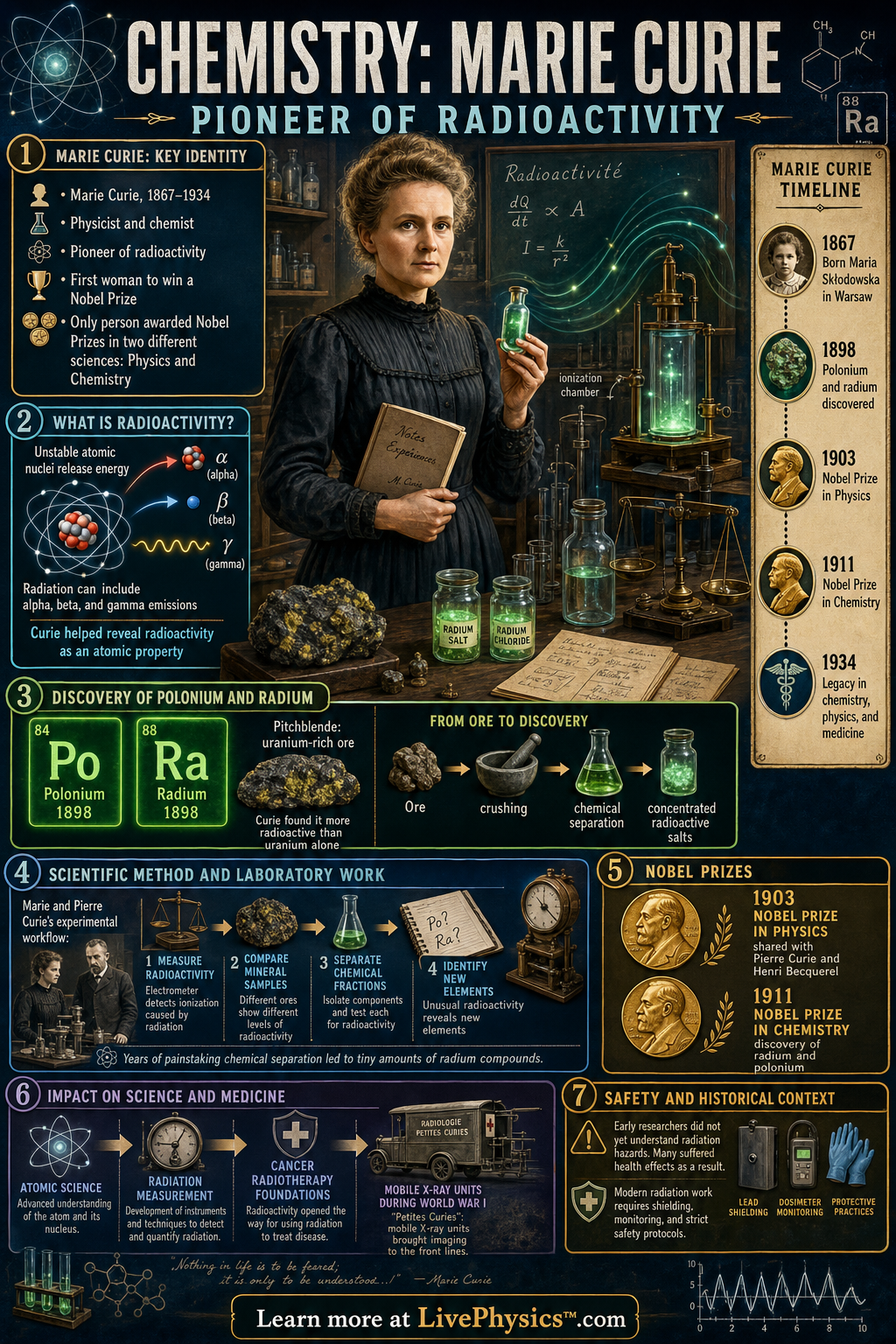
Marie Skłodowska Curie was a physicist and chemist whose work changed how scientists understand matter, atoms, and energy. Born in Warsaw in 1867, she moved to Paris to study science and became the first woman to win a Nobel Prize. With Pierre Curie and Henri Becquerel, she shared the 1903 Nobel Prize in Physics for research on radioactivity.
She later won the 1911 Nobel Prize in Chemistry for discovering and studying the elements polonium and radium.
Understanding Marie Curie, Pioneer of Radioactivity
Curie’s research began with a puzzling observation. Some minerals could make the air conduct electricity without heat, light, or a chemical reaction being supplied from outside. She measured this effect using an electrometer, an instrument developed by Pierre Curie and his brother.
Radiation ionises air by knocking electrons away from atoms. The newly charged particles allow a small electric current to flow.
A stronger current meant a more active sample. This careful measurement mattered because it turned an unusual observation into evidence that could be compared, checked, and repeated.
The source of radiation lies inside the atomic nucleus. A stable nucleus has a balance of particles and energy that can last for an extremely long time. An unstable nucleus can change by itself into a different nucleus.
During that change it releases radiation. The exact moment when one atom decays cannot be predicted. A large group of atoms follows a dependable pattern.
After one half life, half of the original undecayed nuclei remain on average. After two half lives, one quarter remain. This idea explains why a sample becomes less active over time, though some substances stay hazardous for many thousands of years.
Different kinds of radiation behave differently in matter. Alpha particles are relatively heavy and lose energy quickly. Paper or the outer dead layer of skin can stop them, but alpha emitting material is dangerous if breathed in or swallowed.
Beta particles travel farther and can pass through skin to some extent. Gamma rays have no mass or electric charge, so they can penetrate deeply and need dense shielding such as lead or thick concrete.
These differences help explain safety rules. Distance reduces exposure, shielding blocks some radiation, and limiting time near a source reduces the total energy absorbed by the body.
Curie’s work connects to modern medicine, energy research, and scientific measurement. Doctors use radioactive tracers because detectors can follow small amounts of material inside the body. Radiation can help destroy cancer cells, though treatment must be planned carefully to protect healthy tissue.
X ray imaging uses a related idea, since high energy radiation passes through soft tissue more easily than bone. When studying this topic, separate radiation from radioactive material. Radiation is energy or particles moving away from a source.
Radioactive material contains unstable nuclei that keep producing radiation. It is equally important to remember that Curie worked before the dangers of long term exposure were fully understood. Her notebooks remain radioactive today, showing why scientific progress requires both curiosity and strong safety practice.
Key Facts
- Marie Curie coined the term radioactivity to describe spontaneous radiation from unstable atoms.
- Radioactive decay follows N = N0(1/2)^(t/T), where T is the half-life.
- Activity is the number of decays per second, A = λN.
- Alpha radiation is a helium nucleus, beta radiation is a high-speed electron or positron, and gamma radiation is high-energy electromagnetic radiation.
- Curie discovered polonium in 1898 and named it after Poland, then helped isolate radium from pitchblende.
- During World War I, Curie helped develop mobile X-ray units called Little Curies to locate bullets and fractures in wounded soldiers.
Vocabulary
- Radioactivity
- Radioactivity is the spontaneous emission of particles or electromagnetic radiation from unstable atomic nuclei.
- Half-life
- Half-life is the time required for half of the radioactive nuclei in a sample to decay.
- Radium
- Radium is a highly radioactive element discovered by Marie and Pierre Curie in uranium ore.
- Polonium
- Polonium is a radioactive element discovered by Marie Curie and named for her homeland, Poland.
- X-ray
- An X-ray is a high-energy electromagnetic wave that can pass through soft tissue and reveal denser materials such as bone.
Common Mistakes to Avoid
- Thinking Curie invented radioactivity, which is wrong because radioactivity is a natural atomic process that she named and investigated experimentally.
- Treating half-life as the time for all atoms to decay, which is wrong because each half-life reduces the remaining undecayed nuclei by half.
- Assuming all radiation is equally penetrating, which is wrong because alpha, beta, and gamma radiation have different masses, charges, and penetrating abilities.
- Ignoring safety when discussing early radium research, which is wrong because Curie worked before modern radiation protection and prolonged exposure can damage living tissue.
Practice Questions
- 1 A 40.0 g sample of a radioactive material has a half-life of 5.0 years. How much undecayed material remains after 15.0 years?
- 2 A radioactive sample contains 2.0 x 10^12 unstable nuclei and has a decay constant of 3.0 x 10^-5 s^-1. What is its activity in becquerels?
- 3 Explain why Marie Curie's discovery that radioactivity comes from atoms themselves was important for the development of modern atomic physics.