Understanding Radioactive Decay Simulator
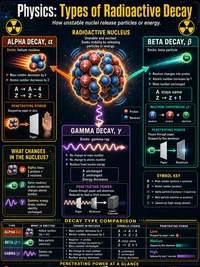
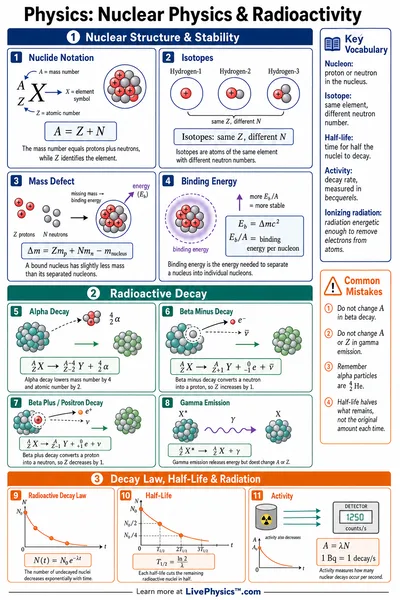
Radioactive atoms have unstable nuclei. Their protons and neutrons are arranged in a state with excess energy or an unbalanced nuclear force. A decay happens when the nucleus changes into a more stable arrangement and releases particles or energy.
No outside action can make one particular nucleus decay at a chosen moment. Heat, pressure, light, and ordinary chemical reactions usually do not alter its decay rate.
This is why radioactive decay behaves differently from processes such as burning fuel or cooling water. It is governed by probability at the level of individual atoms.
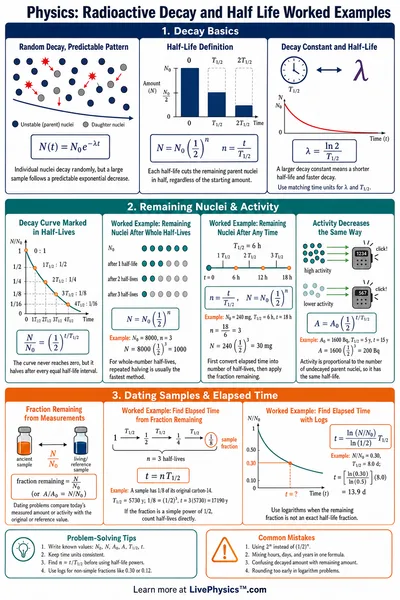
For a large sample, that random behavior produces a very reliable pattern. During each equal time interval, the same fraction of the nuclei present is likely to decay. It is not the same number each time, because fewer undecayed nuclei remain later.
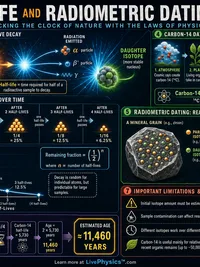
After one half life, one half remains. After two half lives, one quarter remains. After three half lives, one eighth remains.
The curve becomes less steep over time but does not reach exactly zero in the mathematical model. A simulator represents averages, while a small real sample may show noticeable random variation.
The decay constant describes the chance that a nucleus will decay in a short time. A larger decay constant means a shorter half life and a faster fall in the number of undecayed nuclei. Activity measures how many decays occur each second, not how much material is present by mass.
Its SI unit is the becquerel, meaning one decay per second. A sample can have little mass yet high activity if its nuclei decay quickly. Activity decreases as nuclei disappear, so the radiation from a sealed sample generally becomes weaker with time.
Different decays release different forms of radiation. Alpha particles are heavy and can be stopped by paper or skin, though they are dangerous if inhaled or swallowed. Beta particles travel farther and need suitable shielding such as plastic or thin metal.
Gamma rays are high energy electromagnetic radiation and often need dense shielding such as lead or concrete. In medicine, a short half life can limit how long a tracer remains active in the body. In archaeology, a long half life makes carbon dating useful over thousands of years.
When interpreting results, keep units consistent and distinguish elapsed time, number of nuclei, activity, and radiation dose. Dose depends on the radiation type, energy, exposure time, and where the source is located.