
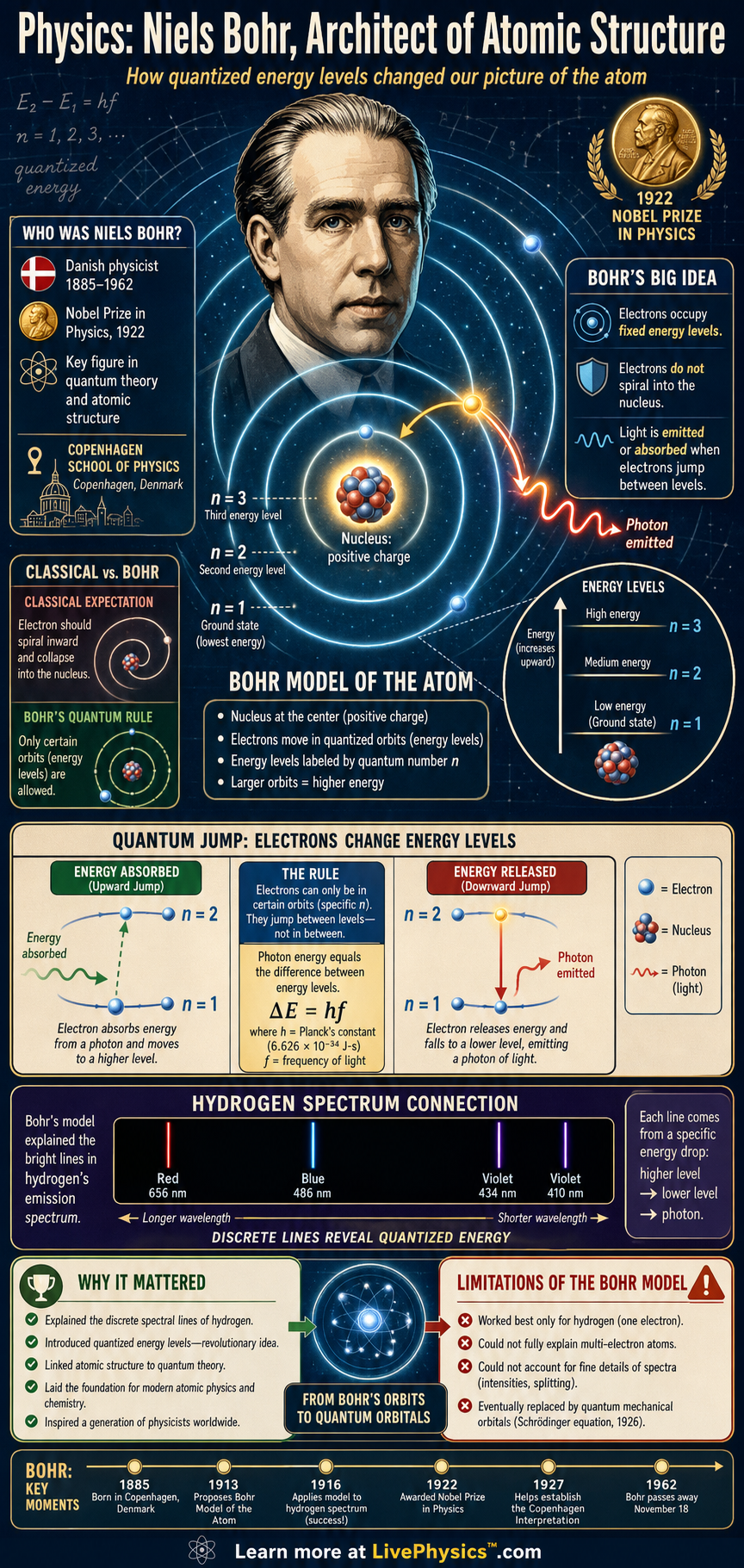
Niels Bohr was a Danish theoretical physicist whose ideas helped change the picture of the atom from a tiny solar system into a quantum system with rules unlike everyday motion. In 1913, he proposed that electrons in atoms occupy only certain allowed energy levels, which explained why hydrogen emits and absorbs specific colors of light. His work connected atomic structure, light spectra, and the emerging theory of quanta.
Bohr later became a central figure in the development of quantum mechanics and won the 1922 Nobel Prize in Physics.
Understanding Niels Bohr, Pioneer of Atomic Theory
Bohr built his atomic picture by combining two ideas that seemed hard to fit together. Rutherford's experiments had shown that nearly all an atom's positive charge and mass sit in a very small nucleus. Ordinary classical physics then gave a serious problem.
A charged electron moving around the nucleus should radiate energy continuously. It would lose speed, spiral inward, and crash into the nucleus. Real atoms are stable.
Bohr treated stability as a new rule of nature. An electron in an allowed state does not steadily leak energy, even though this conflicts with the expectations of classical motion. This rule was bold because it was chosen to match evidence rather than derived from older physics.
The strongest test of the model came from hydrogen, the simplest atom. When hydrogen gas is excited in a lamp, it does not produce every possible colour. It gives separate bright lines at particular wavelengths.
Each line is linked to a specific energy change inside an atom. An electron can move from a higher state to a lower state and release one photon. The photon carries exactly the energy lost by the atom.
A larger energy drop produces light with a higher frequency. Since the speed of light equals wavelength times frequency, higher frequency means a shorter wavelength. Students often use this chain of ideas to connect an energy-level diagram with a spectrum.
The key point is that the light is not chosen randomly. Its colour records the size of an atomic energy change.
The Bohr model works remarkably well for hydrogen, but it has limits. It does not correctly predict all details of atoms with several electrons. It cannot fully explain fine splittings in spectral lines, electron spin, or the bonding patterns that make chemistry possible.
Later quantum mechanics replaced the idea of neat circular electron tracks. Electrons are described by wave functions, which give probabilities for where a measurement may find them. An orbital is therefore not a little road around the nucleus.
It is a three-dimensional pattern of likely locations. The old model remains useful because it gives a clear first picture of energy levels, yet students should remember that a useful model is not always a complete description of reality.
Bohr's later ideas addressed what it means to observe a quantum object. In the Copenhagen view, quantum theory predicts the probabilities of possible measurement results. Before a measurement, it is not valid to imagine every property as having a definite everyday value.
Complementarity helps explain this. Light and electrons can produce wave patterns in one experiment, while in another experiment they arrive as individual detected particles. The apparatus determines which kind of evidence can be observed.
This matters in modern technology. LEDs produce light through electron energy changes in solid materials. Lasers depend on controlled transitions.
Spectroscopy identifies elements in stars, flames, and laboratory samples. When learning this topic, separate the picture used for explanation from the evidence measured in experiments. That habit is central to physics.
Key Facts
- Niels Bohr lived from 1885 to 1962 and worked mainly in theoretical physics.
- The Bohr model says electrons in atoms can occupy only certain allowed orbits or energy levels.
- For a transition between energy levels, photon energy is ΔE = hf.
- For hydrogen in the Bohr model, E_n = -13.6 eV/n^2, where n = 1, 2, 3, ...
- The wavelength and frequency of emitted light are related by c = λf.
- Bohr introduced the complementarity principle, which says quantum objects can show wave-like or particle-like behavior depending on the experiment.
Vocabulary
- Bohr model
- A model of the atom in which electrons occupy specific quantized energy levels around a small positive nucleus.
- Quantization
- The rule that certain physical quantities, such as atomic energy, can have only specific allowed values.
- Energy level
- An allowed energy state that an electron can occupy in an atom.
- Photon
- A packet of electromagnetic radiation with energy given by E = hf.
- Complementarity
- Bohr's idea that quantum systems may require different experimental descriptions, such as wave and particle descriptions, to fully describe their behavior.
Common Mistakes to Avoid
- Treating Bohr orbits as exact planetary paths is wrong because modern quantum mechanics describes electrons with probability clouds, not tiny planets moving in fixed tracks.
- Assuming electrons can have any energy in an atom is wrong because atomic spectra show that only certain energy differences are allowed.
- Forgetting the sign of hydrogen energy levels is wrong because bound electron energies are negative relative to a free electron at zero energy.
- Using ΔE = hf without consistent units is wrong because energy, Planck's constant, and frequency must be in compatible units such as joules, seconds, and hertz.
Practice Questions
- 1 A hydrogen electron drops from n = 3 to n = 2. Using E_n = -13.6 eV/n^2, calculate the photon energy in eV.
- 2 A photon emitted by an atom has frequency 6.0 x 10^14 Hz. Using h = 6.63 x 10^-34 J s, calculate its energy in joules.
- 3 Explain why Bohr's idea of quantized energy levels helped explain the bright line spectrum of hydrogen better than a classical model with any possible electron orbit.