Understanding Hydrogen Atom Orbital Viewer
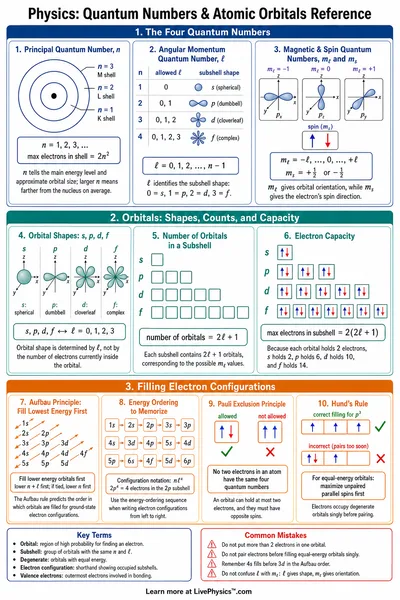
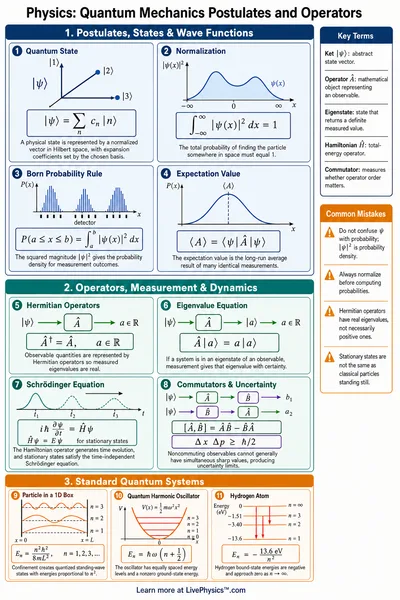
An orbital is not a tiny path that an electron follows like a planet. It is a quantum state, meaning a complete description of the electron allowed by the atom.
The heatmap represents probability density, which tells how strongly each small region contributes to the chance of finding the electron there. Bright regions mean a measurement is more likely to locate the electron in that region, while dark regions mean the chance is low or zero.
A two dimensional image is only a slice through a three dimensional pattern. Some features look simpler in this slice than they are in space.
For example, an orbital with two lobes may have a full three dimensional shape with rotational symmetry around an axis. Changing the value of m changes the directional pattern relative to the chosen axes, so different images can represent states with the same energy in an isolated hydrogen atom.
Nodes are places where the wave describing the electron has exactly zero value. A radial node is a spherical shell at a certain distance from the nucleus, so it appears as a gap in a cross section. An angular node is a plane or cone determined by the orbital's direction pattern.
These empty regions are not caused by the electron avoiding a physical barrier. They result from wave behavior, where parts of the wave cancel exactly.
The radial probability plot answers a different practical question from a density image. It combines probability over every direction at one distance from the nucleus. A large spherical shell has more volume than a small one, so its radial probability can be high even when its local density is lower.
This is why the most likely distance from the nucleus is not always where the heatmap looks brightest. Students should keep density and total probability in a shell separate.
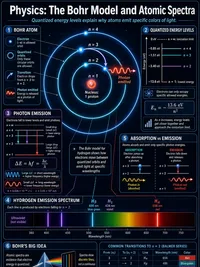
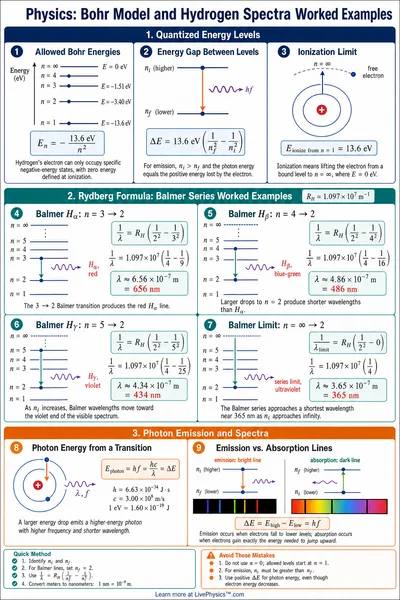
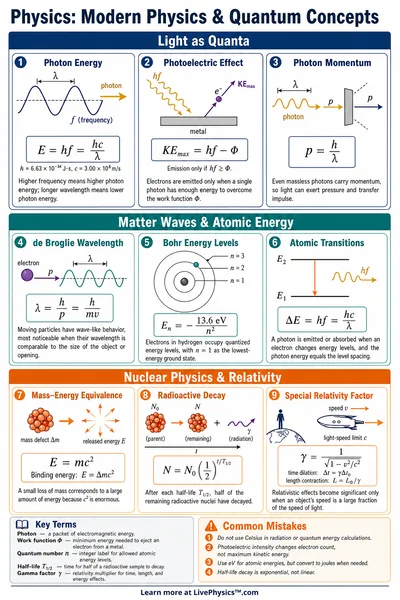
Hydrogen is especially useful because its energy depends mainly on the principal quantum number n. States with larger n are less tightly bound, spread farther from the nucleus, and lie closer to zero energy.
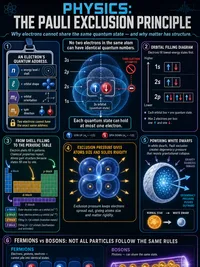
In atoms with many electrons, electron repulsion changes this simple pattern, so orbitals with different l can have different energies. Learning hydrogen first gives a clean foundation for electron configurations, spectra, chemical bonding, and the light emitted or absorbed by gases.