Practice identifying the particles, forces, and organizing ideas in the Standard Model of particle physics.
Read each problem carefully. Use complete sentences when explaining your reasoning. Show your work in the space provided.
Classifying particles and interactions
Physics - Grade 9-12
- 1
The Standard Model organizes elementary particles into two main groups of matter particles and one group of force-carrying particles. Name the two main groups of matter particles and give one example of each.
- 2
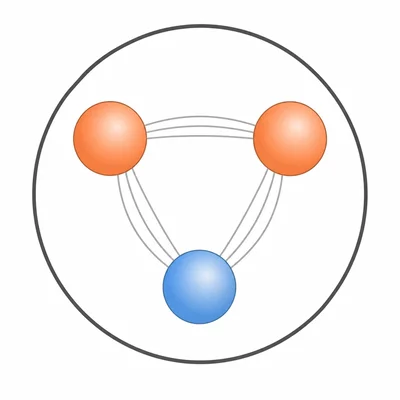
A proton is made of two up quarks and one down quark. The electric charge of an up quark is +2/3 and the electric charge of a down quark is -1/3. Calculate the total electric charge of a proton.
- 3
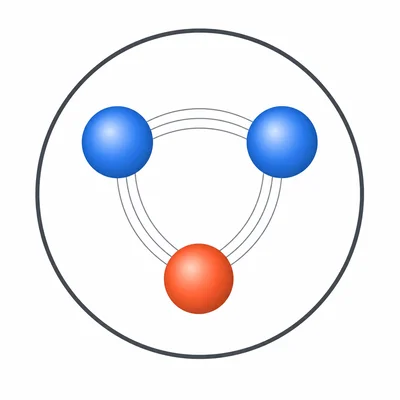
A neutron is made of one up quark and two down quarks. The electric charge of an up quark is +2/3 and the electric charge of a down quark is -1/3. Calculate the total electric charge of a neutron.
- 4
Classify each particle as a quark, lepton, gauge boson, or scalar boson: electron, gluon, top quark, Higgs boson.
- 5
The Standard Model includes six types of quarks called flavors. List the six quark flavors.
- 6
The Standard Model includes six leptons: three charged leptons and three neutrinos. List the three charged leptons and the three neutrinos.
- 7
Match each fundamental interaction with its main force carrier in the Standard Model: electromagnetic force, strong force, weak force.
- 8
Explain why gravity is not included as a force in the Standard Model, even though gravity affects matter in everyday life.
- 9
In particle physics, a generation is a set of particles with similar properties but different masses. Compare the electron, muon, and tau in terms of charge and mass.
- 10
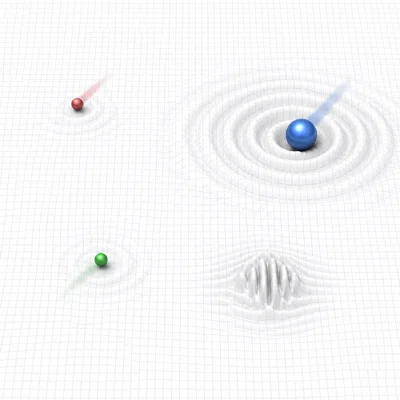
The Higgs field gives many elementary particles mass through their interaction with it. What is the role of the Higgs boson in the Standard Model?
- 11
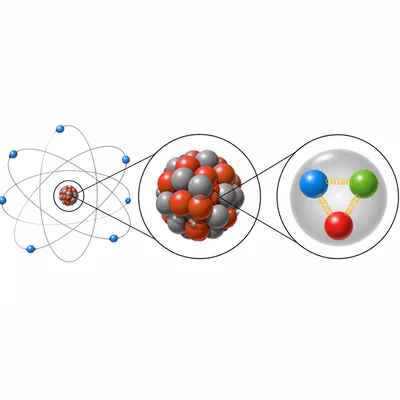
A student says, "Atoms are elementary particles because they are the smallest units of matter." Explain what is incorrect about this statement using the Standard Model.
- 12
Create a short explanation of how the Standard Model helps scientists organize subatomic particles and predict interactions.