
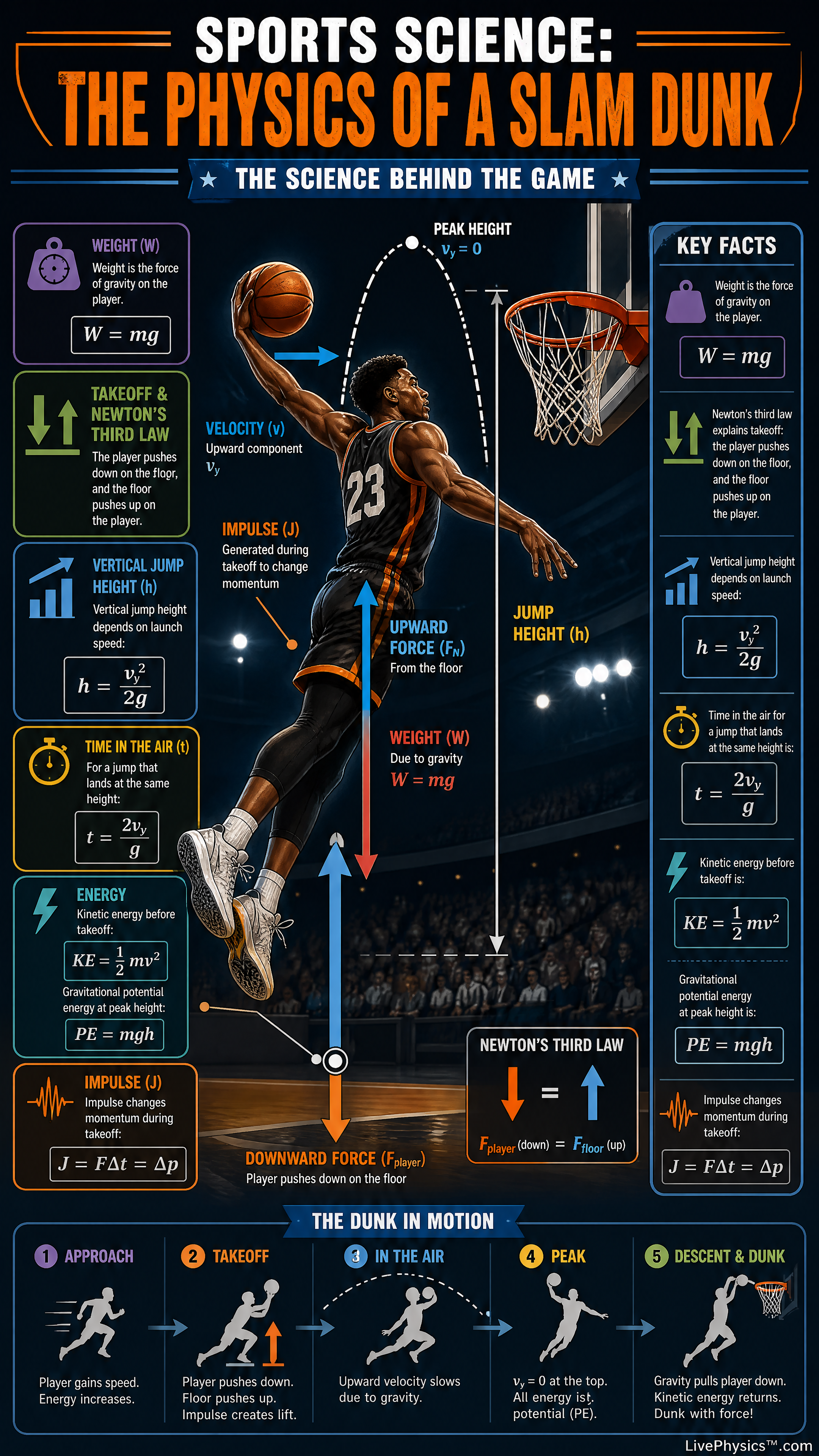
A slam dunk is one of the most exciting plays in basketball because it combines strength, speed, timing, and control. Behind the highlight is a clear physics story about forces, motion, energy, and momentum. The player must push against the floor, launch the body upward, guide the ball, and finish before gravity pulls everything back down.
Studying a dunk helps connect sports performance to science ideas students can measure and calculate.
Understanding Sports Science, The Physics of a Slam Dunk
A strong dunk begins before the feet leave the floor. Most players use a short run-up because horizontal speed can be redirected into upward motion during the final steps. The last one or two steps matter greatly.
A player lowers their body by bending at the ankles, knees, and hips. This movement prepares the leg muscles to shorten powerfully. Muscles and tendons can store some elastic energy during the quick bend.
The Achilles tendon is especially important because it acts a little like a stretched spring. A deeper bend is not always better.
If it takes too long, the player loses speed and timing. Good jumping uses a bend depth that matches the athlete's strength and the situation.
The floor contact in a jump lasts only a fraction of a second. During that brief time, the player needs a large upward force. The important detail is not just the largest force reached.
It is the total effect of force over the contact time. Coaches call this the force-time pattern. A player who creates force quickly can jump well even with a short contact time.
This helps explain why sprinters and skilled jumpers often look springy. Force plates in sports labs measure the changing force under each foot. The graph can show whether one leg pushes harder, whether the player brakes too much on landing, or whether fatigue is reducing takeoff power.
A dunk is more than a vertical jump. The player must control the body while moving toward the hoop. The body rotates easily if the push from the ground does not pass close to its center of mass.
Arm movement can help manage this rotation. Swinging the arms upward adds upward momentum to the body and helps the player reach higher. Holding the ball in one hand changes the balance of the body slightly.
Players often bring the ball close to the body during takeoff because a ball held far away makes control harder. Near the rim, the wrist and fingers guide the ball down through the hoop. The ball needs enough downward speed to clear the net, though too much force can cause it to bounce sharply off the rim.
Landing deserves as much attention as takeoff. On the way down, the player has built up downward speed because of gravity. The legs must remove that motion safely.
Bending the knees and hips increases the stopping distance and stopping time. This lowers the average force on the joints. A stiff landing transfers more force to the ankles, knees, and lower back.
Players should aim to land with knees tracking in roughly the same direction as the toes. Knees collapsing inward can place extra stress on ligaments. In games, defenders, limited space, and the backboard can make a safe two-foot landing impossible, so body awareness matters.
When studying a dunk, separate the motion into approach, plant, takeoff, flight, release, and landing. Video recorded from the side can help students estimate jump time and compare different techniques. Slow motion often reveals that the highest point of the body is not the same as the highest point of the hand.
A tall player may dunk with a modest jump because their standing reach is high. A shorter player needs more rise or better timing.
Physics does not replace practice, strength, or coordination. It gives useful ways to identify where a jump is gaining height, losing energy, or becoming unsafe.
Key Facts
- Weight is the force of gravity on the player, W = mg.
- Newton's third law explains takeoff, the player pushes down on the floor, and the floor pushes up on the player.
- Vertical jump height depends on launch speed, h = v_y^2/(2g).
- Time in the air for a jump that lands at the same height is t = 2v_y/g.
- Kinetic energy before takeoff is KE = 1/2 mv^2, and gravitational potential energy at peak height is PE = mgh.
- Impulse changes momentum during takeoff, J = FΔt = Δp.
Vocabulary
- Force
- A push or pull that can change an object's motion, measured in newtons.
- Impulse
- The product of force and the time the force acts, which changes an object's momentum.
- Projectile motion
- The curved motion of an object moving through the air under the influence of gravity.
- Center of mass
- The average position of an object's mass, which follows a predictable path during a jump.
- Power
- The rate at which work is done or energy is transferred, calculated as P = W/t.
Common Mistakes to Avoid
- Confusing mass and weight. Mass measures how much matter the player has, while weight is the gravitational force on that mass.
- Thinking the upward force continues after takeoff. Once the feet leave the floor, gravity is the main force acting on the player, ignoring air resistance.
- Using horizontal speed to find jump height. Vertical jump height depends on the vertical component of velocity, not the player's forward running speed alone.
- Forgetting that the ball and player have separate motions. The player, ball, and center of mass can move differently during the dunk, especially when the arm swings and the ball is released.
Practice Questions
- 1 A basketball player has a mass of 70 kg. What is the player's weight on Earth if g = 9.8 m/s^2?
- 2 A player leaves the floor with a vertical speed of 3.2 m/s. Using h = v_y^2/(2g), how high does the player's center of mass rise above takeoff height?
- 3 Explain why bending the knees before jumping can help a player dunk, using the ideas of force, impulse, and time of contact with the floor.