Animal Groups & Survival Lab
Classify vertebrates, discover how adaptations help animals survive in different habitats, and simulate natural selection by watching a beetle population change over generations.
Guided ExperimentAnimal Adaptations Investigation
How do you think an animal's characteristics help it survive in its environment? Which beetle color do you predict will survive more rounds in the leaf environment?
Write your hypothesis in the Lab Report panel, then click Next.
Controls
Explore the three tabs to classify animals, discover survival adaptations, and simulate natural selection.
Sort Animals into Groups
Click an animal to select it, then click a group bin to place it there. Sort all 12 animals.
Animals to sort (0/12 placed)
Data Table
(0 rows)| # | Animal | Vertebrate Group | Habitat | Key Adaptation | Notes |
|---|
Reference Guide
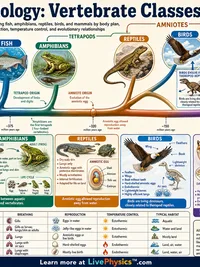
The Five Vertebrate Groups
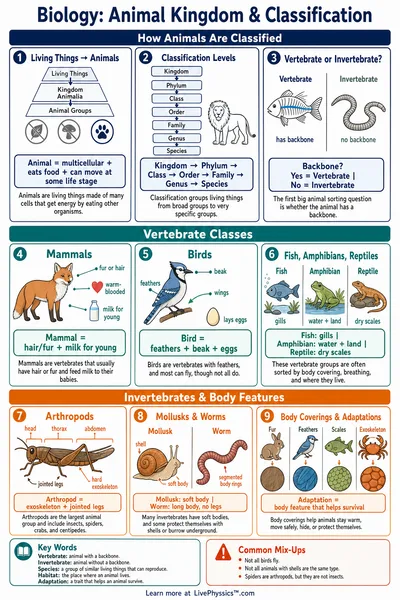
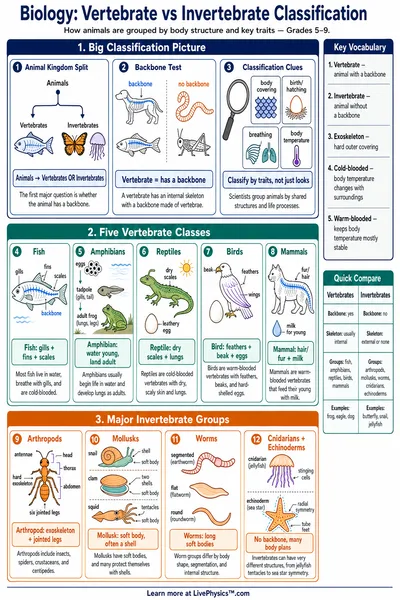
Vertebrates are animals with a backbone. Scientists organize them into five major groups based on shared body features.
- Mammals - warm-blooded, have fur or hair, nurse young with milk
- Birds - warm-blooded, have feathers, lay eggs
- Reptiles - cold-blooded, dry scaly skin, lay eggs on land
- Amphibians - cold-blooded, moist skin, start life in water
- Fish - cold-blooded, breathe through gills, live in water
What Is an Adaptation?
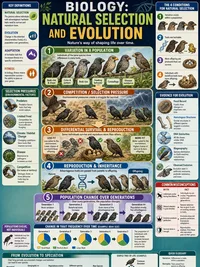
An adaptation is a body feature or behavior that helps an animal survive in its environment. Adaptations develop over many generations of natural selection.
Examples of structural adaptations include thick fur for cold climates, webbed feet for swimming, and sharp claws for catching prey. Behavioral adaptations include migration, hibernation, and camouflage.
Camouflage and Survival
Camouflage is a type of adaptation where an animal's color or pattern blends with its surroundings. This makes it harder for predators to see the animal.
When an environment changes, camouflage that once helped can become a disadvantage. Animals whose color no longer matches their surroundings are spotted more easily by predators.
How Environments Change Populations
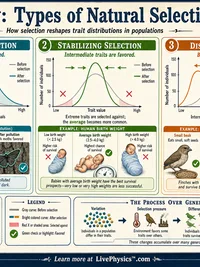
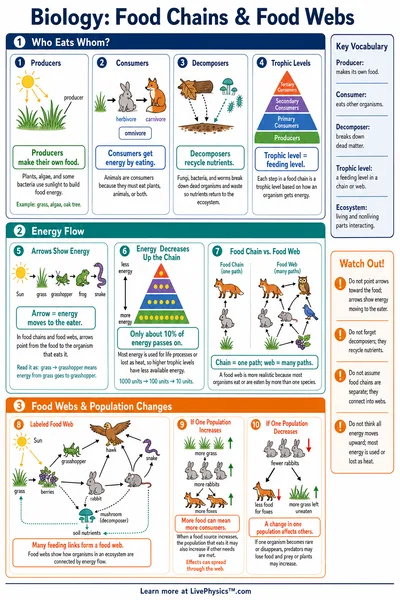
When an environment changes, some individuals survive better than others. Survivors reproduce and pass their helpful traits to offspring. Over many generations, the population shifts toward individuals with those traits.
This is natural selection, nature "selects" individuals whose traits fit the current environment. It explains how populations change over time and how new species can form.
- NGSS 3-LS4-2, evidence that environments change and affect organisms
- NGSS 3-LS4-3, how adaptations improve survival chances