Animal Groups & Survival Explorer
There is safety, warmth, and strength in numbers. Explore how animal groups help each member survive, and discover what would happen if they had to face the world alone.
Explore Animal Groups
Tap an animal to learn how living in a group helps it survive.
🏹Hunting
🔥Warmth
🛡️Protection
💚Care
😵Defense
Animal Groups Reference
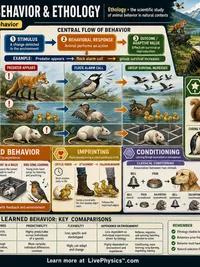
Why Animals Live in Groups
Group living helps animals survive in many ways
- Hunting cooperate to catch larger prey (wolves)
- Warmth share body heat in cold conditions (penguins)
- Protection lookouts warn the group of danger (meerkats)
- Confusion move together to confuse predators (fish, starlings)
Group Names
- Wolves, a pack
- Fish, a school
- Bees, a colony
- Elephants, a herd
- Penguins, a colony or huddle
- Starlings, a murmuration
- Zebras, a herd or dazzle
Related Content
Visual Explainers
Related Tools
Genetics & Punnett Square Calculator
Generate Punnett squares for monohybrid, dihybrid, incomplete dominance, and sex-linked crosses. Color-coded SVG grid with genotype and phenotype ratios and step-by-step analysis.
Pedigree Chart & Inheritance Pattern Analyzer
Read a pedigree chart and work out which inheritance patterns fit, with autosomal and X-linked and Y-linked rules applied and each pattern marked consistent or ruled out.
Population Growth Simulator
Simulate exponential, logistic, and Lotka-Volterra predator-prey population models. Interactive JSXGraph plots with carrying capacity, inflection points, phase portraits, and ecological presets.
DNA/RNA Codon Translator
Transcribe DNA to mRNA and translate codons into amino acid chains. Beautiful sequence diagram with color-coded nucleotides, codon brackets, amino acid pills, full 64-codon table, and reverse translation.
Related Labs
Animal Groups & Survival Lab
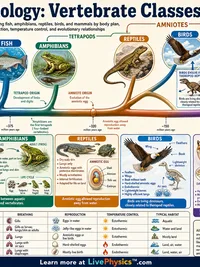
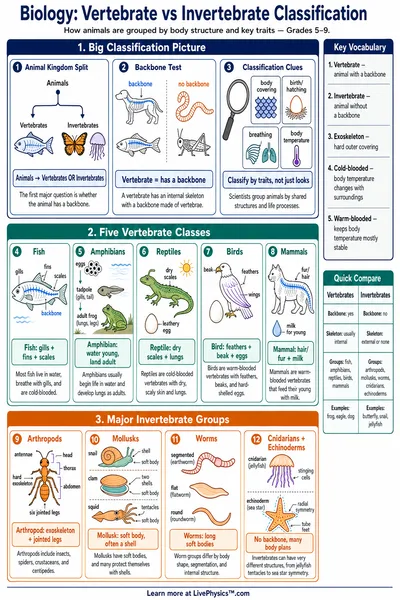
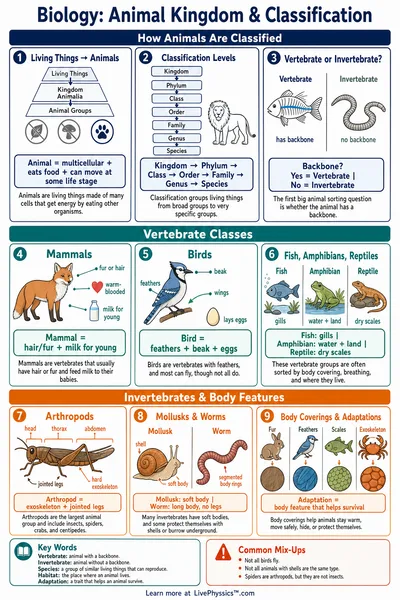
Classify animals into vertebrate groups, explore survival adaptations across habitats, and simulate natural selection with a beetle population. NGSS 3-LS4. Grades 3–5.
Habitats & Adaptations Lab
Test animals in different habitats and score how well their adaptations help them survive. Discover why animals live where they do. Grades 3-5.
School Garden Ecosystem Mission
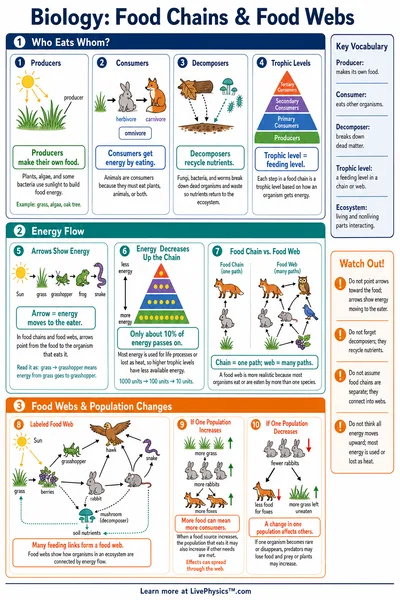
Build a garden ecosystem, predict how populations will change, then simulate predator-prey dynamics week by week. NGSS 5-LS2-1. Grades 3–5.
Predator-Prey Population Lab
Simulate Lotka-Volterra population dynamics with adjustable growth and predation rates. Observe oscillating prey and predator populations over time. NGSS MS-LS2.