Polygon Explorer Lab
Investigate how the properties of regular polygons change as you add more sides. Work from triangle to dodecagon and discover the patterns hidden in angles, diagonals, and symmetry.
Guided ExperimentPolygon Explorer Lab
Before you explore, predict how the interior and exterior angles change as the number of sides of a regular polygon increases.
Write your hypothesis in the Lab Report panel, then click Next.
Select a Polygon
n = 3 sides
Properties
Equilateral TriangleControls
Data Table
(0 rows)| # | Sides (n) | Polygon Name | Interior Angle (°) | Exterior Angle (°) | Sum of Interior Angles (°) | Diagonals | Lines of Symmetry |
|---|
Reference Guide
Interior and Exterior Angles
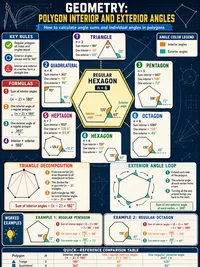
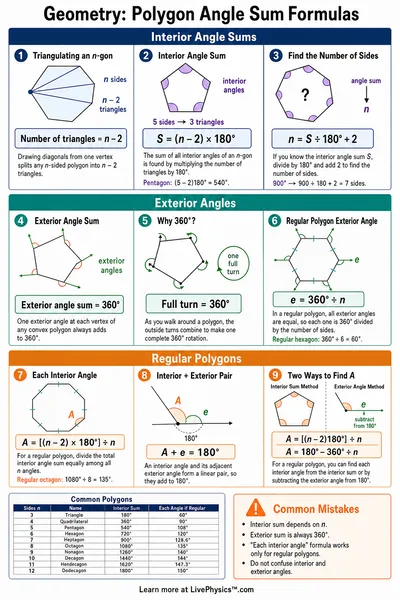
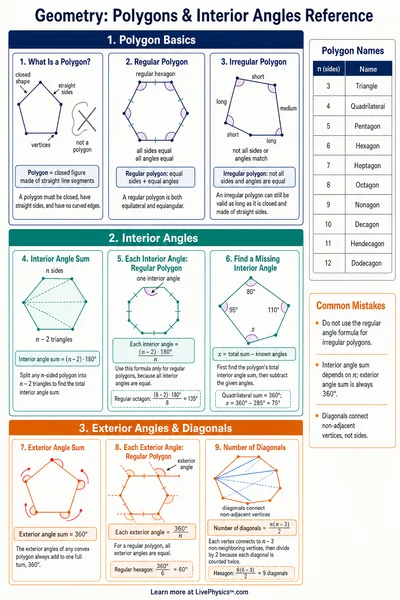
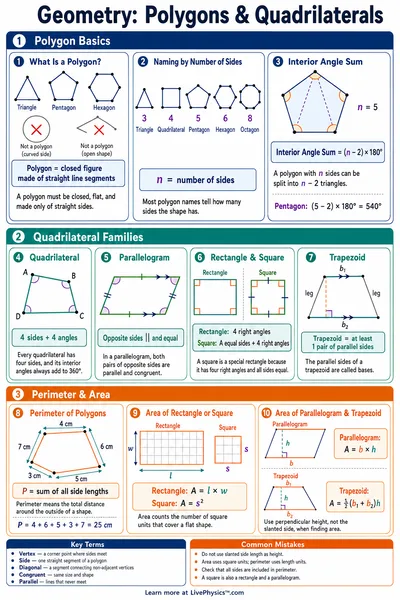
For a regular n-gon, the interior angle equals (n minus 2) times 180, divided by n.
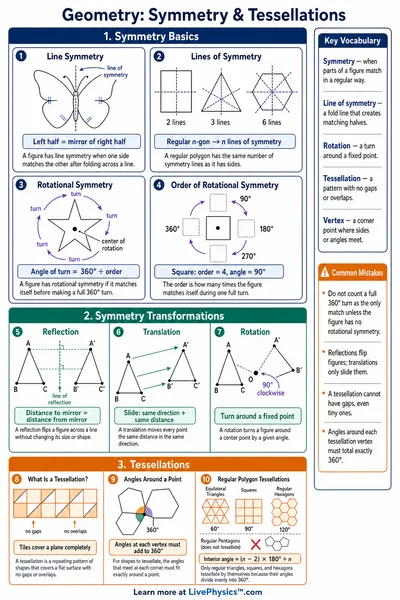
The exterior angle equals 360 divided by n.
These two angles always add up to 180° at each vertex, because they form a straight line together.
Sum of Interior Angles
The sum of all interior angles in any n-gon is (n minus 2) times 180 degrees.
Each new side added to a polygon adds exactly 180 degrees to the total.
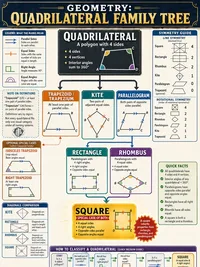
A triangle sums to 180°. A quadrilateral sums to 360°. A pentagon sums to 540°.
Number of Diagonals
A diagonal is a line segment connecting two non-adjacent vertices of a polygon.
For an n-gon, diagonals = n times (n minus 3), divided by 2.
A triangle has 0 diagonals. A square has 2. A hexagon has 9. A decagon has 35.
Analysis Questions
What is the sum of interior angles for a triangle? A square? A pentagon? Can you write a formula using n?
What do you notice about interior angle + exterior angle for every polygon? They should always sum to the same value.
As n gets very large, what value does the interior angle approach? What would a polygon with infinite sides look like?
A polygon has 35 diagonals. Using the formula n(n-3)/2 = 35, can you find n?