Understanding Compass & Straightedge Explorer
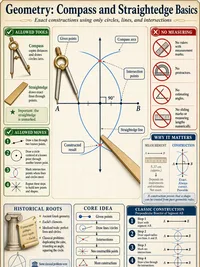
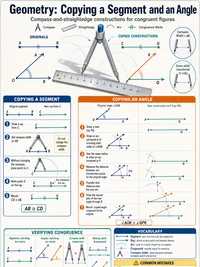
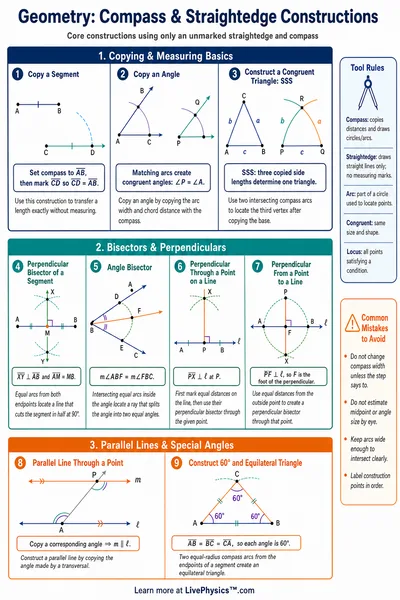
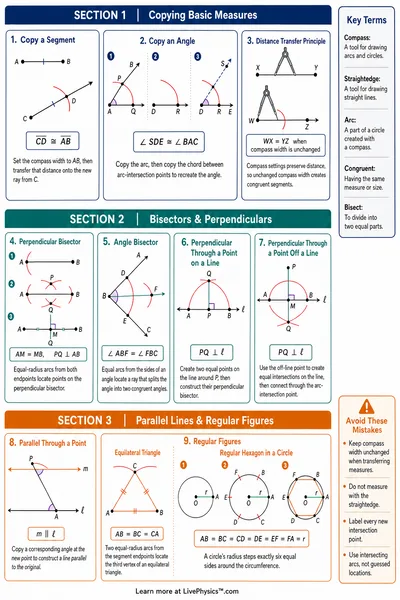
A classical construction is a sequence of allowed moves, not a careful sketch. A straightedge draws the unique line through two known points. A compass copies a distance by drawing a circle with a chosen center and a radius set by two known points.
New points come only from intersections of lines and circles. This rule matters because every new point has a reason for existing. The final figure may look simple, yet its construction records information about equal lengths, equal angles, or fixed directions.
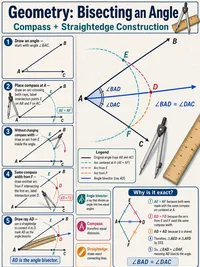
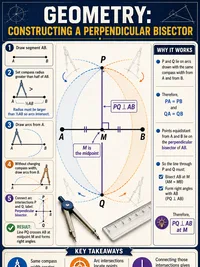
Most constructions work by turning a condition into a location. A point equally far from two endpoints lies on the perpendicular bisector of their segment. A point equally far from the sides of an angle lies on an angle bisector.
Drawing two such loci makes the wanted point appear where they meet. This is the hidden logic behind many steps that seem mysterious in an animation. Students should name the condition each arc or line represents before trusting the picture.
Circles are especially powerful because they carry an exact distance everywhere along their edge. When two circles have the same radius, their intersection can create an equilateral triangle without measuring a single angle. Repeatedly transferring one radius can divide a line into equal steps or build regular patterns.
This does not mean every visually regular pattern is guaranteed. A valid result depends on the specified intersections, including which of two possible intersection points was chosen.
Good construction work separates discovery from proof. During exploration, it is useful to drag the starting points and watch which relationships stay unchanged. A relationship that survives many positions may suggest a theorem, but the moving diagram does not prove it.
Proof comes from facts such as congruent triangles, equal radii, or properties of parallel lines. If a construction breaks when points move, the failure often reveals a hidden assumption, such as collinear points or a circle that no longer intersects a line.
Precision is more than neatness. Thick pencil marks, nearly tangent circles, and intersections that lie very close together can make a correct plan hard to read. In a digital tool, snapping or rounded display values can hide these difficulties, so students should focus on the construction steps rather than judging by appearance alone.
These habits connect to technical drawing, map design, computer graphics, and engineering, where a design must be defined by constraints. Classical constructions teach a useful idea in all of these fields. Rules limit the moves, while logical planning still produces surprisingly rich results.