Recipe Fractions & Mixing Lab
Use a virtual recipe card to explore fraction scaling. Halve, double, or triple each ingredient and see the new amounts on fraction bars. Find equivalent fractions and discover how proportional reasoning works in cooking.
Guided ExperimentScaling a Recipe with Fractions
If you double a recipe, what happens to every ingredient amount? What if you cut it in half? Predict how 3/4 cup of flour changes for each scaling option.
Write your hypothesis in the Lab Report panel, then click Next.
Controls
🧁 Classic Muffin Recipe (Original Batch)
Each ingredient amount is a fraction. Read each one on its fraction bar above.
Data Table
(0 rows)| # | Ingredient | Original Amount | Scaling Factor | New Amount | Equivalent Fraction |
|---|
Reference Guide
Fractions on a Number Line
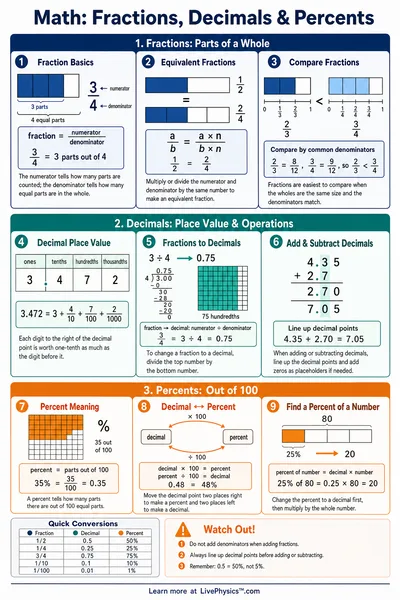
A number line from 0 to 1 can be divided into equal parts to show fractions. The denominator tells how many parts the whole is split into. The numerator tells how many parts you have.
Example, 3/4 means the space from 0 to 1 is split into 4 parts, and you have 3 of them.
Equivalent Fractions
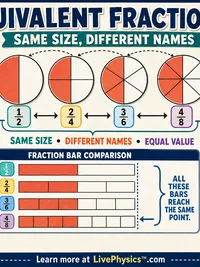
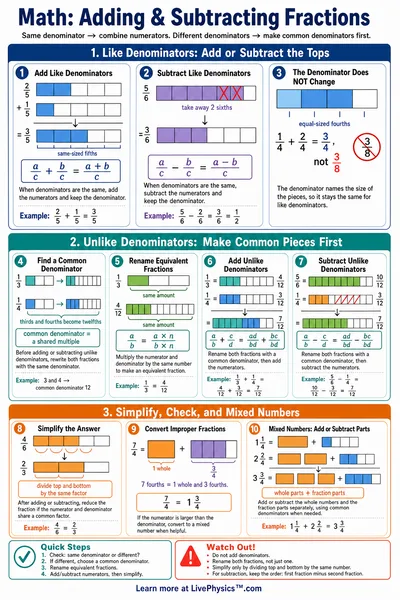
Two fractions are equivalent if they represent the same amount. Multiply or divide the numerator and denominator by the same number.
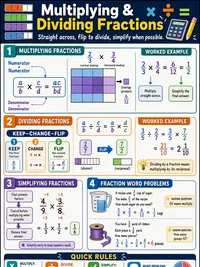
To simplify a fraction, divide both numerator and denominator by their greatest common factor (GCF).
Scaling Fractions
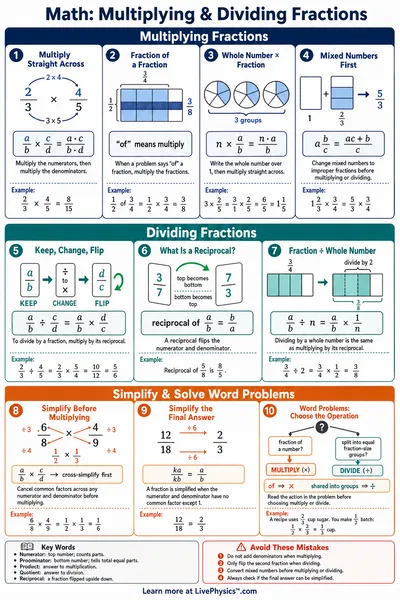
To scale a fraction by a whole number, multiply the numerator by that number. The denominator stays the same (then simplify).
To halve a fraction, multiply by 1/2. Multiply numerators together and denominators together.
Fraction Times a Whole Number
When you multiply a fraction by a whole number, think of it as repeated addition.
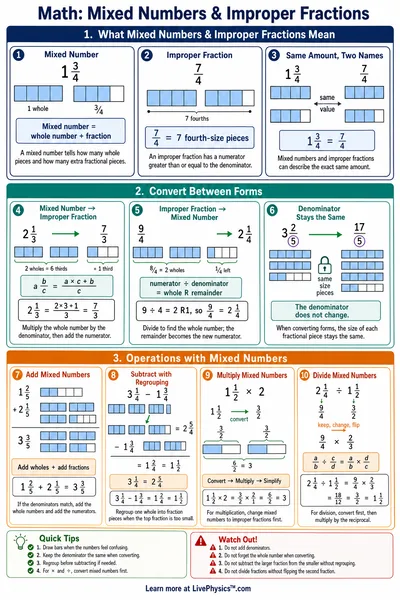
Convert improper fractions (where numerator is bigger than denominator) to mixed numbers by dividing and keeping the remainder.