Understanding Sink or Float Lab
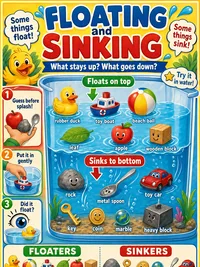
A prediction is most useful when it includes a reason. Before dropping an object into the tank, compare its material and size with objects you already know, then record whether you expect it to sink or float.
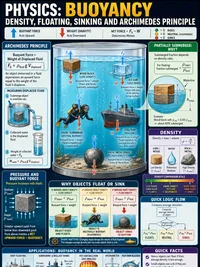
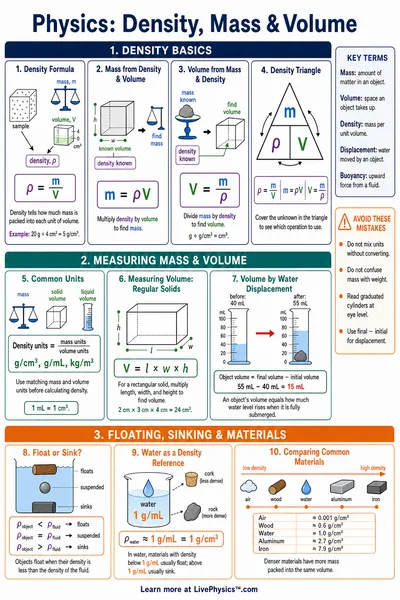
Density connects mass with volume. Two objects can occupy the same amount of space yet have different masses, so the heavier one in that comparison has the greater density.
Mass alone does not decide whether something floats. A large wooden block may have more mass than a small metal coin, but the block can float while the coin sinks because their densities differ.
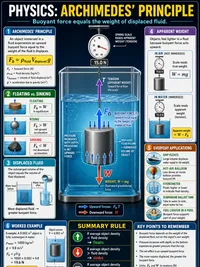
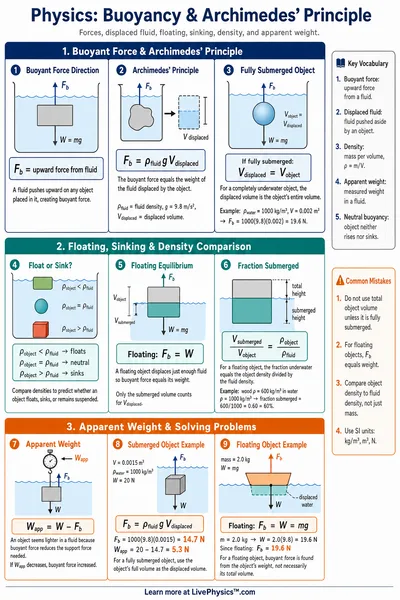
Water pushes upward on an immersed object. This buoyant force comes from the surrounding water pressure, which increases with depth and produces a greater push on the bottom than on the top.
The size of that upward force depends on the amount of water displaced. An object displaces water by occupying space that the water would otherwise fill, and the displaced water has both volume and weight.
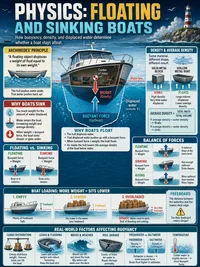
An object floating at rest displaces enough water for the upward force to balance its weight. Part of the object can remain above the surface because it does not need to be fully submerged to reach that balance.
A solid object denser than water cannot obtain enough buoyant support when fully submerged. It sinks until something else, such as the bottom of the tank, supplies the additional upward force.
Equal densities describe a useful boundary case. In an ideal model, an object with the same average density as the liquid can remain suspended, rather than necessarily rising to the surface or sinking to the bottom.
Use the lab to compare predictions with observed outcomes across several objects. Group the results by whether the objects sink or float, and describe a pattern that explains more than one trial rather than treating each result as an unrelated fact.
A hollow boat illustrates why average density matters. Its metal shell and enclosed air together occupy a large volume, allowing it to displace enough water to support its weight before water reaches the open top.
Real experiments introduce details beyond a simple density comparison. Trapped bubbles, water soaking into porous materials, surface tension, and differences between fresh water and salt water can change the outcome or the time needed to observe it.
For a conclusion, identify one prediction you revised and explain the evidence behind the change. Connect the object's density, the displaced water, and the balance of forces in a few sentences that another student could use to make a new prediction.