Soil Absorption Lab
Pour water onto five different soil types and observe how much soaks in versus runs off. Adjust soil depth, pour rate, and observation time to explore permeability, drainage capacity, and connections to the water cycle.
Guided Experiment How Does Soil Type Affect Absorption?
Which soil type do you think will absorb the most water? Which will produce the most runoff? Why?
Write your hypothesis in the Lab Report panel, then click Next.
Soil Cross-Section
Controls
Data Table
(0 rows)| # | Soil Type | Depth(cm) | Pour Rate(mL/min) | Time(min) | Absorbed(mL) | Runoff(mL) | Saturation(%) |
|---|
Reference Guide
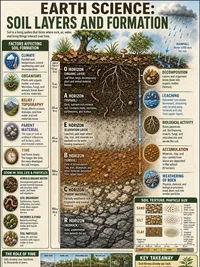
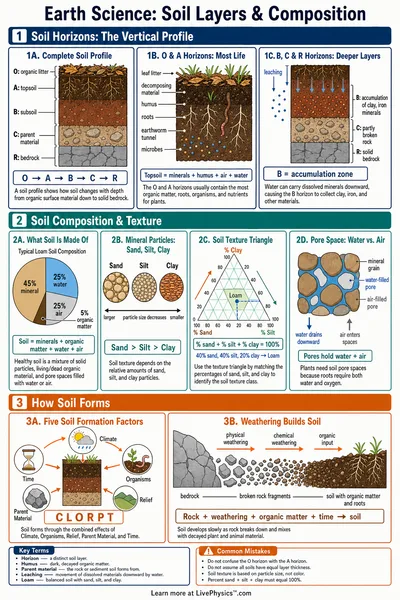
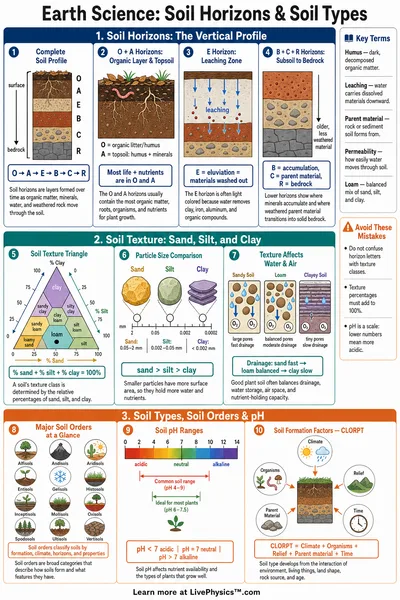
Soil Layers and Composition
Soil is a mixture of mineral particles, organic matter, air, and water. Particle size determines pore space, gravel has large gaps, sand has medium gaps, while clay particles are tiny and pack tightly together.
- Gravel. Particle diameter above 2 mm. Very large pores, rapid drainage.
- Sand. Particle diameter 0.05-2 mm. Good drainage, low water retention.
- Loam. Mixed particle sizes. Balanced drainage and retention, ideal for most plants.
- Clay. Particle diameter below 0.002 mm. Tiny pores, slow drainage, high retention.
- Compacted Clay. Clay with air squeezed out. Near-impermeable, high runoff.
Permeability and Drainage
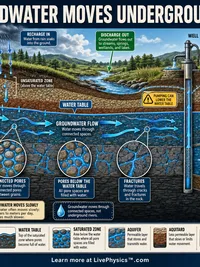
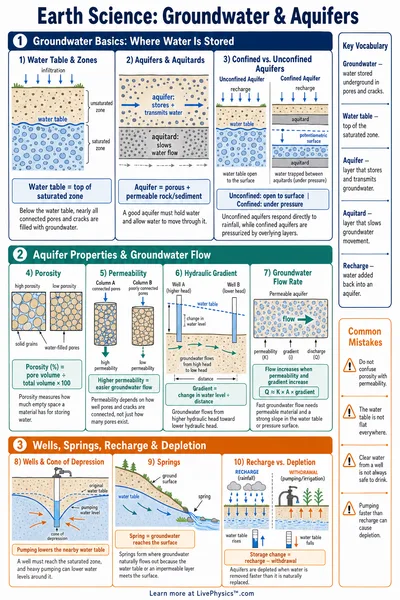
Permeability measures how easily water moves through soil pores. It depends on both the size and connectivity of pore spaces. A soil with high permeability absorbs water quickly and produces little runoff; a low-permeability soil does the opposite.
This lab uses a simplified model where absorption rate is a fixed fraction of the pour rate, capped at the soil's maximum capacity. Real soils show decreasing infiltration rates as pores fill (the Green-Ampt model), but the basic relationship holds.
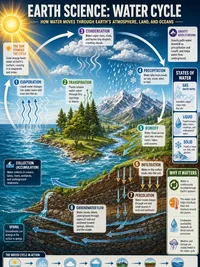
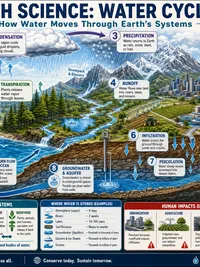
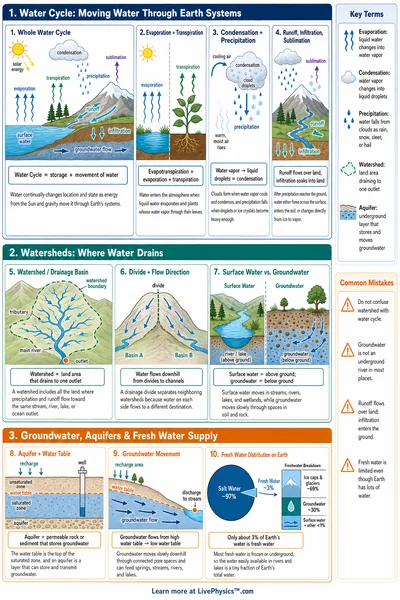
The Water Cycle
Water that falls as precipitation follows one of two paths, it infiltrates the soil and may become groundwater, or it runs off the surface and flows toward rivers and streams.
Soil type is a major control on which path water takes
- Infiltration. Water absorbed by soil recharges aquifers and is available to plant roots.
- Surface runoff. Water that cannot infiltrate flows over the land, potentially causing erosion and flooding.
- Transpiration. Plants release absorbed water back to the atmosphere through their leaves.
Why Soil Type Matters
Understanding soil permeability has real-world consequences for farming, construction, and environmental management.
- Farming. Loam soils are prized because they absorb water readily but also hold it long enough for plant roots. Sandy soils drain too fast; clay soils waterlog easily.
- Flooding. Urbanization replaces permeable soil with impermeable concrete. Runoff increases, rivers rise faster after rain.
- Septic systems. Require permeable soil (gravel or sandy loam) to filter and disperse wastewater safely.
- Erosion. High runoff on bare clay slopes strips away topsoil, degrading agricultural land.