Sign in to save

Bookmark this page so you can find it later.

Sign in to save

Bookmark this page so you can find it later.

Erosion & Landforms Sandbox

Watch how water, wind, ice, and plants slowly reshape the land. Slide through time from 1 year to 1 million years, compare before and after, label 8 landforms, and learn the difference between weathering and erosion.

Try a preset

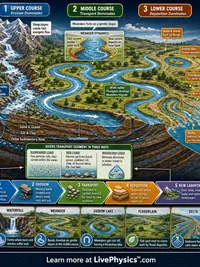
Moving water is the most powerful erosion agent on Earth. Rivers, rain, and waves reshape the land.

  • Carves valleys and canyons
  • Creates riverbeds
  • Smooths rocks
  • Builds deltas where rivers meet the sea

Landscape View

Water erosion
Before50% erodedAfter
1 thousand years
1 year1,000 yr1 million yr

Landforms created by Water

Valley

Low area between mountains, carved by water or ice

Canyon

Deep, narrow valley with steep sides carved by a river

Delta

Fan-shaped land built where a river meets the sea

Cliff

Steep rock face shaped by waves, ice, or weathering

Cave

Underground hollow carved by water dissolving rock

River

Flowing water that carries sediment and shapes the land

Reference Guide

Erosion

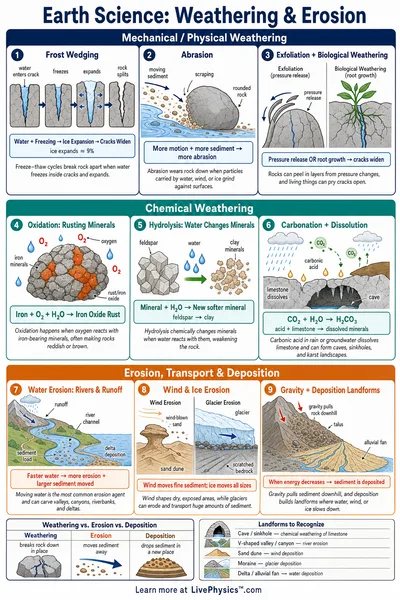
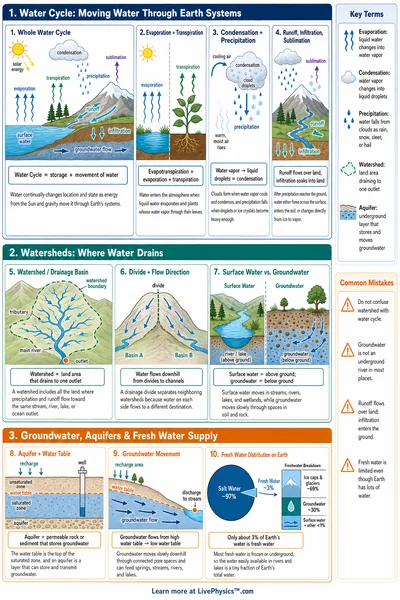
Erosion is the movement of rock and soil from one place to another by water, wind, ice, or gravity. Moving water is the strongest erosion force on Earth.

Rivers carve valleys and canyons. Ocean waves shape cliffs and beaches. Rain washes soil downhill. Over thousands or millions of years, erosion reshapes entire landscapes.

Water
Rivers, rain, waves
Wind
Sand, dust storms
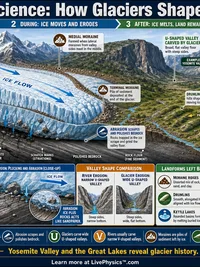
Ice
Glaciers
Gravity
Landslides, rockfalls

Weathering

Weathering breaks rock into smaller pieces without moving it. There are three kinds of weathering.

Mechanical weathering breaks rock physically. Ice freezes in cracks and expands, splitting rock apart.
Chemical weathering changes rock through chemical reactions. Acid rain slowly dissolves limestone.
Biological weathering happens when living things break rock. Tree roots grow into cracks and push rock apart.

Landforms

Landforms are natural features on Earth's surface. Erosion creates and shapes many landforms over long periods of time.

MountainTall, pushed up by Earth's forces ValleyLow area carved by water or ice CanyonDeep narrow valley from a river DeltaFan of land where river meets sea Sand DuneHill of sand shaped by wind CliffSteep rock face from waves or ice CaveHollow carved by dissolving rock RiverFlowing water that shapes the land

Time and Change

Erosion is slow. Most changes take thousands or millions of years. Small changes add up over very long periods.

The Grand Canyon took about 5 to 6 million years to form. The Colorado River carved through layer after layer of rock, a little bit each year.

Think about it: If a river erodes 1 millimeter of rock per year, that is 1 meter every 1,000 years and 1 kilometer every 1 million years!
Related Content

Related Tools

Earthquake Magnitude Calculator
Four modes: magnitude scales (Richter Mₗ, moment magnitude M𝑤, energy), energy comparison (each step = 31.6× more energy, logarithmic bar chart), Modified Mercalli Intensity I-XII with descriptions, and Richter magnitude from seismograph amplitude. Presets include Minor M3 through Great M8, 1906 San Francisco M7.9, and 2011 Japan M9.1.
Carbon Footprint Calculator
Estimate annual CO₂ emissions from transportation (car miles, fuel type, flights), home energy (electricity, heating, AC), diet (meat consumption, food waste), and lifestyle (shopping, recycling). Pie chart breakdown, country comparison bar chart, trees-to-offset and equivalent-driving metrics. Five presets: Average American, Eco-Conscious, Heavy Commuter, Frequent Flyer, Work from Home.
Star Lifecycle Visualizer
Three modes: interactive HR diagram with 23 real stars (click to see properties), stellar evolution pathway from nebula to end state (white dwarf, neutron star, or black hole based on initial mass), and star properties calculator (luminosity L∝M^3.5, radius, lifetime t∝M^-2.5, apparent magnitude). Six presets: Sun, Red Dwarf (0.3 M☉), Sirius A (2 M☉), Blue Giant (20 M☉), Betelgeuse (15 M☉), Supergiant (50 M☉). Includes spectral class colour strip and SVG star visualization.
H-R Diagram Explorer
Three modes: plot a single star on the Hertzsprung-Russell diagram from temperature, radius, and mass (Stefan-Boltzmann luminosity, spectral class O-M, absolute magnitude, HR region); compare multiple stars side by side; and browse the spectral atlas with typical properties for each class. 23 reference stars plotted, 6 presets from Proxima Centauri to Rigel.