Earth Systems Interactions Explorer
Earth is made of four connected systems. A change in one almost always affects the others. Pick an event and trace how its effects ripple through the atmosphere, hydrosphere, geosphere, and biosphere.
Explore Earth Events
Pick any event. See how it changes each of Earth's four systems at once.
Pick an event to see how it affects Earth's four systems.
🌍
Select an event above to begin exploring.
High impactMedium impactLow impact
Earth Science Reference
Earth's Four Systems
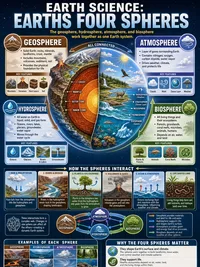
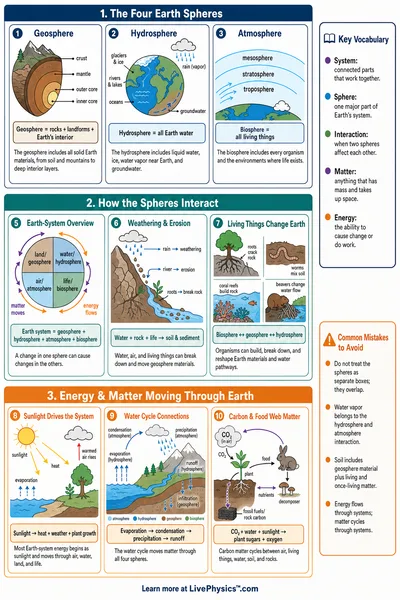
Scientists organize Earth into four interconnected systems
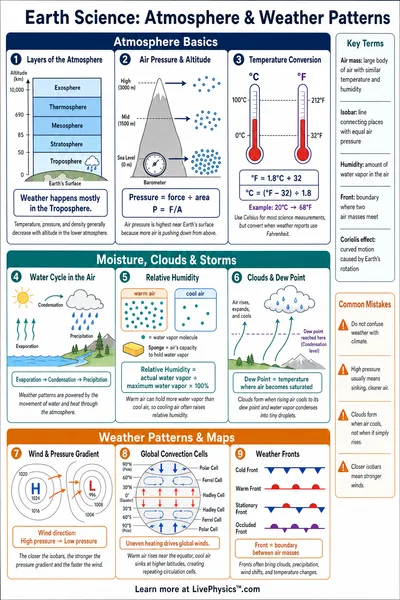
- Atmosphere. The layer of gases surrounding Earth, including the air we breathe and all weather.
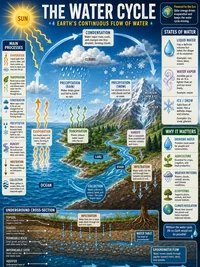
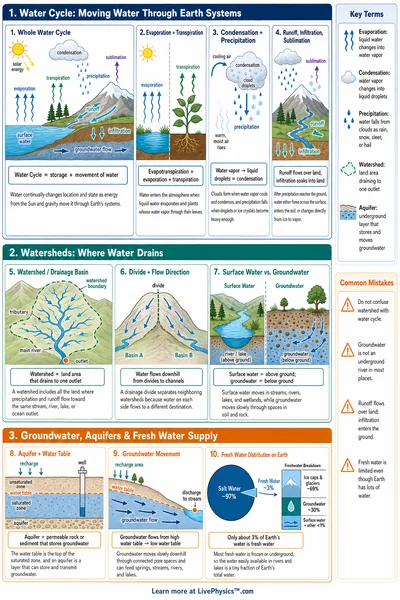
- Hydrosphere. All water on Earth, oceans, rivers, lakes, glaciers, groundwater, and water vapor.
- Geosphere. The solid Earth including rocks, soil, mountains, valleys, and the layers beneath our feet.
- Biosphere. Every living organism on Earth, from bacteria in soil to whales in the ocean.
How Systems Interact
A change in one system often sets off a chain reaction
- Rain falls (atmosphere) and fills rivers (hydrosphere), which erode soil (geosphere), providing nutrients for plants (biosphere).
- Plants grow (biosphere) and release water vapor (atmosphere), which forms clouds (atmosphere) and produces more rain.
- Feedback loops happen when one change causes another change that circles back and amplifies the first.
- Understanding these connections helps scientists predict what happens when one system is disrupted.
Natural Events
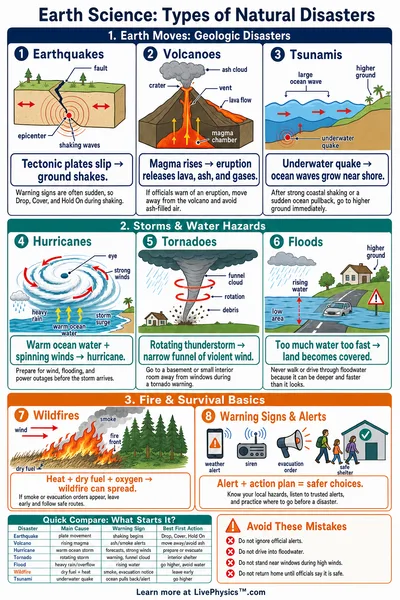
Natural events can dramatically shift multiple Earth systems at once
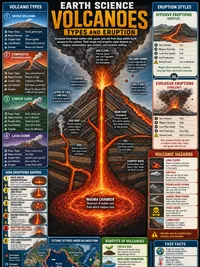
- Volcanic eruptions release ash into the atmosphere, acid rain into rivers, and new lava rock onto the geosphere, all while destroying habitats in the biosphere.
- Droughts reduce water in the hydrosphere, cause soil to crack in the geosphere, and stress plants and animals in the biosphere.
- Glaciers melting raises sea levels (hydrosphere), warms the atmosphere further, and destroys polar habitats (biosphere).
Human Impact
Human activities also affect all four Earth systems
- Deforestation removes trees that once absorbed CO2 (atmosphere), held water in soil (hydrosphere), anchored the ground (geosphere), and sheltered wildlife (biosphere).
- Ocean warming from increased greenhouse gases heats ocean water, triggering stronger storms, coral bleaching, and shifts in where fish live.
- When humans change one system, the effects spread. Protecting one system often means caring for all four together.
Related Content
Related Tools
Earthquake Magnitude Calculator
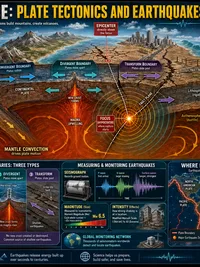
Four modes, magnitude scales (Richter Mₗ, moment magnitude M𝑤, energy), energy comparison (each step = 31.6× more energy, logarithmic bar chart), Modified Mercalli Intensity I-XII with descriptions, and Richter magnitude from seismograph amplitude. Presets include Minor M3 through Great M8, 1906 San Francisco M7.9, and 2011 Japan M9.1.
Carbon Footprint Calculator
Estimate annual CO₂ emissions from transportation (car miles, fuel type, flights), home energy (electricity, heating, AC), diet (meat consumption, food waste), and lifestyle (shopping, recycling). Pie chart breakdown, country comparison bar chart, trees-to-offset and equivalent-driving metrics. Five presets, Average American, Eco-Conscious, Heavy Commuter, Frequent Flyer, Work from Home.
Star Lifecycle Visualizer
Three modes: interactive HR diagram with 23 real stars (click to see properties), stellar evolution pathway from nebula to end state (white dwarf, neutron star, or black hole based on initial mass), and star properties calculator (luminosity L∝M^3.5, radius, lifetime t∝M^-2.5, apparent magnitude). Six presets: Sun, Red Dwarf (0.3 M☉), Sirius A (2 M☉), Blue Giant (20 M☉), Betelgeuse (15 M☉), Supergiant (50 M☉). Includes spectral class colour strip and SVG star visualization.
H-R Diagram Explorer
Three modes, plot a single star on the Hertzsprung-Russell diagram from temperature, radius, and mass (Stefan-Boltzmann luminosity, spectral class O-M, absolute magnitude, HR region); compare multiple stars side by side; and browse the spectral atlas with typical properties for each class. 23 reference stars plotted, 6 presets from Proxima Centauri to Rigel.
Related Labs
Wildfire Spread & Mitigation Lab
Set wind, humidity, slope, fuel density, and firebreak width, then run a cellular automaton wildfire and watch it spread across the landscape. Compare mitigation strategies and see whether the town survives.
Weather Hazards & Safe Design Lab
Test building designs against weather hazards, apply the engineering design cycle, and discover which protection features reduce storm damage
Hurricane Path & Storm Surge Simulator
Set sea-surface temperature, wind shear, initial storm strength, coastal slope, and forward speed, then watch a hurricane track across the basin, intensify or weaken, make landfall, and generate a storm surge. Shows Saffir-Simpson category, central pressure, and surge height, illustrating how warm water fuels intensification and how coastal slope amplifies flooding.
Fertilizer Runoff & Eutrophication Lab
Model fertilizer runoff from farmland through buffer strips into a water body. Watch the eutrophication cascade from algal bloom to dissolved oxygen crash, and test buffer strip effectiveness