Sign in to save

Bookmark this page so you can find it later.

Sign in to save

Bookmark this page so you can find it later.

Water on Earth Explorer

Earth is called the Water Planet, but did you know most of that water is salty and we cannot drink it? Explore interactive charts to discover where water is hiding and why clean freshwater is so precious. All computation runs in your browser.

Reference Guide

Earth's Water at a Glance

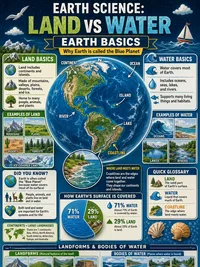
About 71% of Earth's surface is covered with water, but the vast majority is saltwater in the oceans.

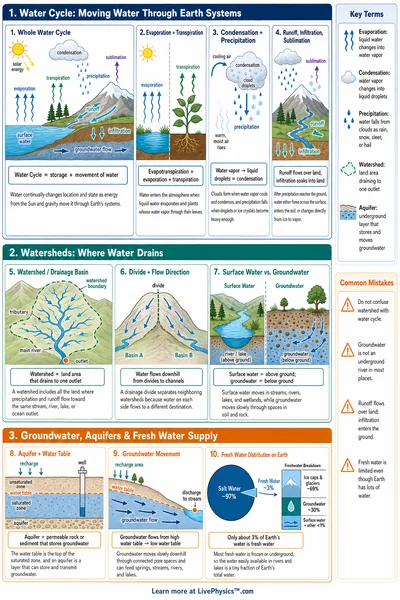
  • Saltwater = 97.2% of all water
  • Freshwater = only 2.8%

Of the small amount of freshwater, most is frozen in ice caps or stored deep underground.

Where is the Freshwater?

The 2.8% of freshwater is divided into three main types.

  • Ice caps and glaciers = 68.7% of freshwater
  • Groundwater = 30.1%
  • Surface water = only 1.2%

Surface water includes all the lakes, rivers, and swamps we can see, yet it is a tiny fraction of total freshwater.

Water We Can Actually Use

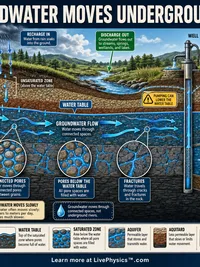
Humans mainly use groundwater (wells) and surface water (lakes and rivers) for drinking.

Usable water ≈ less than 1% of all water on Earth!

That is why protecting water quality and not wasting water is so important for people everywhere.

The Water Cycle

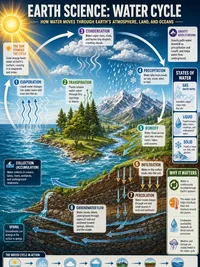
Water constantly moves between oceans, air, and land through the water cycle.

  • Evaporation turns liquid water into vapor
  • Condensation forms clouds from water vapor
  • Precipitation returns water as rain or snow
  • Collection gathers water in lakes, rivers, and oceans

The total amount of water on Earth stays the same. It just keeps moving in this endless cycle!
Related Content

Related Tools

Earthquake Magnitude Calculator
Four modes: magnitude scales (Richter Mₗ, moment magnitude M𝑤, energy), energy comparison (each step = 31.6× more energy, logarithmic bar chart), Modified Mercalli Intensity I-XII with descriptions, and Richter magnitude from seismograph amplitude. Presets include Minor M3 through Great M8, 1906 San Francisco M7.9, and 2011 Japan M9.1.
Carbon Footprint Calculator
Estimate annual CO₂ emissions from transportation (car miles, fuel type, flights), home energy (electricity, heating, AC), diet (meat consumption, food waste), and lifestyle (shopping, recycling). Pie chart breakdown, country comparison bar chart, trees-to-offset and equivalent-driving metrics. Five presets: Average American, Eco-Conscious, Heavy Commuter, Frequent Flyer, Work from Home.
Star Lifecycle Visualizer
Three modes: interactive HR diagram with 23 real stars (click to see properties), stellar evolution pathway from nebula to end state (white dwarf, neutron star, or black hole based on initial mass), and star properties calculator (luminosity L∝M^3.5, radius, lifetime t∝M^-2.5, apparent magnitude). Six presets: Sun, Red Dwarf (0.3 M☉), Sirius A (2 M☉), Blue Giant (20 M☉), Betelgeuse (15 M☉), Supergiant (50 M☉). Includes spectral class colour strip and SVG star visualization.
H-R Diagram Explorer
Three modes: plot a single star on the Hertzsprung-Russell diagram from temperature, radius, and mass (Stefan-Boltzmann luminosity, spectral class O-M, absolute magnitude, HR region); compare multiple stars side by side; and browse the spectral atlas with typical properties for each class. 23 reference stars plotted, 6 presets from Proxima Centauri to Rigel.