States of Matter Lab
Drag the temperature slider and watch how particles behave when a substance is a solid, a liquid, or a gas. Try water, ethanol, mercury, iron, and oxygen with their real melting and boiling points.
Guided Experiment Water Through Three States
As you slowly raise the temperature of water from -30 °C to 120 °C, what do you predict will happen to its state at the freezing and boiling points?
Write your hypothesis in the Lab Report panel, then click Next.
Liquid Water (H₂O)
Particles slide past each other while staying close. Definite volume but takes shape of container.
Readings
Data Table
(0 rows)| # | Trial | Substance | Temp(°C) | Phase | Melts at(°C) | Boils at(°C) |
|---|
Reference Guide
The Three States
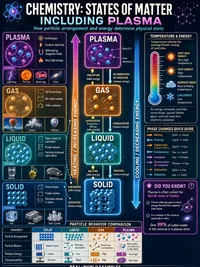
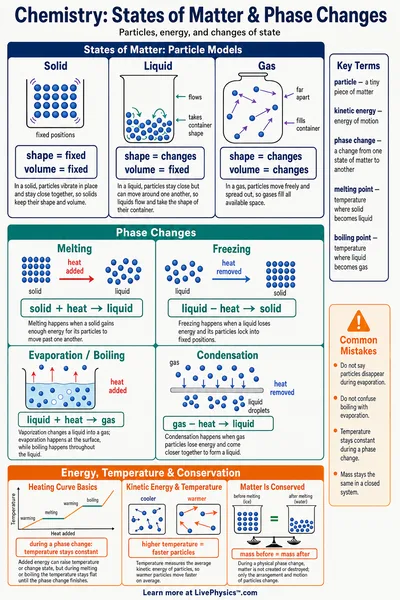
Solids hold their shape and volume. Their particles vibrate in fixed positions arranged in a tight pattern called a lattice.
Liquids keep their volume but flow to fit a container. Their particles slide past each other while staying in contact.
Gases have no fixed shape or volume. Their particles fly around freely and spread out to fill any space.
Phase Transition Points
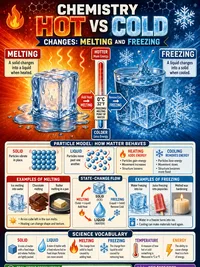
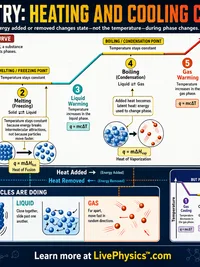
The melting point is the temperature where a solid turns into a liquid. The boiling point is where a liquid turns into a gas.
For water these are 0 °C and 100 °C. Iron melts near 1538 °C and boils near 2862 °C. Different substances need very different amounts of energy to change phase.
Kinetic Theory of Matter
Temperature is a measure of how fast particles are moving on average. Hotter means faster, colder means slower.
Each phase change happens when the particles have enough energy to overcome the forces holding them in place. Stronger forces between particles require higher temperatures to escape.
Why Mercury Is Special
Most metals are solids at room temperature, but mercury melts at -39 °C. That makes it the only common liquid metal at everyday temperatures.
Mercury was used inside old-style thermometers for this reason. Modern thermometers use safer alternatives, but the physics is the same.