Sign in to save

Bookmark this page so you can find it later.

Sign in to save

Bookmark this page so you can find it later.

Chemistry middle-school May 20, 2026

What Makes Soap Actually Clean

How molecules pull grime into water
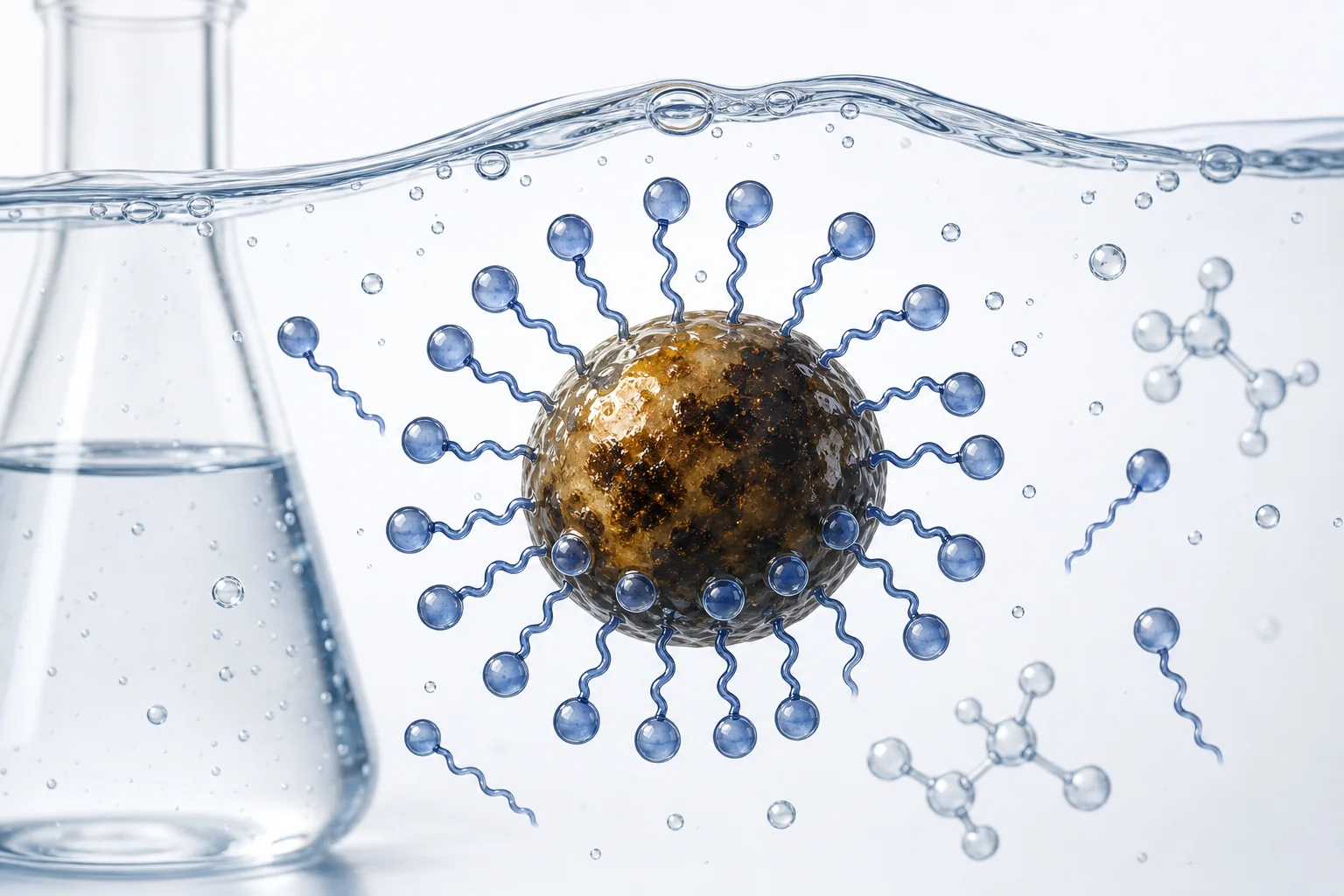
Soap molecules surrounding a drop of oil so it can mix with rinse water

Soap cleans because each soap particle has one end that likes water and one end that likes oil. The oil-loving end grabs grease and dirt, while the water-loving end helps pull the mess into the rinse water. Rubbing and rinsing then carry the trapped dirt away.

Big Idea. NGSS MS-PS1-1 connects soap cleaning to how atoms combine into molecules with structures that explain their properties.

A greasy plate can sit under plain water for a long time and still feel slick. The grease does not mix well with water, so it clings to the plate and to your fingers. Soap changes the situation. It is made of molecules with two very different parts. One part mixes well with water. The other part mixes well with oils and fats. That split personality lets soap act like a bridge between things that usually stay apart. When you scrub, soap molecules move into the grease, break it into smaller droplets, and help those droplets float away in the rinse water. This is chemistry you can feel at the sink. It connects to NGSS MS-PS1 because the structure of a molecule helps explain the properties of the substance. Soap is a useful example because a tiny shape change can cause a large cleaning effect.

Water and oil separate
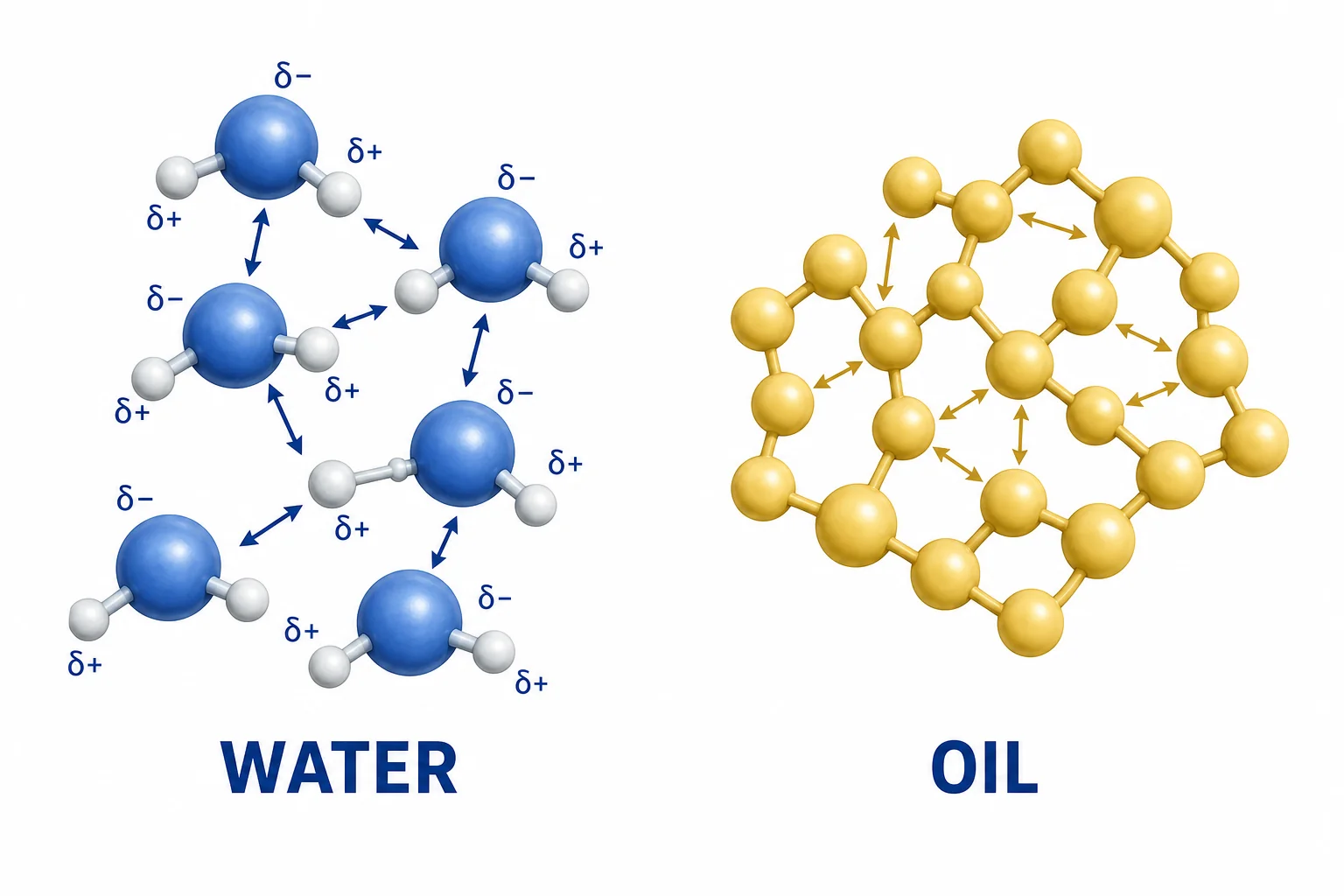
Water molecules grouped together beside oil molecules that stay in a separate droplet
Water mixes with water. Oil gathers with oil.
Water molecules are polar. That means their electric charge is unevenly shared. One side is slightly negative, and the other side is slightly positive. Because of this, water molecules attract other polar molecules and charged particles. Oil molecules are mostly nonpolar. Their charge is spread out more evenly. Water does not form strong attractions with oil, so oil gathers with other oil instead. This is why grease forms beads on wet dishes and why plain water often slides past a greasy fingerprint. Dirt is often stuck inside that grease. If water cannot mix with the grease, it cannot easily carry the dirt away. Cleaning needs something that can interact with both substances. Soap provides that link because its molecules have a water-friendly end and an oil-friendly end. The cleaning power begins with this difference between polar and nonpolar materials.

Plain water has trouble removing grease because oil and water do not mix well.

Soap has two ends
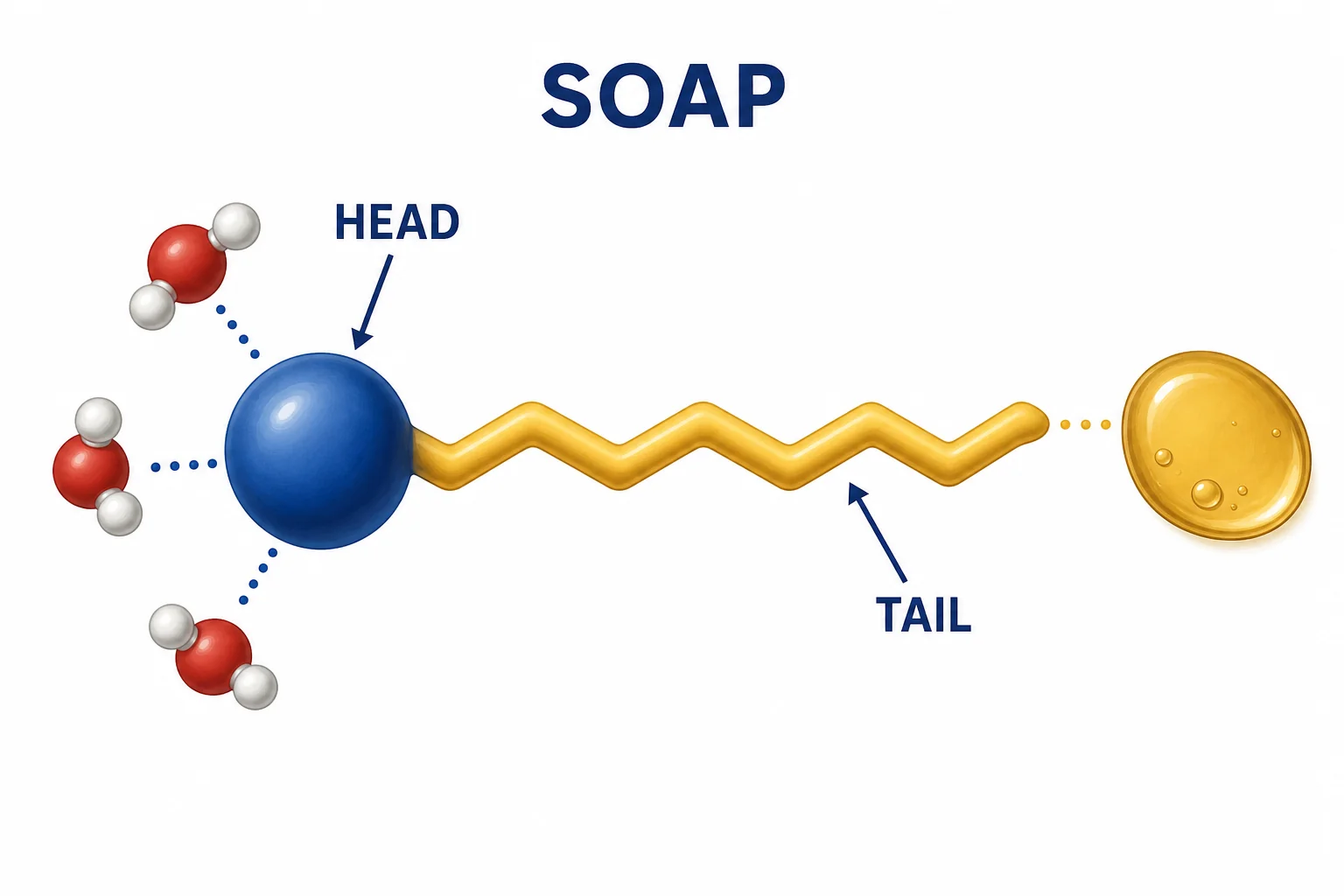
A soap molecule with a water-loving head and an oil-loving tail
A soap molecule acts like a tiny connector.
A soap molecule is a type of surfactant. This word means it affects how substances meet at a surface. One end of a soap molecule is polar and mixes well with water. This is often called the head. The other end is a long nonpolar chain that mixes well with oils and fats. This is often called the tail. The two ends give soap a useful job. The tail can bury itself in grease. The head can stay in water. A single molecule is far too small to see, but billions of them can change how a whole sink of water behaves. They lower the pull at the water surface and help water spread across dirty material. They also give water a way to connect to oily grime. Soap works because its structure is not the same all the way through.

Soap works because one molecule can interact with water and oil at the same time.

Soap surrounds grease
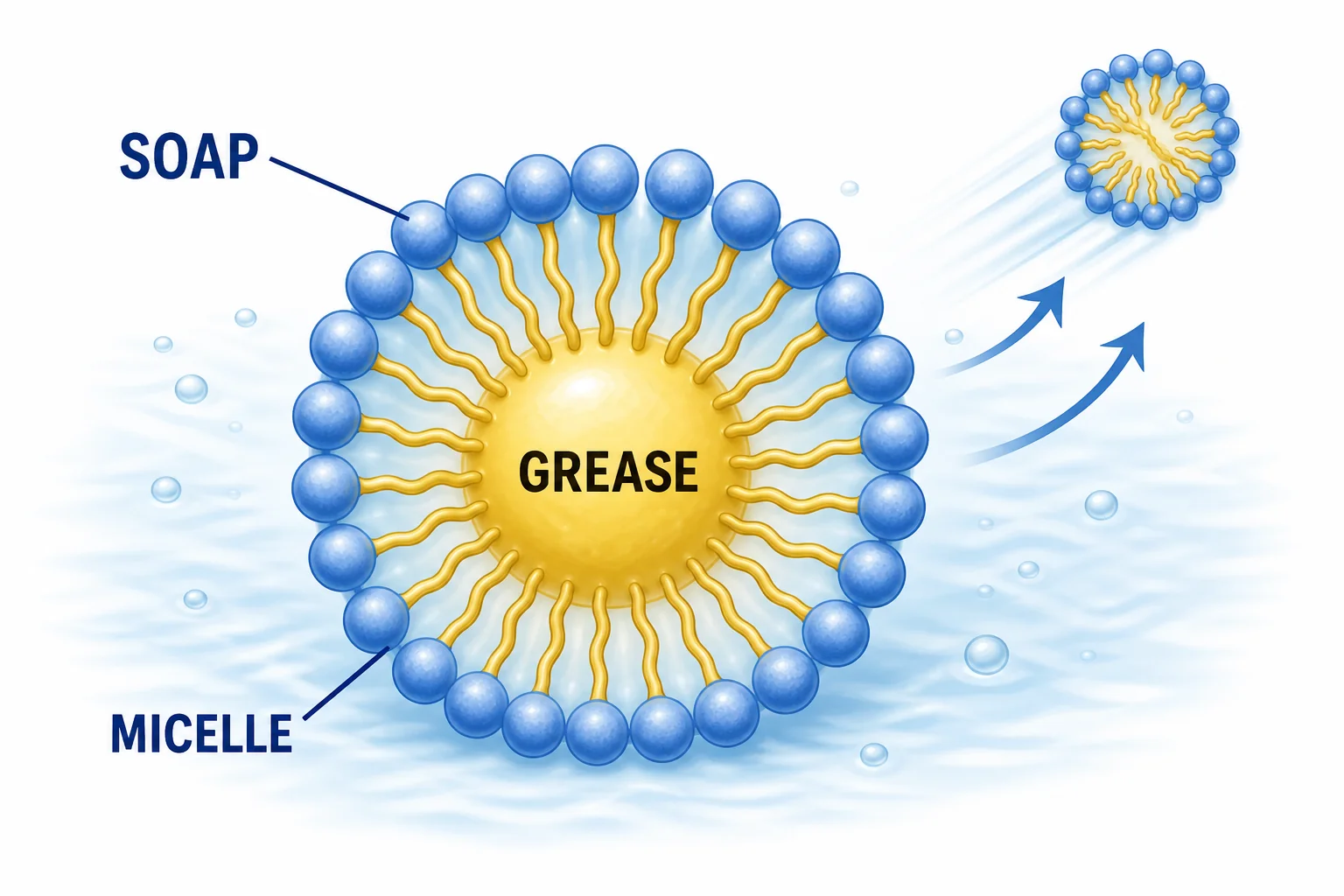
Soap molecules arranged around a grease droplet with tails inward and heads outward
A micelle traps grease inside a water-friendly shell.
When soap touches greasy dirt, the tails move into the oil. The heads stay in the surrounding water. With enough soap molecules, the grease becomes covered by a layer of molecules. The tails point inward toward the grease, and the heads point outward toward the water. This rounded packet is called a micelle. The grease is trapped inside, away from the dish or skin. The outside of the packet is water-friendly, so the whole packet can move through water. This is the main reason soap can remove oily dirt that water alone leaves behind. Scrubbing helps by breaking large grease patches into smaller pieces. Smaller pieces have more surface area for soap molecules to cover. Once many micelles form, rinse water can carry them away. The dirt is not destroyed. It is packaged so water can move it.

Soap does not make grease vanish. It surrounds grease so water can carry it.

Scrubbing helps the chemistry
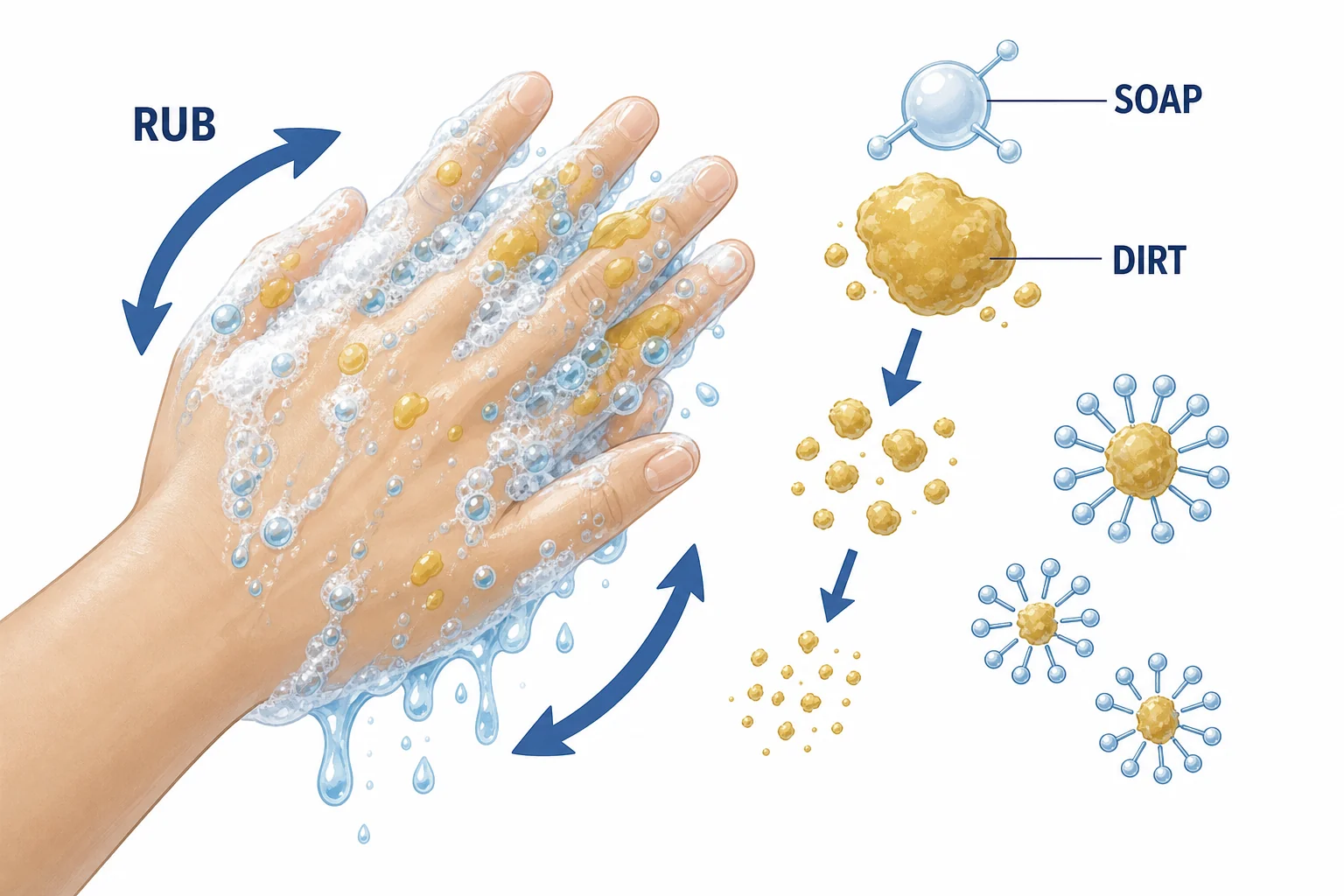
Hands rubbing with soap as small grease droplets break apart and become surrounded by soap molecules
Motion spreads soap and breaks grime into smaller pieces.
Soap molecules do the molecular work, but motion matters too. Rubbing your hands or scrubbing a pan breaks up grease and dirt. It also spreads soap into tiny cracks, fingerprints, and rough spots. This gives more soap molecules a chance to reach the oily material. Warm water can help some fats soften, but the soap still provides the chemical bridge. Time also matters. Soap needs contact time to surround grime and lift it from a surface. That is why careful handwashing takes more than a quick splash. The foam is not the main cleaner. Bubbles can show that soap is present, but the important action is happening at the surface of the dirt. Good cleaning combines molecular attraction, mixing, friction, and rinsing. Each part helps the others. Without the rinse, loosened dirt can stay on the surface.

Scrubbing increases contact between soap molecules and greasy dirt.

Rinsing carries it away
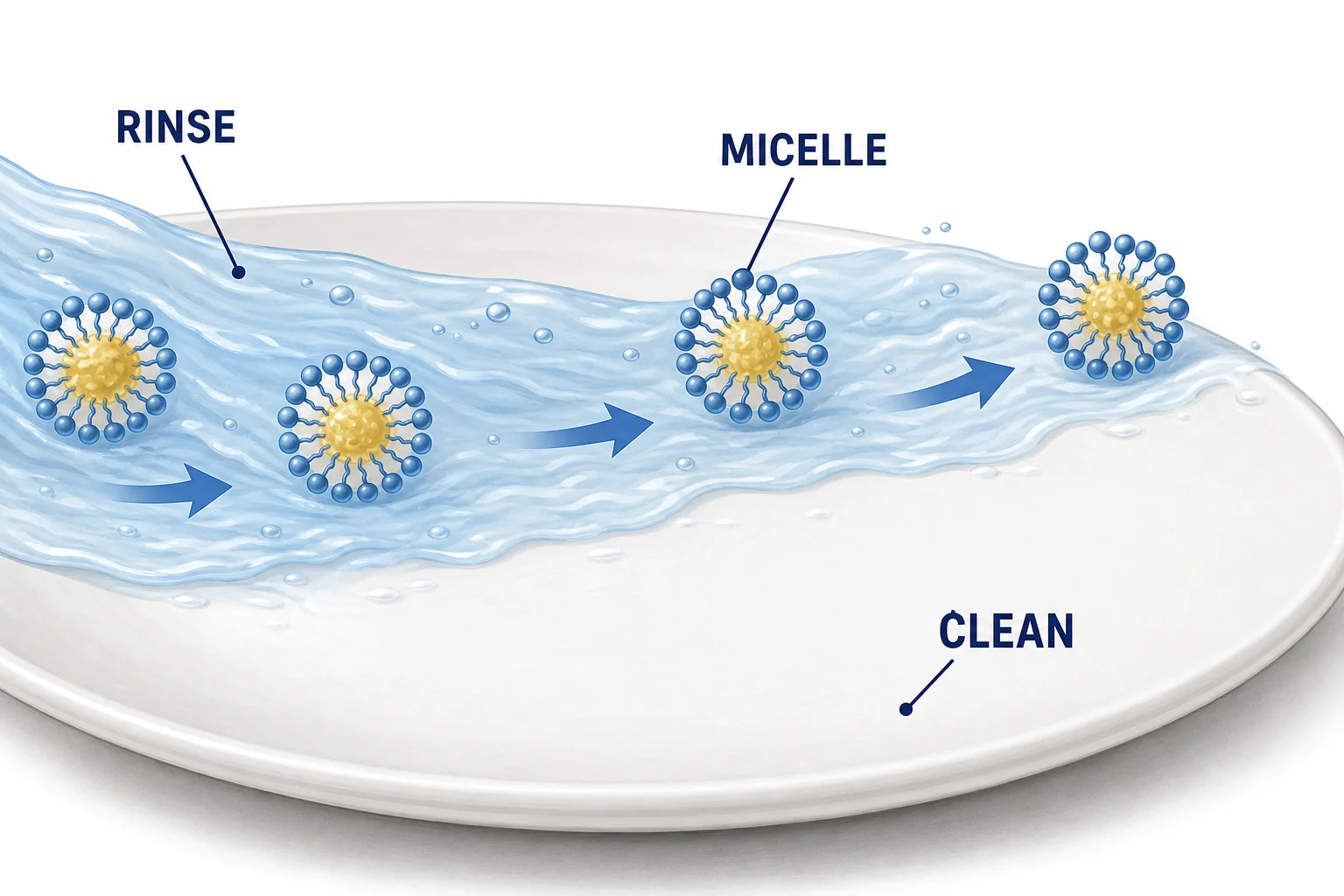
Rinse water carrying micelles with trapped grease away from a clean surface
Rinse water removes the soap packets and the dirt inside.
After soap surrounds oily dirt, rinse water can move the micelles off the surface. The water-friendly heads face outward, so the packets stay suspended in the flowing water. This is why rinsing is a key part of washing. Soap that remains on a surface can leave a film. Dirt trapped in soap can also settle again if it is not washed away. Detergents use a similar idea, but they are designed to work in more conditions. Some detergents clean better in hard water, which contains minerals that can react with soap. The main pattern stays the same. Cleaning depends on molecular structure and interactions. A substance can have one part that is attracted to water and another part that is attracted to oil. That structure lets it move oily grime from a surface into water. Then the flowing water finishes the job.

Rinsing removes the trapped grime after soap has lifted it from the surface.

Vocabulary

Polar molecule
A molecule with an uneven charge pattern, so one area is slightly positive and another area is slightly negative.
Nonpolar molecule
A molecule with charge spread out more evenly, which makes it mix poorly with water.
Surfactant
A substance that changes how materials interact at a surface, often by helping water mix with oily dirt.
Micelle
A tiny cluster of soap molecules that surrounds oil or grease so it can move through water.
Surface tension
The pull between molecules at the surface of a liquid, which can make water bead up.

In the Classroom

Pepper and soap model

15 minutes | Grades 6-8

Sprinkle pepper on a shallow dish of water, then touch the surface with a soapy toothpick. Students observe the pepper move as soap changes the water surface. Connect the model to surface tension and discuss what the model does not show about grease.

Oil, water, and soap jar test

25 minutes | Grades 6-8

Students shake one jar with oil and water, and a second jar with oil, water, and a small amount of soap. They compare how long droplets stay mixed in each jar. Use drawings to connect the cloudy mixture to micelles.

Build a soap molecule model

20 minutes | Grades 6-8

Students use beads, pipe cleaners, or paper cutouts to model a polar head and nonpolar tail. They arrange many models around a paper oil droplet to show a micelle. This helps students link molecular structure to cleaning behavior.

Key Takeaways

  • Water removes many substances, but it does not mix well with oils and grease.
  • Soap molecules have a water-friendly end and an oil-friendly end.
  • The oil-friendly tails move into grease while the water-friendly heads stay in water.
  • Soap molecules can form micelles that trap oily dirt inside.
  • Scrubbing and rinsing help soap lift dirt and carry it away.
Content generated with AI assistance and reviewed by the LivePhysics editorial team. See sources below for original references.